
Electra
....Electra is an international periodical dedicated to all areas of culture, promoting dialogue between different artistic disciplines, humanistic knowledge and science, cultural theories and practices. ..Electra é uma revista internacional de crítica e reflexão cultural, social e política, dedicada às diversas áreas da cultura, promovendo diálogos e oscilações de fronteiras entre disciplinas artísticas, saberes humanísticos e ciência, entre teorias e práticas culturais.
....
....
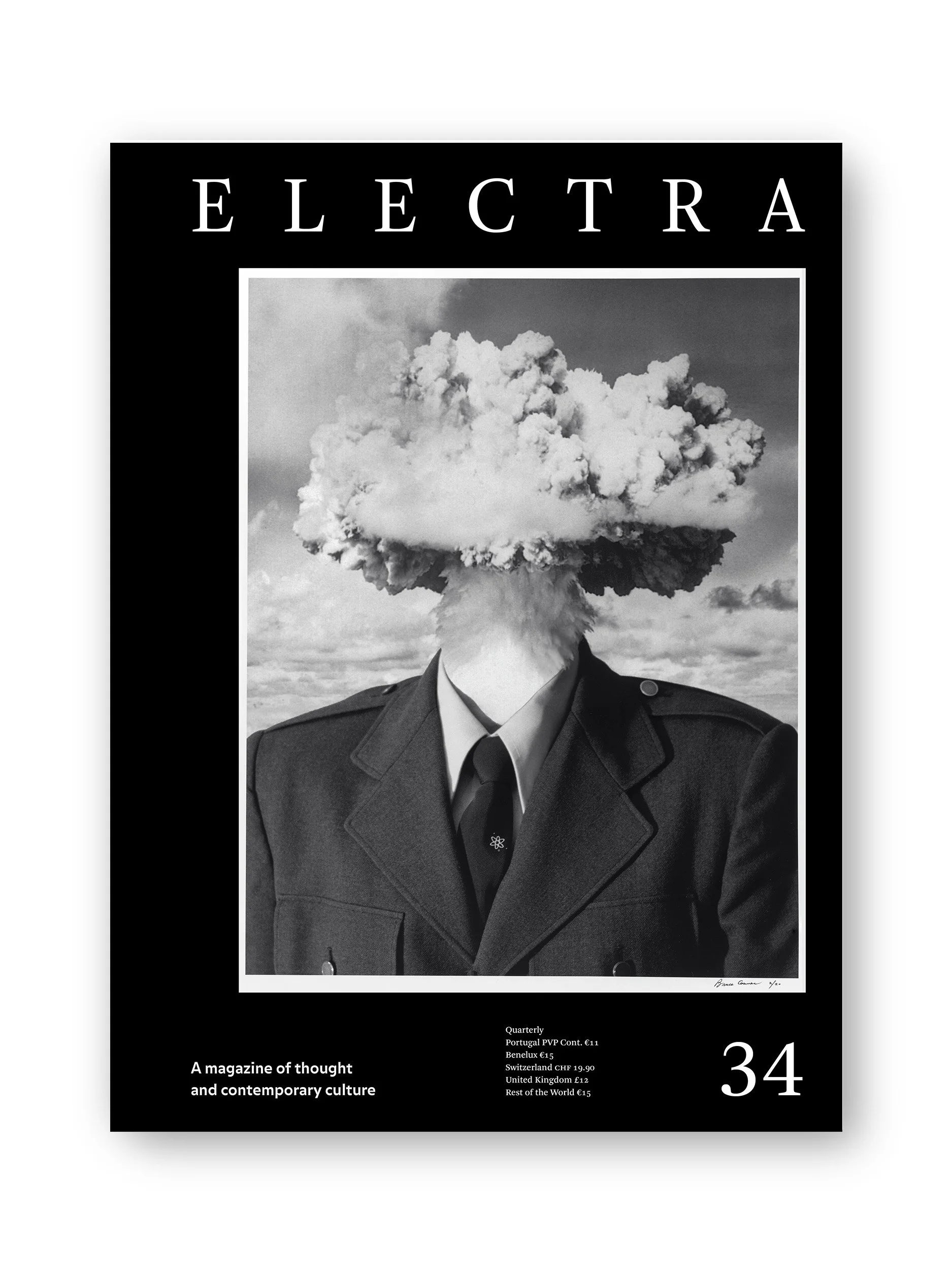
No longer a distant threat, but a defining feature of our times, ‘Chaos’ is the central theme of issue 34 of Electra. It is eroding political, economic, social, scientific and cultural institutions and fuelling instability in democracies that, until recently, we believed to be firmly established. It renders the geostrategic landscape unstructured, with the outbreak of wars we cannot even name. Everything tends towards extremes: climate, technology, the city, wealth concentration. And it is there that chaos bursts forth, giving rise to visions of catastrophe and the end of times. To reflect on the various manifestations of chaos that have taken hold in our time, this issue brings together interviews with Nobel Laureate in Economics Paul Krugman, Andrea Cavalletti, Arnaud Miranda, Gonçalo Pessa Costa, and Roberto Esposito, as well as texts by Étienne Ghys, José Gil, Kerry Emanuel, and Massimo de Carolis.
The issue also includes an interview with the renowned author on political philosophy and critical theory, Nancy Fraser; in conversation with Afonso Dias Ramos, she highlights some of the key political and social issues in an era marked by radicalism, instability and populism.
Also featured are previously unpublished materials from the archive of the artist and critic Ernesto de Sousa (1921–1988), which prove to be a vibrant space for experimentation. Photographs, notes and fragments, spanning decades of work, bring together art and life, document and poetry, body and language.
In the ‘Planisphere’ section, we visit the Italian town of Gibellina, destroyed by an earthquake in 1968 and rebuilt in a new location with the collaboration of renowned architects and artists. Through the text by curator and professor Cristina Costanzo and the images by photographers José Pedro Cortes and Stefano Graziani, we observe how, as we walk towards the future, we discover the past.
Also in this issue, Brazilian essayist, literary critic and journalist Júlia Corrêa da Rocha introduces us to the life and work of the fascinating figure of Giuseppe Tomasi di Lampedusa, author of the novel The Leopard; poet, essayist, curator and filmmaker Giorgiomaria Cornelio explores the history and present-day life of the city of Venice; two writers, Olivia Rosenthal and Paola D’Agostino, comment on a quote by Irvine Welsh, author of Trainspotting, who associates reading novels with the ability to foster empathy; and Electra’s editor, António Guerreiro, writes about the word ‘disruptive’.
.
Softcover, 27 x 20 cm, 244 pages
—
..
O “Caos” é o tema central da edição 34 da Electra: já não é uma ameaça distante, mas uma condição do nosso tempo. Corrói as instituições políticas, económicas, sociais, científicas e culturais, alimentando a instabilidade em democracias que, até há pouco, julgávamos sólidas. Torna informe o mapa geoestratégico, onde deflagram guerras que nem sabemos nomear. Tudo tende para o extremo: o clima, a tecnologia, a cidade e a riqueza concentrada. É aí que o caos irrompe e faz emergir o imaginário da catástrofe e do fim. Para pensar as várias figuras do caos que se instalaram no nosso tempo, este número reúne textos e entrevistas do Prémio Nobel da Economia Paul Krugman e de Andrea Cavalletti, Arnaud Miranda, Étienne Ghys, Gonçalo Pessa Costa, José Gil, Kerry Emanuel, Massimo de Carolis, e Roberto Esposito.
Nesta edição, é entrevistada a consagrada autora de filosofia política e teoria crítica Nancy Fraser, que destaca, em conversa com Afonso Dias Ramos, alguns dos principais problemas políticos e sociais numa época de radicalismo, instabilidade e populismo.
São também publicados materiais inéditos do arquivo do artista e crítico Ernesto de Sousa (1921–1988), que se revelam como um território vivo de experimentação. Fotografias, notas e fragmentos, que percorrem décadas de trabalho, aproximam arte e vida, documento e poesia, corpo e linguagem.
Na secção «Planisfério», é visitada a cidade italiana de Gibellina, destruída por um terramoto, em 1968, e reconstruída num outro lugar com a colaboração de reconhecidos arquitectos e artistas. Nesta visita, observamos como, ao caminharmos para o futuro, descobrimos o passado, através do texto da curadora e professora Cristina Costanzo e das imagens dos fotógrafos José Pedro Cortes e Stefano Graziani.
Ainda neste número a ensaísta, crítica literária e jornalista brasileira Júlia Corrêa da Rocha dá-nos a conhecer a vida e a obra da figura fascinante de Giuseppe Tomasi di Lampedusa, autor do romance O Leopardo; o poeta, ensaísta, curador e cineasta Giorgiomaria Cornelio explora a história e o presente da cidade de Veneza; duas escritoras, Olivia Rosenthal e Paola D'Agostino, comentam uma frase de Irvine Welsh, autor de Trainspotting, que atribui à leitura dos romances a faculdade de alimentar a empatia; e o editor da Electra António Guerreiro escreve sobre a palavra “Disruptivo”.
Capa mole, 27 x 20 cm, 244 páginas
—
....
....
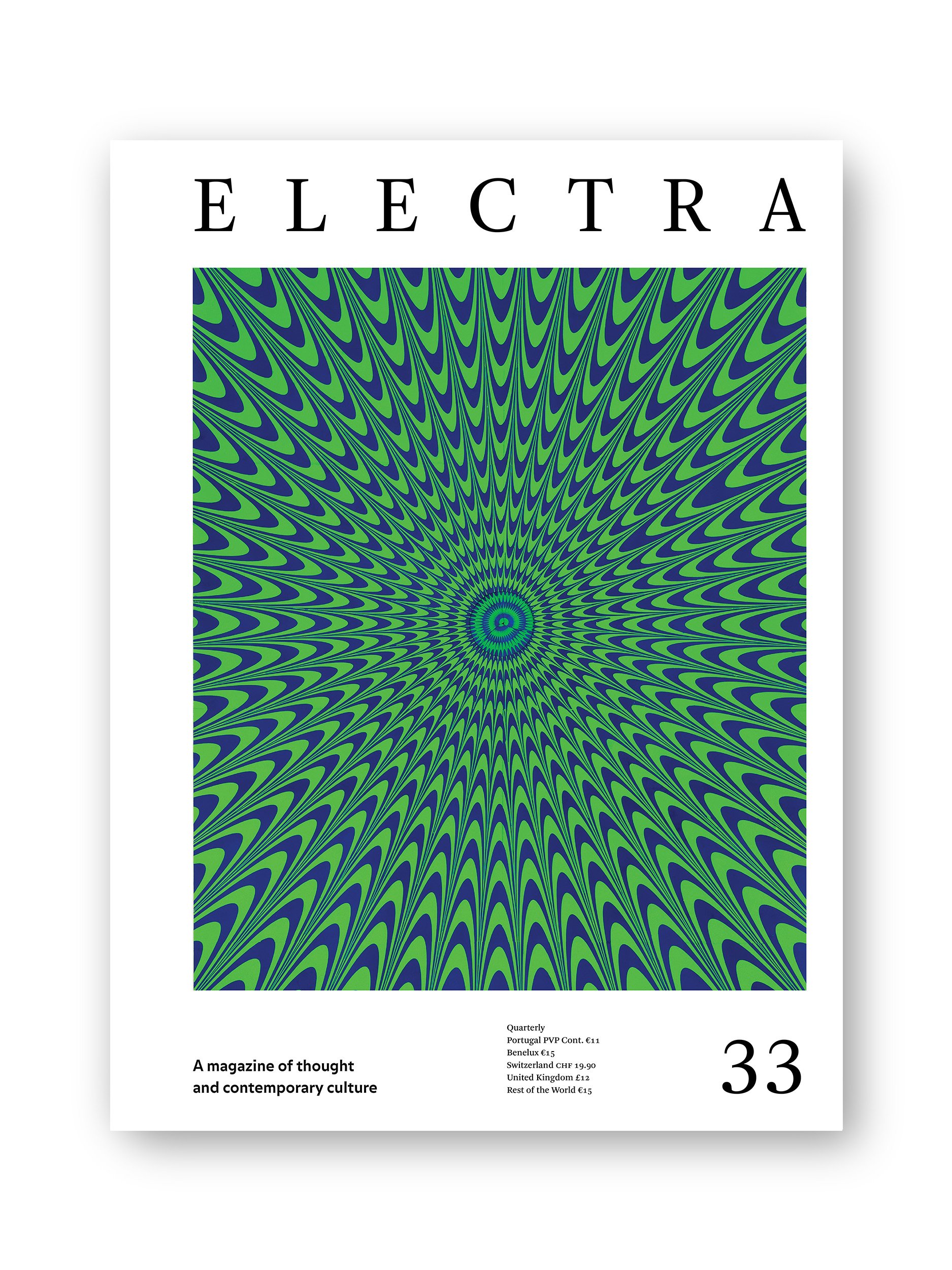
Electra devotes the special feature of issue 33 to the theme of ‘Psyche’, examining the psychologisation of the world and contemporary life. At a time when the language of psychology has permeated politics, society and everyday life, we all seem to be becoming both subjects and objects of analysis. From the sociology of emotions and therapeutic culture to the diagnosis of new authoritarian figures and the digital construction of the subject, the dossier section reveals how this psychologisation is inseparable from global commodification, with profound effects on society, politics, the economy and culture. Drawing on different perspectives and contributions from various authors, including Avital Ronell, Ole Jacob Madsen, Sinziana Ravini, Fabrice Bourlez, Jan de Vos and Pedro Varandas, this dossier analyses and interprets this fundamental symptom of the era in which we live.
Benjamin H. D. Buchloh, one of the most respected art critics of the last half-century and a leading authority on the work of artists such as Gerhard Richter, Marcel Broodthaers and Nancy Spero, speaks to Afonso Dias Ramos about the growing problems arising from a divide between critical practice and artistic production.
This issue’s portfolio section is by Anne-Mie Van Kerckhoven. It presents a representative series of her work, which explores the fundamental and thought-provoking relationship between eroticism and technology from a female perspective. This relationship is inseparable from the broader critical and innovative reflection that this Belgian artist has developed on art, science, politics, society, image and communication.
In the ‘Noah’s Ark’ section, an essay by journalist Andrea Prada Bianchi sheds light on the friendship between fascist dictator Benito Mussolini and anti-fascist resistance fighter Pietro Nenni, leader of the Italian Socialist Party. A narrative of a turbulent and dangerous time, in which life and death were at stake every day, it portrays people and events that shaped the tragic history of the 20th century.
Also in this issue, writer Marie Darrieussecq, a leading figure in the current French fiction scene, publishes a diary interwoven with journeys and places, political unease and family memories, reflecting on the condition of being a writer and a woman; Italian critic Andrea Cortellessa revisits the singular figure of writer, painter, essayist, musician and composer Alberto Savinio, who is often presented as merely Giorgio de Chirico’s brother; writer and essayist Christian Salmon comments on an aphorism by Friedrich Nietzsche; geographer Michel Lussault examines planetary urbanisation and the environmental vulnerability of our habitats; and astrophysicist and journalist Sergio C. Fanjul writes about the word ‘dystopia’.
.
Softcover, 27 x 20 cm, 224 pages
—
..
A Electra dedica o dossier da edição 33 ao tema da “Psique”, interrogando a psicologização do mundo e da vida contemporânea. Num tempo em que a linguagem da psicologia se disseminou pela política, pela sociedade e pelo quotidiano, todos parecemos tornar-nos simultaneamente sujeitos e objectos de análise. Da sociologia das emoções e da cultura terapêutica ao diagnóstico das novas figuras autoritárias e à construção digital do sujeito, revela-se como esta psicologização é inseparável de uma mercantilização global e como produz efeitos profundos na sociedade, na política, na economia e na cultura. A partir de diferentes ângulos e da colaboração de vários autores como Avital Ronell, Ole Jacob Madsen, Sinziana Ravini, Fabrice Bourlez, Jan de Vos e Pedro Varandas, o dossier analisa e interpreta este sintoma fundamental da época em que vivemos.
Benjamin H. D. Buchloh, um dos críticos de arte mais respeitados do último meio século e uma das maiores referências sobre o trabalho de artistas como Gerhard Richter, Marcel Broodthaers ou Nancy Spero, conversa com Afonso Dias Ramos sobre os crescentes problemas que nascem de uma separação entre a prática crítica e a produção artística.
O portfólio deste número é da autoria de Anne-Mie Van Kerckhoven. Nele, apresenta-se uma série representativa da sua obra, na qual está presente a relação fundamental e interpeladora entre erotismo e tecnologia, olhada de um ponto de vista feminino. Tal relação é inseparável da reflexão crítica e inovadora que a artista belga tem desenvolvido sobre arte, ciência, política, sociedade, imagem e comunicação.
Na secção “Arca de Noé”, um ensaio escrito pelo jornalista Andrea Prada Bianchi dá-nos a conhecer a amizade entre o ditador fascista Benito Mussolini e o resistente antifascista Pietro Nenni, líder do Partido Socialista Italiano. Narrativa de um tempo convulsivo e perigoso, em que a vida e a morte se jogavam todos os dias, nela são retratados pessoas e acontecimentos que marcaram a história trágica do século XX.
Ainda nesta edição, a escritora Marie Darrieussecq, nome cimeiro no actual panorama francês da ficção narrativa, publica um diário atravessado por viagens e lugares, pela inquietação política e pela memória familiar, pela condição de escritora e pela condição de mulher; o crítico italiano Andrea Cortellessa revisita a figura do singular escritor, pintor, ensaísta, músico e compositor Alberto Savinio, com frequência apresentado apenas como o irmão de Giorgio de Chirico; o escritor e ensaísta Christian Salmon comenta um aforismo de Friedrich Nietzsche; o geógrafo Michel Lussault trata da urbanização do planeta e da vulnerabilidade e insustentabilidade dos nossos habitats; e o astrofísico e jornalista Sergio C. Fanjul escreve sobre a palavra “Distopia”.
Capa mole, 27 x 20 cm, 224 páginas
—
....
....
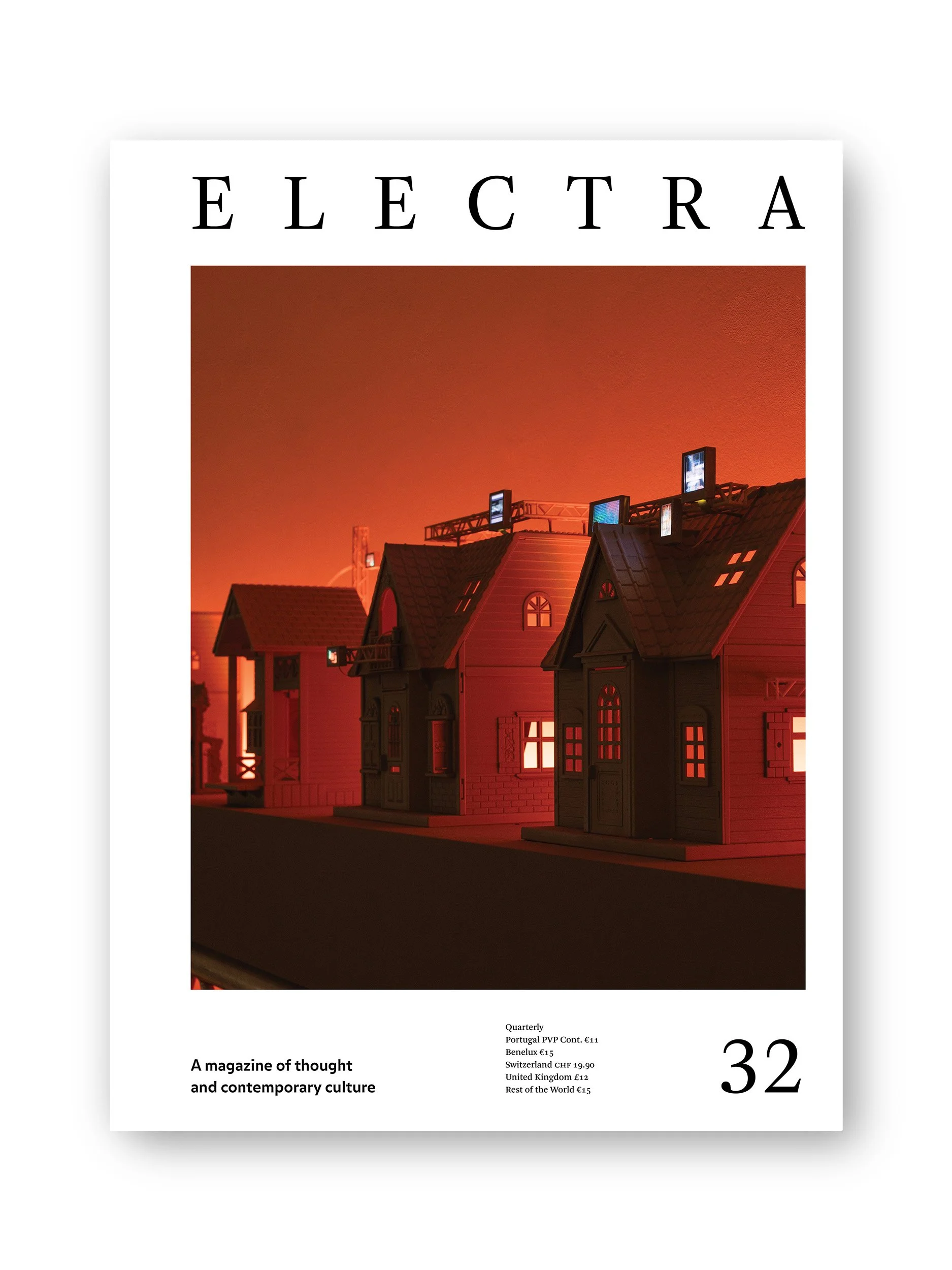
The special feature of Electra issue 32 is ‘Infrastructures’. In a globalised world, this subject has become fundamental for understanding the dynamics that support contemporary societies: from technical progress to the circulation of information and goods, from the logistics that sustain life in major cities to the geopolitical strategies and new technologies that underpin digital platforms. Yet we must not think about infrastructures from a merely technical perspective: we need to examine their increasingly decisive role in systems of political power and economic domination, in regimes of freedom and dependence, in mechanisms of surveillance and control, in apparatuses of administration and oversight. Contributing to this discussion are texts by Yves Citton, Giorgiomaria Cornelio, Anselm Jappe, Brett Neilson, Matteo Pasquinelli and Boris Vormann.
‘In the First Person’ features an interview between Afonso Dias Ramos and renowned German filmmaker, artist and author Hito Steyerl, where she reflects on the complexities of the constant metamorphosis of art, images and technology in the age of Artificial Intelligence.
Anna Maria Maiolino, an acclaimed artist of Italian origin based in Brazil, who received the Golden Lion at the Venice Art Biennale in 2024, is the author of this issue’s Portfolio, where she brings together a selection of her works accompanied by an interview with American curator Helen Molesworth as part of the project The Forgotten Her Story.
With an internationally acclaimed career and a body of work characterised by his striking artistic imagination and technical creativity, Alexandre Estrela was the artist chosen to represent Portugal at the 2026 Venice Art Biennale. For this issue’s ‘Scoop’ section, he and his team have prepared an extension of the RedSkyFalls project to be shown in the Portuguese Pavilion, conceived and graphically structured specifically for the pages of the magazine.
Elizabeth II, Queen of the United Kingdom and Head of the Commonwealth, was born a hundred years ago. Her reign, the longest in British history, lasted more than seventy years, during which the world changed radically; yet she always remained true to herself. Journalist Marc Roche, who met her, has written an article for Electra focusing on the Queen’s careful attention to her public image.
Also in this issue, art director Serge Ricco profiles Bea Feitler, a key figure in the global history of graphic design who left her creative mark on the most important American magazines of her time: Harper’s Bazaar, Ms., Rolling Stone and Vanity Fair; Turkish writer and journalist Kaya Genç takes a stroll through his city, Istanbul, revealing a rich cultural metropolis; Brazilian philosopher Eduardo Wolf offers a critical reflection on the relevance (and irrelevance) of the concept of the ‘Western tradition’ following the publication in the US of The Golden Thread: A History of the Western Tradition, by James Hankins and Allen C. Guelzo; sociologist Vania Baldi examines a quote by Martin Heidegger regarding technology; António Guerreiro writes about the contemporary city as an urban space without limits; and filmmaker and columnist Graça Castanheira reflects on the word ‘immigrant’.
.
Softcover, 27 x 20 cm, 240 pages
—
..
“As infra-estruturas” são o tema do dossier central do número 32 da Electra. Num mundo globalizado, o assunto tornou-se fundamental para compreender as dinâmicas que sustentam o funcionamento das sociedades contemporâneas: do progresso técnico à circulação de informação e mercadorias, da logística que permite a vida nas grandes metrópoles às estratégias geopolíticas e às novas tecnologias que deram origem às plataformas digitais. Mas pensar as infra-estruturas não é apenas uma reflexão técnica: é também procurar entender o seu lugar cada vez mais determinante nos sistemas de poder político e de domínio económico, nos regimes de liberdade e de dependência, nos dispositivos de vigilância e controlo, nos aparelhos de administração e nos mecanismos de fiscalização. Para esta reflexão contribuem os textos de Yves Citton, Giorgiomaria Cornelio, Anselm Jappe, Brett Neilson, Matteo Pasquinelli e Boris Vormann.
Na secção "Primeira Pessoa", é entrevistada a reconhecida cineasta, artista e autora alemã Hito Steyerl que, numa conversa conduzida por Afonso Dias Ramos, nos fala sobre as complexidades da metamorfose constante da arte, das imagens e da tecnologia na era da Inteligência Artificial.
Anna Maria Maiolino, consagrada artista de origem italiana radicada no Brasil, que recebeu, em 2024, o Leão de Ouro da Bienal de Arte de Veneza, é a autora do Portfolio desta edição. Para as páginas da Electra reuniu um conjunto de trabalhos seus, acompanhado de uma entrevista realizada pela curadora norte-americana Helen Molesworth no âmbito do projeto The Forgotten Her Story.
Com uma carreira de notável projecção internacional e uma obra de forte imaginação artística e reconhecida criatividade técnica, Alexandre Estrela representa Portugal na Bienal de Arte de Veneza de 2026. Para a secção Furo desta edição, o artista e a sua equipa prepararam uma extensão-revelação do projeto RedSkyFalls, apresentado no Pavilhão de Portugal, concebida e estruturada graficamente para as páginas da revista.
Isabel II, Rainha do Reino Unido e chefe da Commonwealth, nasceu há cem anos. O seu reinado, o mais longo da história britânica, durou mais de setenta anos, ao longo dos quais o mundo mudou radicalmente; mas ela manteve-se sempre fiel a si mesma. O jornalista Marc Roche, que a conheceu, escreve para a Electra um artigo centrado no cuidado da rainha com a sua imagem.
Ainda nesta edição o director de arte Serge Ricco retrata Bea Feitler, figura fundamental da história mundial do design gráfico e que deixou marca do seu talento criador nas mais importantes revistas americanas do seu tempo, Harper’s Bazaar, Ms., Rolling Stone e Vanity Fair; o escritor e jornalista turco Kaya Genç passeia pela sua cidade, Istambul, e revela uma riquíssima metrópole cultural; o filósofo brasileiro Eduardo Wolf pensa criticamente a pertinência e a impertinência do conceito de «tradição ocidental», a propósito da publicação, nos EUA, da obra The Golden Thread: A History of the Western Tradition, de James Hankins e Allen C. Guelzo; o sociólogo Vania Baldi comenta uma citação de Martin Heidegger sobre a questão da técnica; António Guerreiro escreve sobre a cidade contemporânea como um espaço urbano sem limites; e a realizadora e cronista Graça Castanheira reflecte sobre a palavra “Imigrante”.
Capa mole, 27 x 20 cm, 240 páginas
—
....
....
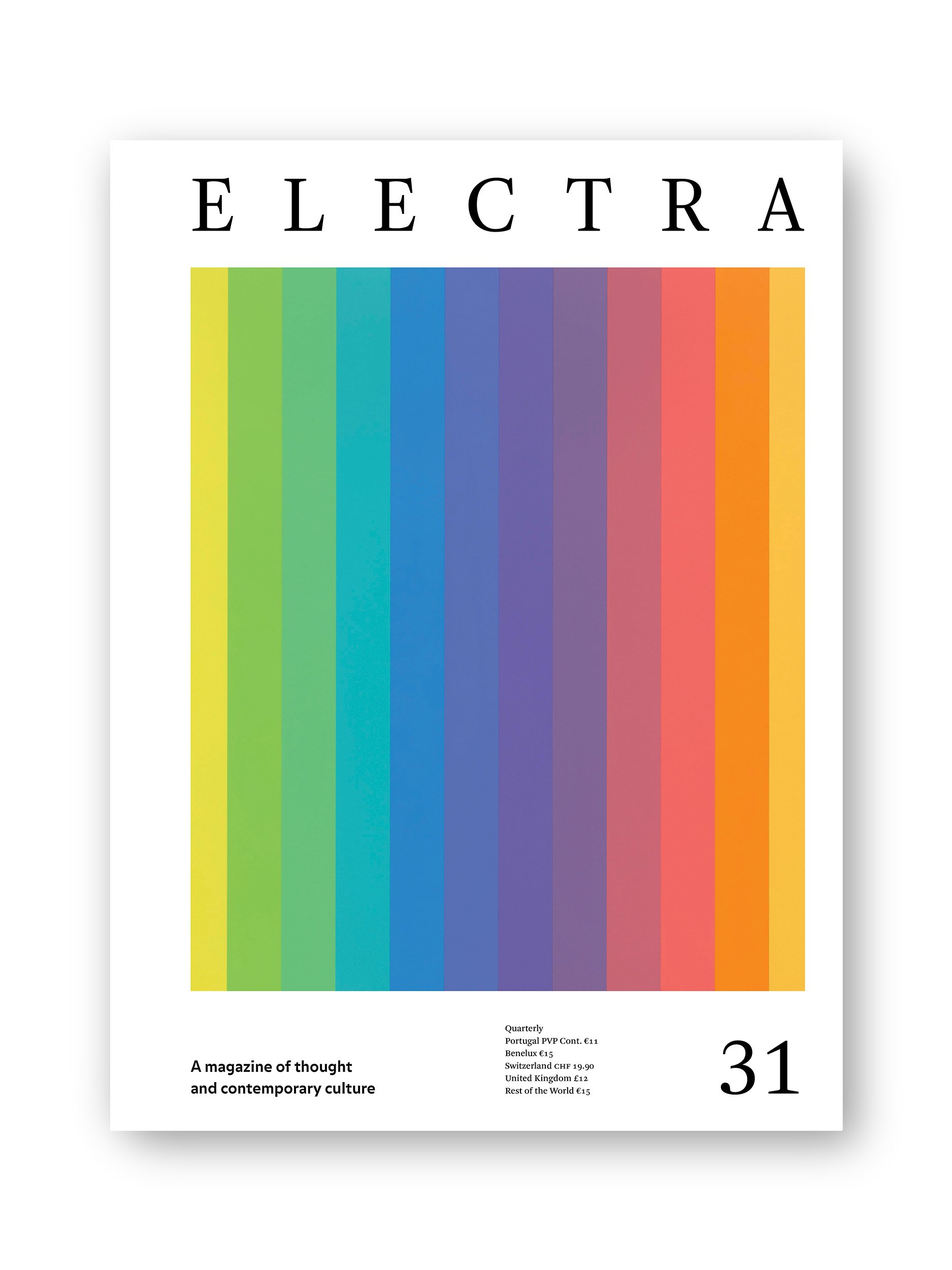
What is colour? What are colours like? How do we see colours? What is the colour of our time? Colour is the central theme of Electra's 31st issue. It imposes itself on our vision with almost irrefutable evidence, yet remains shrouded in mystery. Far from being a property of objects, it is rather a question of perception resulting from light, present in all dimensions of human experience. From art to architecture, from design to politics, colour permeates practices, discourses, and cultures, conveying symbolism and codes that vary across time and space, geography and chronology. Neither science nor empirical knowledge can fully explain it, marked as it is by tensions between chromophilia and chromophobia, exuberance and sobriety. This ‘Subject’, enriched by perspectives from different disciplinary fields, brings together contributions from Michel Pastoureau, Elena Manferdini, Andrea Cavalletti, Anne Lafont, Ricardo Vieira Lisboa, David Scott Kastan, and António Guerreiro.
The renowned curator, art historian, and feminist Tamar Garb is interviewed by Afonso Dias Ramos for the ‘In the First Person’ section. In this conversation, held in Lisbon, she reflects on the multiple geographies that have shaped her life and work, from Cape Town to Paris and London, and on the challenge of different ways of looking at culture across Africa and Europe in times of great tension and political instability.
This issue of Electra also features as yet unpublished works by the great writer, poet, and visual artist Henri Michaux. A leading figure in 20th-century European intellectual scene, he was the author of works of inexhaustible originality, combining surprisingly different types of knowledge and wisdom, genres and disciplines. The important drawings featured in this edition, which are part of his Archive, are presented in a text by curator Tim Geissler.
In the ‘Portfolio’ section, we leaf through the pages of Electra and, at the same time, through the pages of a book intervened and recreated by the imagination and wisdom of Sonia Gomes, one of Brazil's most internationally renowned artists. This work is presented by curators João Mourão and Luís Silva.
On the hundredth anniversary of the birth of Marilyn Monroe, a universal and enduring icon, the renowned Italian philosopher Mario Pezzella, a specialist in film aesthetics, writes an essay of great interpretative depth on what Marilyn was, with her innocent and guilty beauty, and what the world made her. He recounts how Monroe lived her tormented life as a woman, between fame and emptiness, and her dazzling career as an actress.
This issue also features an interview with architect Neil Leach, conducted by Lucinda Correia, in which they discuss architecture in the age of artificial intelligence and reflect on the future of cities; Turkish novelist and journalist Kaya Genç writes about the fascinating figure of German philologist Erich Auerbach and his masterpiece, Mimesis: The Representation of Reality in Western Literature, written in Istanbul; renowned Portuguese artist Jorge Martins comments on a famous quote by Pablo Picasso; writer, multimedia artist, and curator Jeremy Fernando writes, in a very personal tone, about his hometown, Singapore; and professor Damiano Palano offers a reflection on the word ‘Polarisation’.
.
Softcover, 27 x 20 cm, 241 pages
—
..
O que é a cor? Como são as cores? Como vemos as cores? Qual é a cor do nosso tempo? A cor é o tema do dossier do número 31 da Electra. Ela impõe-se à nossa visão com uma evidência quase irrefutável e, ainda assim, permanece envolta em enigmas. Longe de ser uma propriedade dos objectos, é antes uma perceção resultante da luz, presente em todas as dimensões da experiência humana. Da arte à arquitectura, do design à política, a cor atravessa práticas, discursos e culturas, transportando simbolismos e códigos que variam no tempo e no espaço, na geografia e na cronologia. Nem a ciência nem o saber empírico esgotam a sua compreensão, marcada por tensões entre cromofilia e cromofobia, exuberância e sobriedade. Este “Assunto”, enriquecido por perspectivas de diferentes campos disciplinares, reúne os contributos de Michel Pastoureau, Elena Manferdini, Andrea Cavalletti, Anne Lafont, Ricardo Vieira Lisboa, David Scott Kastan e António Guerreiro.
Tamar Garb, a reconhecida curadora e historiadora de arte, e feminista, é entrevistada por Afonso Dias Ramos para a secção “Primeira Pessoa”. Nesta conversa, realizada em Lisboa, ela reflecte sobre as múltiplas geografias que traçaram a sua vida e trabalho, da Cidade do Cabo até Paris e Londres, e o desafio de encarar a cultura em África e na Europa de outras formas, em tempos de grande tensão e instabilidade política.
Este número da Electra revela também obras inéditas do grande escritor, poeta e artista visual Henri Michaux. Figura capital da vida intelectual europeia do século XX, autor de uma obra de inesgotável originalidade, que liga, surpreendentemente, saberes e sabedorias, géneros e disciplinas diferentes. Os importantes desenhos dados a conhecer nesta edição, e que integram o seu Arquivo, são apresentados por um texto do curador Tim Geissler.
Na secção “Portfolio”, folheamos as páginas da Electra e folheamos, ao mesmo tempo, as páginas de um livro intervencionado e recriado pela imaginação e a sabedoria de Sonia Gomes, uma das artistas brasileiras com maior projecção internacional. Este trabalho é apresentado pelos curadores João Mourão e Luís Silva.
Nos cem anos do nascimento de Marilyn Monroe, ícone universal perpétuo, o conceituado filósofo italiano Mario Pezzella, especialista de estética do cinema, escreve um ensaio de grande profundidade interpretativa sobre o que Marilyn, com a sua inocente beleza culpada, era e no que o mundo a tornou. E diz-nos como ela, entre a fama e o vazio, viveu a sua atormentada vida de mulher e a sua fulgurante carreira de actriz.
Ainda nesta edição é publicada uma entrevista ao arquitecto Neil Leach, conduzida por Lucinda Correia, onde se fala de arquitectura na era da inteligência artificial e se reflecte sobre o futuro das cidades; o romancista e jornalista turco Kaya Genç assina um texto sobre a fascinante figura do filólogo alemão Erich Auerbach e a sua obra-prima, Mimesis: A Representação da Realidade na Literatura Ocidental, escrita em Istanbul; o consagrado artista português Jorge Martins comenta uma famosa frase de Pablo Picasso; o escritor, artista multimédia e curador Jeremy Fernando escreve, num registo muito pessoal, sobre a sua cidade natal, Singapura; e o professor catedrático Damiano Palano propõe uma reflexão sobre a palavra “Polarização”.
Capa mole, 27 x 20 cm, 241 páginas
—
....

....
Who among us doesn't feel afraid today? And where do these fears lie? ‘Fear’ is the theme of the central dossier of Electra 30. An omnipresent subject in today's political and cultural discourse, it is analysed here in terms of the intentions behind it, its functions, and its effects. Renowned authors have studied the multiple dimensions of this topic, which today occupies a fundamental place in everyday life. Its power stems not only from objective and uncontrollable causes — be they war, environmental crisis, or economic instability — but also from its deliberate use as an instrument in government practices. Over the history of Western thought, fear has been a structuring element of various philosophical anthropologies. It is also one of the raw materials of history, characterising eras, shaping regimes, and fuelling collective dynamics over the centuries. This dossier brings together texts and interviews that seek to reflect on the specific fears of our time, born of current historical, social, political, and cultural conditions, with contributions from authors such as Frank Furedi, Miguel Benasayag, Frédéric Neyrat, Pedro Levi Bismarck, Jonathan Rosenbaum, and António Guerreiro.
Two interviews feature in the ‘In the First Person’ section: one with French writer Pascal Quignard, author of an immense literary work that spans several genres, dialogues with other arts, and is marked by his cultural and historical incursions, with an emphasis on Roman Antiquity; another with American academic W. J. T. Mitchell, one of the leading figures in the field of visual studies, who talks to us about the new challenges posed by digital machines and artificial intelligence, and about the difficulties of envisaging the very survival of the human species in the current political climate.
Acclaimed American artist Julia Wachtel is the author of this edition's portfolio, representative of a work of great visual seduction underpinned by a critical thinking that questions images and their incessant proliferation. This work is accompanied by a text by poet and essayist Arthur Solway.
Tilmann Lahme, a renowned expert on the Mann family and its notable members, writes an interpretative essay for Electra that reveals the figure of the great writer Thomas Mann, who became a symbol of a time and a world, of its conflicts and tragedies.
In the section ‘Noah's Ark,’ writer and curator Thomas Dylan Eaton tells us about filmmaker Kenneth Anger's relationship with biologist Alfred C. Kinsey and the research institute he founded, which revolutionised our understanding of human sexuality.
Also in this edition, researcher Anne Clerval reflects on the gentrification of cities, examining the case of Paris; historian Yannick Ripa recalls the 50th anniversary of the UN's creation of International Women's Day and the passing of the Veil Law in France, which decriminalised voluntary termination of pregnancy; curator Frederico Duarte visits Chemnitz, named European Capital of Culture 2025, also travelling through the cities that over the years have been successively chosen to embody this ambitious initiative; and journalist José Vítor Malheiros writes about the word ‘Stability.’
.
Softcover, 27 x 20 cm, 216 pages
—
..
Hoje, quem não tem medo? E quais são os nossos medos? “O medo” é o tema do dossier central da Electra 30. Assunto omnipresente no discurso político e cultural da actualidade, é aqui analisado nas suas intenções, funções e efeitos. Conceituados autores têm estudado as múltiplas dimensões deste tópico, que ocupa hoje um lugar fundamental na vida quotidiana. O seu poder não decorre apenas de causas objectivas e incontroláveis — como a guerra, a crise ecológica ou a instabilidade económica —, mas também do seu uso deliberado como instrumento nas práticas de governo. Na história do pensamento ocidental, o medo tem sido um elemento estruturante de várias antropologias filosóficas. É, também, uma das matérias-primas da História: ao longo dos séculos, caracterizou épocas, deu forma a regimes e alimentou dinâmicas colectivas. Neste dossier, reúnem-se textos e entrevistas que procuram pensar os medos específicos do nosso tempo, nascidos das actuais condições históricas, sociais, políticas e culturais, com contributos de autores como Frank Furedi, Miguel Benasayag, Frédéric Neyrat, Pedro Levi Bismarck, Jonathan Rosenbaum e António Guerreiro.
Na secção “Primeira Pessoa”, são publicadas duas entrevistas: uma com o escritor francês Pascal Quignard, autor de uma imensa obra literária que atravessa vários géneros, que dialoga com outras artes e é marcada pelas suas incursões culturais e históricas, com destaque para a Antiguidade Romana; outra com o académico norte-americano W. J. T. Mitchell, uma das referências maiores no campo dos estudos visuais, que nos fala dos novos desafios colocados pelas máquinas digitais e a inteligência artificial, e sobre as dificuldades de entrever a própria sobrevivência da espécie humana no actual clima político.
Julia Wachtel, consagrada artista norte-americana, é autora do portfolio desta edição, representativo de uma obra de grande sedução visual em que está presente um pensamento crítico que interroga as imagens e a sua incessante proliferação. Este trabalho é acompanhado por um texto do poeta e ensaísta Arthur Solway.
Tilmann Lahme, reconhecido especialista da família Mann e dos seus notáveis membros, escreve para a Electra um ensaio interpretativo que nos revela a figura do grande escritor Thomas Mann, que se tornou símbolo de um tempo e de um mundo, dos seus conflitos e tragédias.
Na secção “Arca de Noé”, o escritor e curador Thomas Dylan Eaton conta-nos a relação do cineasta Kenneth Anger com o biólogo Alfred C. Kinsey e com o instituto de investigação por ele fundado, que revolucionou o entendimento sobre a sexualidade humana.
Ainda nesta edição a investigadora Anne Clerval reflecte sobre a gentrificação das cidades, partindo do caso de Paris; a historiadora Yannick Ripa evoca o cinquentenário da criação pela ONU do Dia Internacional da Mulher e da aprovação, em França, da Lei Veil, que despenalizou a interrupção voluntária da gravidez; o curador Frederico Duarte visita Chemnitz, nomeada Capital Europeia da Cultura 2025, viajando também pelas cidades que ao longo dos anos foram sucessivamente escolhidas para darem corpo a esta ambiciosa iniciativa; e o jornalista José Vítor Malheiros escreve sobre a palavra “Estabilidade”.
Capa mole, 27 x 20 cm, 216 páginas
—
....
....
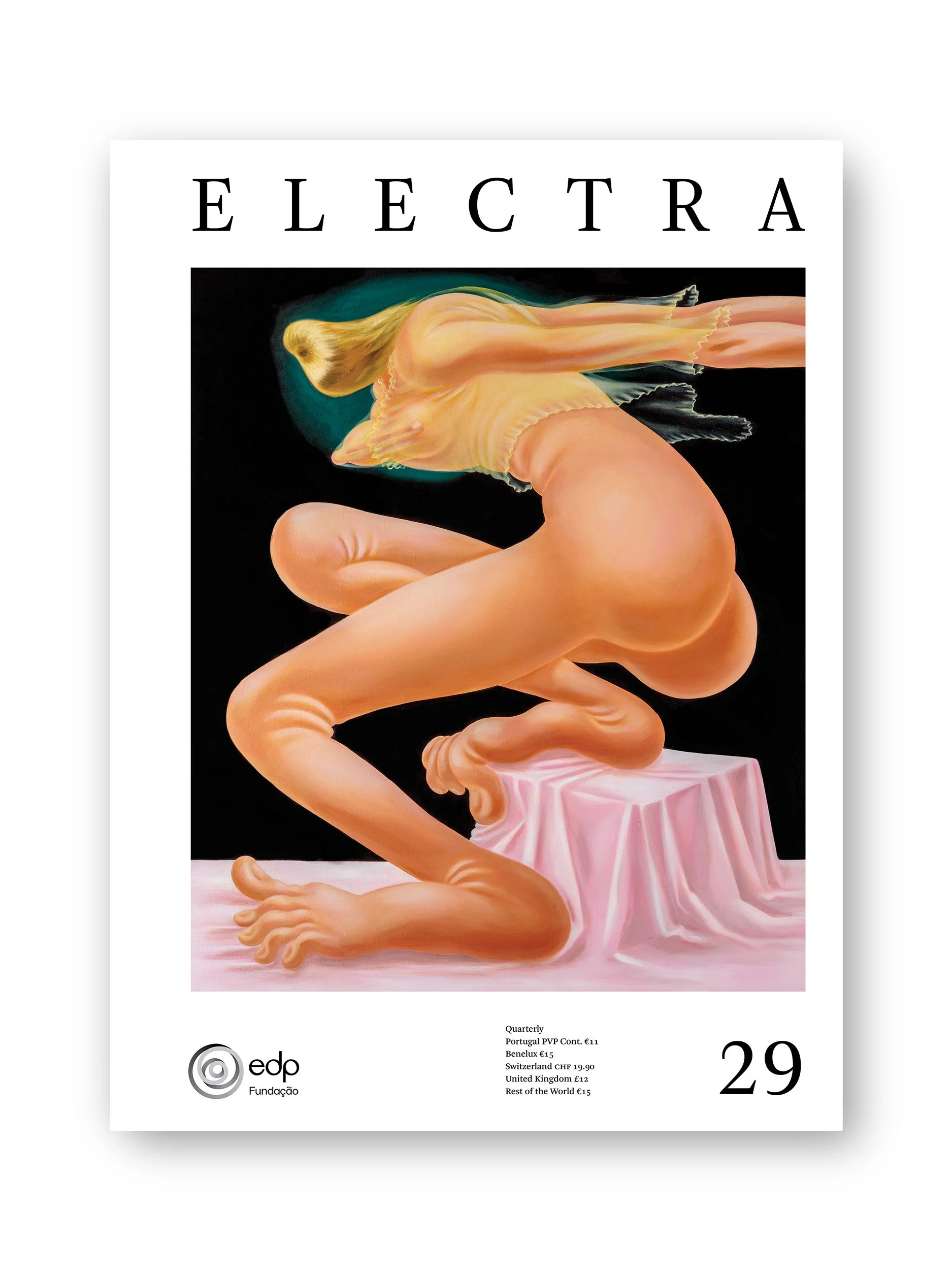
‘The Body’ — in the past, present and future — is the main theme of Electra 29. This issue looks at the body and the place it occupies in time and in a changing world: changes in our relationship with our own bodies and with the bodies of others, in the relationship between body and gender or sex, between the individual and the social body, and also between biological body and cultural body, or between physical body and ageing body. We live in a time when the cultural, social and aesthetic codes that underpin discourses on the body are closely related to the technologies that produce it as a marker of identities and subjectivities. From scientific breakthroughs to technotopias, from cyborgs to queer bodies, mutants and monsters, the condition of transhumanism is a characteristic of our time. These topics are tackled by prestigious authors such as Pascal Quignard, Paul B. Preciado, Camille Froidevaux-Metterie, Arianna Sforzini, Isabelle Queval, José Maria Vieira Mendes, and António Guerreiro, in texts accompanied by pictures by Louise Bonnet and Willem de Kooning.
This issue’s Portfolio is by German artist Imi Knoebel, one of the most important names of post-war art, whose works are represented in the world's most prestigious art collections. The works included here are being shown for the first time, as an exclusive for Electra, and introduced in an essay by Gabriel Barbi.
Also featured exclusively in this issue is the conversation between photographer Jeff Wall and film-maker Pedro Costa, which took place in Lisbon at the opening of MAAT's exhibition Jeff Wall – Time Stands Still. Brought together by mutual admiration and profound reflection on their artistic practices, in this exceptional encounter Wall and Costa explore the affinities and tensions between cinema, photography and painting, bringing to this discussion a unique combination of intellectual rigour and artistic sensitivity.
This summer issue of Electra magazine also features a collection of articles marking the World Expo 2025 in Osaka, and Portugal's participation in it. Photographer Daniel Blaufuks presents a recent campaign in Japan, with images captured in Osaka, Kyoto, Kobe Koyasan, Hiroshima and Himeji. The Portuguese photographer matches the images with haikus by the great Japanese poet Matsuo Bashō. On the centenary of the birth of Yukio Mishima, Thomas Garcin, professor of Japanese Studies at the University of Paris, brings us a portrait that contradicts the clichés surrounding this author. Finally, a set of previously unpublished pictures by female photographer Sakiko Nomura, one of the most prestigious names in Japanese contemporary photography, accompanied by an essay by professor and essayist José Bértolo.
Also in this issue, Afonso Dias Ramos interviews T. J. Clark, one of the most renowned art historians of the last fifty years; researcher and curator Anabela Becho draws a portrait of Mariano Fortuny – painter, sculptor, set and costume designer, theatre director, collector and inventor – in a text that traces his life and work, against a backdrop of images of his palace in Venice; psychoanalyst, novelist and curator Sinziana Ravini deciphers an obscure quote by Jacques Lacan; and Bobby Duffy, Professor of Public Policy at King´s College London, comments on the word ‘Perception,’ examining our common misperceptions of fundamental social and political realities.
.
Softcover, 27 x 20 cm, 227 pages
—
..
“O corpo” — no passado, no presente e no futuro — é o assunto central da Electra 29. Trata-se neste dossier do corpo e da sua inscrição no tempo e num mundo em mudança. Mudanças na relação de cada um de nós com o próprio corpo, na relação do nosso corpo com o corpo dos outros, na relação do corpo com o género e com o sexo, na relação do corpo individual com o corpo social, na relação do corpo biológico com o corpo cultural, na relação do corpo físico com o corpo etário. Vivemos num tempo em que os códigos culturais, sociais e estéticos que estão na base dos discursos sobre o corpo têm uma ligação estreita com as tecnologias que o produzem como marcador de identidades e subjectividades. Dos avanços científicos às tecnotopias, dos cyborgs aos corpos queer, passando pelos mutantes e os monstros, a condição do transumanismo configura-se como uma das características distintivas da nossa época. Sobre estes temas são publicados textos de nomes tão prestigiados como Pascal Quignard, Paul B. Preciado, Camille Froidevaux-Metterie, Arianna Sforzini, Isabelle Queval, José Maria Vieira Mendes e António Guerreiro, acompanhados de imagens de Louise Bonnet e Willem de Kooning.
O “Portfolio” desta edição é da autoria do artista alemão Imi Knoebel, um dos mais importantes do período do pós-guerra e representado nas mais prestigiadas colecções de arte do mundo. O trabalho aqui publicado é inédito, preparado em exclusivo para a Electra, e é apresentado num ensaio de Gabriel Barbi.
Com destaque e também em exclusivo, é publicada uma conversa entre o fotógrafo Jeff Wall e o cineasta Pedro Costa, que teve lugar em Lisboa, por ocasião da inauguração da exposição Jeff Wall – Time Stands Still, no MAAT. Unidos por uma admiração mútua e por um pensamento profundo sobre as suas práticas artísticas, Wall e Costa exploram, neste raro encontro, as afinidades e tensões entre cinema, fotografia e pintura, trazendo para esta discussão uma singular combinação de rigor intelectual e sensibilidade artística.
Neste número de Verão da Electra é reunido um conjunto de artigos que assinalam a Exposição Universal de Osaka e a presença portuguesa nela. Do fotógrafo Daniel Blaufuks é publicada uma campanha realizada recentemente no Japão, com imagens captadas em Osaka, Kyoto, Kobe Koyasan, Hiroshima e Himeji. Às imagens, o fotógrafo juntou as palavras dos haikus do grande poeta Matsuo Bashō. No centenário do nascimento do escritor Yukio Mishima, Thomas Garcin, professor de Estudos Japoneses na Universidade de Paris, desenha-nos um retrato que contraria os lugares-comuns que se acumularam sobre este autor. Por último, é apresentado um conjunto de imagens inéditas da fotógrafa Sakiko Nomura, um dos nomes mais prestigiados da fotografia japonesa contemporânea, acompanhado por um ensaio do professor e ensaísta José Bértolo.
Ainda nesta edição, é entrevistado, por Afonso Dias Ramos, T. J. Clark, um dos historiadores da arte mais importantes dos últimos cinquenta anos; a investigadora e curadora Anabela Becho traça um retrato de Mariano Fortuny - pintor, escultor, cenógrafo, figurinista, encenador, coleccionador, e inventor - num texto que percorre a vida e obra, tendo como cenário as imagens do seu palácio em Veneza; a psicanalista, romancista e curadora Sinziana Ravini decifra uma obscura citação de Jacques Lacan; e Bobby Duffy, Professor de Políticas Públicas no King´s College de Londres comenta a palavra “Percepção”, examinando as percepções erradas que fazemos de realidades sociais e políticas fundamentais.
Capa mole, 27 x 20 cm, 227 páginas
—
....
....
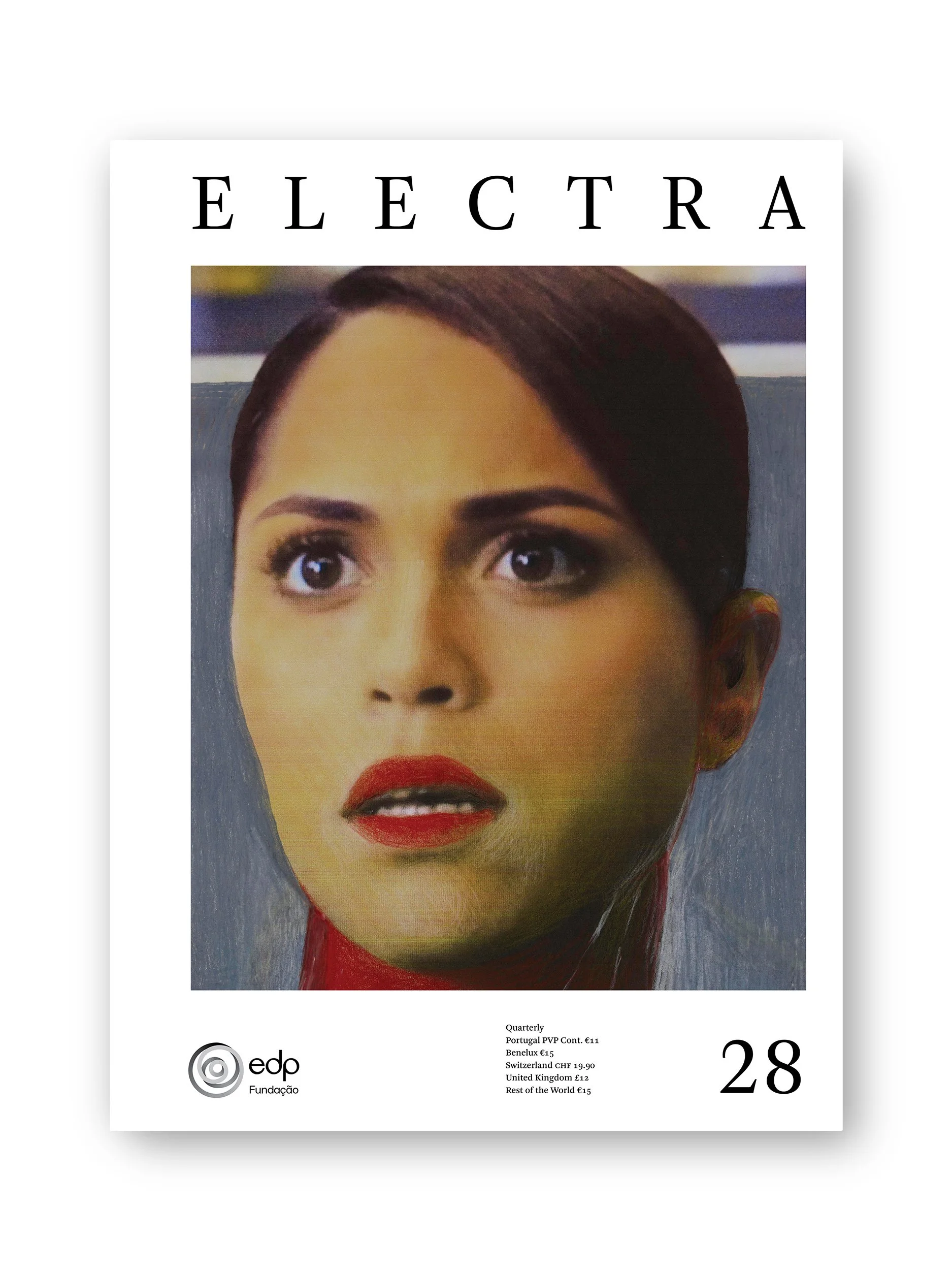
‘The Book,’ ground for culture and civilisation, is the central theme of Electra 28. An extension of memory and imagination, child of obscurity and silence, product of labour and fun, a place of continuity and rupture, motive for bonfires and reason for censure and persecution, an object that spans centuries of history, shaping societies and ways of thinking, but also an entity that goes beyond physical supports and embodies memory, knowledge and the individual and collective imagination, the book has carried the substance of time and the vertigo of life with it over the centuries. This is a subject that, more than ever, requires a deep understanding of its many dimensions: material, cultural, historical, political and symbolic. This dossier brings together texts and interviews from various experts, such as Roger Chartier, Robert Darnton, Rita Luís, John B. Thompson, Adam Garfinkle and Diogo Ramada Curto, who analyse the history of the book and its dissemination, from the invention of the printing press to the digital book, including the transformations in the world of publishing, the impacts of censorship, literacy and ways of reading.
Miriam Cahn, regarded as one of today’s most active and influential artists, is the author of this edition's portfolio. With exhibitions in the most prestigious contemporary art venues, Cahn has created a vast body of work (painting, drawing, photography, sculpture, installation) giving form to the great issues and causes of our time (feminism, ecology, pacifism, war, vulnerable populations) with an intensity and force that often takes on a stance of combat and protest. This portfolio, prepared by the Swiss artist for Electra, is as overview of her works on paper over the last thirty years.
The name Emir Kusturica arouses both admiration and controversy, as one of the most awarded and controversial film directors of the 1990s. True to himself, Kusturica spoke to Electra in a rare interview, conducted by Italian journalist Andrea Prada Bianchi, in which he comments on his work and his vision of the world today, in a provocative and challenging tone that many find difficult to accept. The conversation was held in Serbia during the Küstendorf Film Festival, taking place during a car journey, narrated as a chapter in a novel.
Also in this issue, renowned writer Brenda Lozano evokes the place where she was born, Mexico City; essayist and novelist Christian Salmon reflects on the political matrix of an emerging neofascism; filmmaker Francisco Noronha revisits Jean-Luc Godard’s biographical and artistic career; professor and poet Giancarlo Consonni addresses the disappearance of the historic city, the regression of urbanity and the degradation of urban beauty; António Guerreiro interprets a quote by the writer Stéphane Mallarmé; the poet José António Almeida comments on the ‘Declaration Fiducia supplicans: On the Pastoral Meaning of Blessings’ approved by Pope Francis; and Diogo Vaz Pinto writes about podcasts.
.
Softcover, 27 x 20 cm, 210 pages
—
..
Fundamento de cultura e de civilização, “O livro” é o tema central da Electra 28. Extensão da memória e da imaginação, filho da obscuridade e do silêncio, produto do trabalho e do divertimento, lugar de continuidade e de ruptura, móbil de fogueiras acesas e motivo de censuras e perseguições, objecto que atravessa séculos de história, moldando sociedades e modos de pensar, mas também uma entidade que ultrapassa suportes físicos e encarna a memória, o saber e o imaginário individual e colectivo, o livro tem transportado consigo, ao longo dos séculos, a substância do tempo e a vertigem da vida. Este é um tema que, mais do que nunca, exige uma compreensão profunda das suas múltiplas dimensões: materiais, culturais, históricas, políticas e simbólicas. Neste dossier são reunidos textos e entrevistas de diversos especialistas, como Roger Chartier, Robert Darnton, Rita Luís, John B. Thompson, Adam Garfinkle e Diogo Ramada Curto, que analisam a história do livro e da sua difusão, desde a invenção da imprensa até ao livro digital, incluindo as transformações do mundo da edição, os impactos da censura, a literacia e os modos de ler.
Miriam Cahn, considerada uma das artistas mais activas e influentes da actualidade, é a autora do portfólio desta edição. Com exposições nos mais prestigiados lugares da arte contemporânea, Cahn é a criadora de uma vasta obra (pintura, desenho, fotografia, escultura, instalação), na qual as grandes questões e causas do nosso tempo (feminismo, ecologia, pacifismo, guerra, populações vulneráveis) ganham forma e figura com uma intensidade e força que, não raro, assumem a postura do combate e do protesto. Este portfólio, preparado pela artista suíça para a Electra, é representativo dos seus trabalhos sobre papel dos últimos trinta anos.
O nome de Emir Kusturica desperta tanto admiração como polémica. Foi um dos realizadores de cinema mais premiados e controversos dos anos 90. Fiel a si mesmo, Kusturica falou para a Electra numa entrevista rara, conduzida pelo jornalista italiano Andrea Prada Bianchi, em que comenta a sua obra e a sua visão do mundo actual, num tom provocador e desafiante que muitos consideram difícil de aceitar. A conversa aconteceu na Sérvia, durante o festival de cinema de Küstendorf, e decorreu numa viagem de carro, contada como se fosse um capítulo de um romance.
Ainda nesta edição, a reconhecida escritora Brenda Lozano faz uma evocação do lugar onde nasceu, a Cidade do México; o ensaísta e romancista Christian Salmon reflecte sobre a matriz política de um neofascismo emergente; o realizador Francisco Noronha revisita o percurso biográfico e artístico de Jean-Luc Godard; o professor e poeta Giancarlo Consonni aborda o tema do desaparecimento da cidade histórica, da regressão da urbanidade e da degradação da beleza urbana; António Guerreiro interpreta uma citação do escritor Stéphane Mallarmé; o poeta José António Almeida comenta a «Declaração Fiducia supplicans sobre o sentido pastoral das bênçãos», aprovada pelo Papa Francisco; e Diogo Vaz Pinto escreve sobre podcasts.
Capa mole, 27 x 20 cm, 210 páginas
—
....

....
Of narcissism, as Flaubert said of stupidity, it can aso be said that it is found in all ages, but each age has its own narcissism. That of our time appears to be an omnipresent germ in all aspects of individual and collective life, active in the multiple political, cultural, economic, social, technological and communication systems, giving rise, directly or indirectly, closely or remotely, to the greatest perversions, excesses and arbitrariness, and jeopardising primordial ethical codes and the founding rules of coexistence. The subject of the Electra27 central dossier is exactly ‘Narcissism,’ one of the traits that shape our time, presenting essays and interviews by prominent authors such as Élisabeth Roudinesco, Sinziana Ravini, Miguel Benasayag, Dominique Rabaté, António Bracinha Vieira and Vincent Cocquebert.
In this issue, anthropologist Giulia Bogliolo Bruna writes about Jean Malaurie, a sage whose life was like a novel: scientific explorer of the polar regions and defender of the rights of Arctic minorities, particularly of the indigenous peoples in Greenland, ethnohistorian, geographer and writer, Malaurie was also director of the École des Hautes Études en Sciences Sociales and founder of the prestigious ‘Terre Humaine’ collection.
Yuri Slezkine, professor at the Universities of Berkeley and Oxford and considered one of the world's leading experts on Russian history, summons a beautiful and original memory of Moscow, combining his personal story with the history of the city, visiting different periods, political and cultural figures, memorable events and places of worship.
This issue’s ‘In the First Person’ section features acclaimed British author and essayist Geoff Dyer, who speaks to Electra about books, photographs and the idea of the end, exploring a variety of themes in contemporary culture, ranging from the creative process of writing to the attention to the world that images evoke.
Also in this issue we find recent works by artist Francisca Carvalho; poet, playwright and filmmaker Regina Guimarães comments on a statement by Jean Genet about art and politics; architect Gilles Delalex, founder of Studio Muoto, questions whether anarchist reasoning can generate an architecture; writer and curator Thomas Dylan Eaton tells the story of the famous Hanuman book collection, from India to New York and San Francisco in the late 20th century; Afonso Dias Ramos comments on and connects two of the most eagerly awaited publications of recent years, the catalogue of photographic materials that belonged to W.G. Sebald, and the letters that John Berger exchanged with his son at the end of his life; and journalist Bárbara Reis writes about the word ‘Bubble.’
.
Softcover, 27 x 20 cm, 194 pages
—
..
Do narcisismo, como Flaubert disse da estupidez, pode também afirmar-se que é de todos os tempos, mas que cada tempo tem o seu narcisismo. O do nosso tem mostrado ser um germe omnipresente em todos os aspectos da vida individual e colectiva, activo nos vários sistemas políticos, culturais, económicos, sociais, tecnológicos e comunicacionais, originando, de modo directo ou indirecto, próximo ou remoto, as maiores perversões, excessos e arbitrariedades, que põem em causa os códigos éticos primordiais e as regras fundadoras da convivência. É sobre “O narcisismo”, um dos traços que desenham o perfil do nosso tempo, que trata o dossier central da Electra 27, com ensaios e entrevistas de figuras tão relevantes como Élisabeth Roudinesco, Sinziana Ravini, Miguel Benasayag, Dominique Rabaté, António Bracinha Vieira e Vincent Cocquebert.
Neste número, a antropóloga Giulia Bogliolo Bruna, escreve sobre Jean Malaurie, um sábio cuja vida foi um romance: explorador científico das regiões polares e defensor dos direitos das minorias árticas, nomeadamente da Gronelândia, etno-historiador, geógrafo e escritor, Malaurie foi também director na École des Hautes Études en Sciences Sociales e fundador da prestigiada colecção “Terre Humaine”.
Yuri Slezkine, professor na Universidade de Berkeley e de Oxford, considerado um dos grandes especialistas mundiais de História da Rússia, faz nesta edição uma bela e original evocação de Moscovo, cruzando a história pessoal com a história da cidade, e onde passam épocas distintas, figuras da política, vultos da cultura, acontecimentos memoráveis, lugares de culto.
Na secção “Primeira Pessoa”, o aclamado escritor e ensaísta britânico Geoff Dyer fala com a Electra sobre livros, fotografias e a ideia de fim, explorando uma diversidade de temas da cultura contemporânea que vão desde o processo criativo de escrever um texto à atenção ao mundo que as imagens despertam.
Ainda nesta edição, são reveladas obras muito recentes da artista Francisca Carvalho; a poeta, dramaturga e cineasta Regina Guimarães comenta uma afirmação de Jean Genet sobre arte e política; o arquitecto Gilles Delalex, fundador do Studio Muoto, questiona se o pensamento anarquista pode gerar uma arquitectura; o escritor e curador Thomas Dylan Eaton faz a história da famosa colecção de livros Hanuman, desde a Índia até à Nova Iorque e São Francisco do final do século XX; Afonso Dias Ramos comenta e relaciona duas das mais aguardadas publicações dos últimos anos, o catálogo dos materiais fotográficos que pertenciam a W. G. Sebald, e as cartas originais que John Berger trocou com o filho na fase final da sua vida; e a jornalista Bárbara Reis escreve sobre a palavra “Bolha”.
Capa mole, 27 x 20 cm, 194 páginas
—
....
....
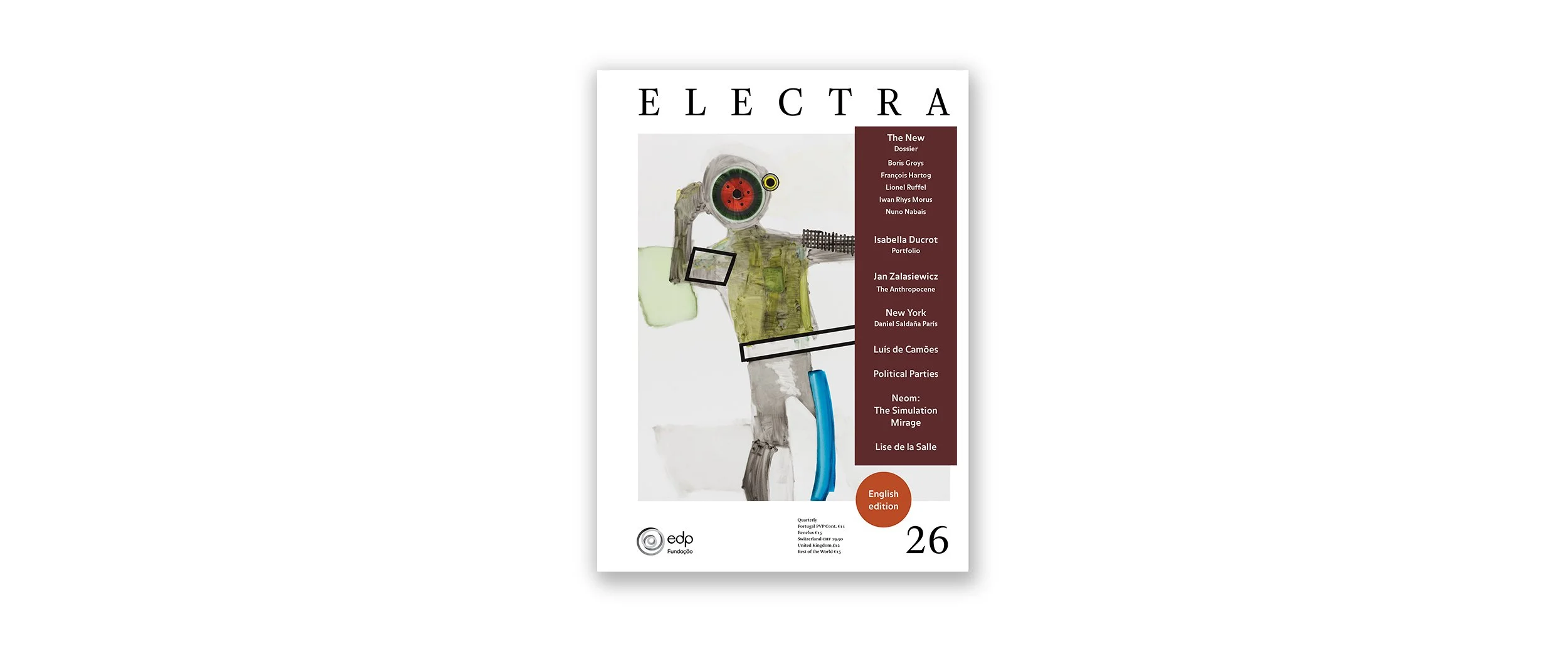
It is a hallmark of our time, an imperative that has spread to all the expressions of our common experience, a theme that, by definition, is always topical. We're talking about ‘The New,’ and the central dossier of Electra 26 is dedicated to it. But what is new today is not that which interrupts the course of the world and of time, such as revolutions in the world of politics or artistic avant-gardes in the cultural field. There is another sense of the new, one which is suited to the spirit of the age and the social and cultural logics that define it: the new in the sense of novelty, amplified by consumer society, as an eloquent manifestation of the futility of time. To develop this theme, Electra brings together contributions from Boris Groys, interviewed by Catarina Pombo Nabais, François Hartog, Iwan Rhys Morus, Lionel Ruffel, and Nuno Nabais.
Highlights of this issue include the interview and portfolio by Italian artist, writer and collector Isabella Ducrot, in whose work textiles are of fundamental importance. At the age of 94, Ducrot's artistic recognition and international media acclaim continue to grow. In her studio, located in the magnificent Palazzo Doria Pamphilj in Rome, where she continues to work, Ducrot received and spoke with Electra, and showed her works and her collections of art and textiles.
The ‘First Person’ section features an interview with geologist and palaeontologist Jan Zalasiewicz, a remarkable scientist who, against the decision taken by a subcommittee of the International Union of Geological Sciences, argued that there is clear scientific evidence that the Earth has entered the beginning of a new geological epoch which meteorologist and atmospheric chemist, Paul Crutzen, dubbed the ‘Anthropocene.’
In the area of political theory, the fate and formal metamorphosis of the ‘political party’ is discussed, an institution that has played a fundamental role in the construction of the modern political body. This topic is discussed in two articles by sociologist Pedro Magalhães and political philosophy professor Damiano Palano.
Also in this issue of Electra, writer Christian Salmon, using a classic phrase by Charles Péguy, analyses the relationship between the present day and Greek antiquity; on the 500th anniversary of the uncertain birth date of Luís de Camões, José Augusto Bernardes writes about the life and work of the great Portuguese poet; Lise de la Salle talks about her work as a pianist, testifying to her daily intimacy with music and meditating on what it means to her; mathematician Umberto Bartocci revisits the mystery of the disappearance in 1938 of Italian physicist Ettore Majorana, a scientist with a remarkably promising career and a disciple of the Nobel Prize for Physics Enrico Fermi, who considered him a genius; architect João Bravo da Costa reflects on Neom, a colossal urban and architectural project being built in the remote deserts of Saudi Arabia; novelist and essayist Daniel Saldaña París tells us about New York, the city where he lives, and about his discovery of this fascinating American city, recalling everything he has read, seen and experienced about it; and Rui Manuel Amaral writes about the word ‘Innovation’.
.
Softcover, 27 x 20 cm, 220 pages
—
..
É uma marca distintiva do nosso tempo, um imperativo que se estendeu a todos os fenómenos da nossa experiência comum, um tema que por definição, é sempre actual. Falamos de “O novo”. A este assunto é dedicado o dossier da Electra 26. Mas o novo, nos nossos dias, não é o que interrompe o curso do mundo e do tempo, como foram os fenómenos das revoluções, no domínio político, ou das vanguardas artísticas, no campo cultural. Há um outro sentido do novo, que se adequa ao espírito da época e às lógicas sociais e culturais que o definem: é o novo no sentido da novidade, amplificado pela sociedade de consumo, enquanto manifestação eloquente da futilidade do tempo. Para desenvolver este tema, a Electra reúne contributos de Boris Groys, entrevistado por Catarina Pombo Nabais, François Hartog, Iwan Rhys Morus, Lionel Ruffel e Nuno Nabais.
Em destaque, neste número, estão a entrevista e o portfólio da artista, escritora e coleccionadora italiana Isabella Ducrot, em cuja obra os tecidos assumem uma importância fundamental. Aos 94 anos, o reconhecimento artístico e a consagração mediática internacionais não param de aumentar. No atelier, situado no magnífico Palazzo Doria Pamphilj, em Roma, onde continua a trabalhar, Ducrot recebeu e conversou com a Electra, e mostrou as suas obras e as suas colecções de arte e de têxteis.
Na secção "Primeira Pessoa”, é entrevistado o geólogo e paleontólogo Jan Zalasiewicz, um notável cientista que, contra a decisão tomada por uma subcomissão da União Internacional das Ciências Geológicas, defendeu que há evidentes provas científicas que atestam a entrada da Terra no início de uma nova época geológica, a que um meteorologista e químico da atmosfera, Paul Crutzen, chamou «Antropoceno».
Na área da teoria política, são abordados o destino e as metamorfoses da forma “partido”, essa instituição que teve um papel fundamental na construção do corpo político moderno. Um tema discutido em dois artigos pelo sociólogo Pedro Magalhães e pelo professor de Filosofia Política Damiano Palano.
Ainda nesta edição da Electra o escritor Christian Salmon, a partir de uma frase, que se tornou clássica, de Charles Péguy, analisa a relação da nossa actualidade com a Antiguidade grega; nos quinhentos anos da incerta data do nascimento de Luís de Camões, José Augusto Bernardes escreve sobre a vida e a obra do grande poeta português; Lise de la Salle fala do seu ofício de pianista, dando testemunho da intimidade quotidiana que tem com a música, meditando sobre o que isso representa para ela; o matemático Umberto Bartocci revisita o mistério do desaparecimento, em 1938, do físico italiano Ettore Majorana, cientista com uma notável carreira carregada de futuro e discípulo do Prémio Nobel da Física Enrico Fermi, que o considerava um génio; o arquitecto João Bravo da Costa reflecte sobre o Neom, um colossal projecto urbanístico e arquitectónico que está a ser edificado nos desertos remotos da Arábia Saudita; o romancista e ensaísta Daniel Saldaña París dá-nos um testemunho sobre Nova Iorque, cidade onde reside, e da descoberta que fez desta fascinante urbe norte-americana, evocando tudo o que, sobre ela, leu, viu e viveu; e Rui Manuel Amaral escreve sobre a palavra “Inovação”.
Capa mole, 27 x 20 cm, 220 páginas
—
....

....
‘We have never lied as much as today. Nor have we ever done it so blatantly, systematically and constantly.’ These words were written by Russian-born French philosopher Alexandre Koyré during the Second World War, a statement that takes on a new and unexpected relevance in our time. The history of humanity is inseparable from the history of lies, recording its forms and metamorphoses through the centuries and according to the paradigms of each era and its social, economic, cultural and religious practices. ‘‘Lies’ is the subject of the Electra #25 central dossier, a theme that is both universal and contemporary, in an issue that includes contributions on politics, art and images, the post-truth media regime and fake news, the stages of phylogenetic natural history, and the hegemony of technology. On ‘Lies’ we find texts by Martin Jay, Bárbara Reis, Daisy Dixon, Myriam Revault d’Allonnes, Peter Hill, and António Bracinha Vieira.
For the centenary of Franz Kafka's death, this issue features three articles on the Czech writer: one by Gianluca Cuozzo on representations of bureaucracy and the exercise of power; another by António Guerreiro focusing on biographical issues; and finally, an article by Jacques Le Rider on Kafka's bilingual condition, his relationship with the German and Czech languages, and the historical and linguistic context of Prague.
Simon Critchley, one of the most prolific and popular philosophers of recent decades, speaks to Electra about some of the themes that have guided his work, from the place of philosophy in contemporary society to the disillusionment with liberal democracy, from the cultural importance of football to the challenge of autobiographical writing.
This issue's portfolio presents a new series of photographs by João Penalva, an artist widely recognised for his work that crosses video, installation, photography, music, performance, text, and image.
The ‘Figure’ of this issue is Anabela Becho, fashion historian, curator and researcher, who shows us how the great American painter Georgia O'Keeffe turned the way she dressed her body into an affirmation of herself, both as a woman and a modern artist. In a new section of Electra entitled ‘Noah's Ark’, Italian sociologist Vania Baldi questions the limitless belief in AI and the ethical neglect towards new Artificial Intelligence systems.
Also in this issue, journalist Alexandra Prado Coelho and semiotics professor Gianfranco Marrone comment on a provocative statement by the famous and feared Spanish gastronomic critic Rafael García Santos; Marta G. Franco tells us about Holy Week in Seville; art critic José Marmeleira writes about a recent book by Hal Foster, one of North America’s best known art critics and historians; and António Guerreiro reflects on the word ‘Commentator’.
.
Softcover, 27 x 20 cm, 223 pages
—
..
«Nunca se mentiu tanto como nos dias de hoje. Nem alguma vez se mentiu de uma maneira tão descarada, sistemática e constante.», escreveu o filósofo francês de origem russa Alexandre Koyré, durante a Segunda Guerra Mundial. Esta afirmação assume no nosso tempo uma nova e inesperada validade. A história da humanidade é inseparável da história da mentira, registando as suas formas e metamorfoses ao longo dos séculos e segundo os paradigmas de cada tempo e as suas práticas sociais, económicas, culturais e religiosas. “A mentira”, um tema ao mesmo tempo muito universal e muito contemporâneo, é o assunto do dossier central da Electra 25, que conta com contribuições que abordam a política, a arte e as imagens, o regime mediático da pós-verdade e as fake news, as etapas da história natural filogenética e a hegemonia da técnica. Sobre “A mentira” escrevem Martin Jay, Bárbara Reis, Daisy Dixon, Myriam Revault d’Allonnes, Peter Hill e António Bracinha Vieira.
Pelo centenário da morte de Franz Kafka, são publicados nesta edição três artigos sobre o escritor checo: um de Gianluca Cuozzo, sobre as representações da burocracia e do exercício do poder; outro de António Guerreiro centrado nas questões biográficas; e, por último, um artigo de Jacques Le Rider, sobre a condição bilingue de Kafka, a sua relação com as línguas alemã e checa, e o contexto histórico e linguístico de Praga.
Simon Critchley, um dos filósofos mais prolíficos e populares das últimas décadas, fala com a Electra sobre alguns dos temas que têm vindo a orientar o seu trabalho, desde o lugar da filosofia na sociedade contemporânea à desilusão com a democracia liberal, da importância cultural do futebol até ao desafio de uma escrita autobiográfica.
O portfólio deste número é da autoria de João Penalva, um artista amplamente reconhecido pelos seus trabalhos de cruzamento do vídeo, da instalação, da fotografia, da música, da performance, do texto e da imagem, e que aqui apresenta uma série inédita de fotografias.
Na secção “Figura”, Anabela Becho, historiadora de moda, curadora e investigadora, mostra-nos como a grande pintora americana Georgia O’Keeffe fez da maneira como vestia o seu corpo uma afirmação como mulher e artista moderna. Numa nova secção da Electra, intitulada “Arca de Noé”, o sociólogo italiano Vania Baldi, elabora uma reflexão que contraria a crença ilimitada e a negligência ética em relação aos novos sistemas da Inteligência Artificial.
Ainda nesta edição, a jornalista Alexandra Prado Coelho e o professor de semiótica Gianfranco Marrone comentam uma afirmação provocadora do famoso e temido crítico gastronómico espanhol Rafael García Santos; Marta G. Franco faz-nos um relato da Semana Santa de Sevilha; o crítico de arte José Marmeleira escreve sobre um livro recente de Hal Foster, um dos mais importantes críticos e historiadores de arte norte-americanos, e António Guerreiro sobre a palavra “Comentador”.
Capa mole, 27 x 20 cm, 223 páginas
—
....

....
A law of excess rules the contemporary world in every domain. The products of consumer society, the financial logic, wealth and poverty, the phenomena of social and political life, the growth of cities, the circulation of people and goods, rubbish and waste: everything has abandoned its due measure and has been growing and proliferating unchecked. The notion of Excess, its manifestations and effects, is the theme of the central section of Electra 24, with essays by Gianluca Cuozzo, Christian Salmon, Maddalena Mazzocut-Mis, McKenzie Wark, Paul Morland and Laurent de Sutter.
In this edition, the renowned Italian literary critic Alfonso Berardinelli writes about Italo Calvino, the great writer who took narrative, the short story and short forms to a supreme level of literary construction, and Michael Hardt, one of the most distinguished political theorists of our time, speaks to Electra about love and revolution, language and liberation, activism and prison, and his new project on the urgent need to take another look at the revolutionary movements of the 1970s.
In the ‘Planisphere’ section, photographer André Príncipe travels to Tunisia, where he meets Badiaa Bouhrizi and engages the singer, author, composer and activist for freedom and social justice in a conversation on politics, music and African identities. The words of the interview are enhanced by images to form a visual essay.
For Electra 24’s ‘Scoop’, visual artist Mónica de Miranda, historian Sónia Vaz Borges and choreographer Vânia Gala, who form the collective representing Portugal at the 2024 Venice Art Biennale, contributed a series of texts and images that reveal the major themes and motivations of the ‘Greenhouse’ project, a creole garden, through which they explore the themes of colonialism, war, liberation struggles and ecology.
Also in this issue, Italian philosopher Donatella Di Cesare describes her visit to Portugal immediately after the Revolution of April 1974; designer Ruedi Baur proposes a ‘forest city’ in opposition to the ongoing urban destruction; Afonso Dias Ramos reviews the release, in France, of the unpublished course on the relationship between painting and philosophy given by Gilles Deleuze in 1981; Amândio Reis analyses a verse from a poem by Fernando Pessoa/Álvaro de Campos; essayist and photographer José Bértolo visits the Japanese city of Tokushima, following in the footsteps of diplomat and writer Wenceslau de Moraes and filmmaker Paulo Rocha; Nélio Conceição presents a reading of Essays by Robert Musil; and Gonçalo M. Tavares writes about the word ‘Toxic’.
.
Softcover, 27 x 20 cm, 231 pages
—
..
Uma lei do excesso governa o mundo contemporâneo em todos os domínios. Os produtos da sociedade de consumo, a lógica financeira, a riqueza e a pobreza, os fenómenos da vida social e política, o crescimento das cidades, a circulação de pessoas e mercadorias, o lixo e os resíduos: tudo abandonou a justa medida e se pôs a crescer e a proliferar sem contenção. É sobre o Excesso, as suas manifestações e os seus efeitos, que trata o dossier central da Electra 24, com ensaios de Gianluca Cuozzo, Christian Salmon, Maddalena Mazzocut-Mis, McKenzie Wark, Paul Morland e Laurent de Sutter.
Nesta edição, o mais importante crítico literário italiano, Alfonso Berardinelli, escreve sobre Italo Calvino, o grande escritor, que levou a narrativa, o conto e as formas breves, a um grau supremo de construção literária, e Michael Hardt, um dos teóricos políticos mais conceituados do nosso tempo, fala com a Electra sobre amor e revolução, linguagem e libertação, activismo e prisão, e o seu novo projecto acerca da necessidade urgente de voltar a olhar para os movimentos revolucionários dos anos 70.
Na secção “Planisfério”, o fotógrafo André Príncipe viaja até à Tunísia e encontra-se com Badiaa Bouhrizi. É com esta cantora, autora e compositora, militante das causas da liberdade e da justiça social, que se desenvolve uma conversa sobre política, música e identidades africanas. Às palavras da entrevista juntam-se as imagens de um ensaio visual.
Para o “Furo” da Electra 24, a artista visual Mónica de Miranda, a historiadora Sónia Vaz Borges e a coreógrafa Vânia Gala, que constituem o colectivo que assegura a representação de Portugal na Bienal de Arte de Veneza 2024, destinaram um conjunto de textos e imagens que revelam os grandes temas e motivações do projecto «Greenhouse», um jardim crioulo, a partir do qual são pensados os temas do colonialismo, da guerra, das lutas de libertação e da ecologia.
Ainda neste número, a filósofa italiana Donatella Di Cesare presta testemunho da sua visita a Portugal e do período que se seguiu à Revolução de Abril de 1974; o designer Ruedi Baur propõe uma «cidade-floresta» em oposição à destruição urbana em curso; Afonso Dias Ramos comenta a publicação, em França, do curso inédito sobre a relação entre pintura e filosofia que Gilles Deleuze lecionou em 1981; Amândio Reis analisa um verso de um poema de Fernando Pessoa/Álvaro de Campos; o ensaísta e fotógrafo José Bértolo visita a cidade japonesa de Tokushima, seguindo o rasto do diplomata e escritor Wenceslau de Moraes e do cineasta Paulo Rocha; Nélio Conceição faz uma leitura dos Ensaios de Robert Musil; e Gonçalo M. Tavares escreve sobre a palavra “Tóxico”.
Capa mole, 27 x 20 cm, 231 páginas
—
....

....
Attention, the subject of the central dossier of issue 23 of Electra magazine, is a scarce and precious resource, and therefore subject to an unrelenting battle to capture it. And there has never been such a proliferation of information, consumer products, cultural goods, and events that demand our attention. Attention is the commodity on which the value of all other commodities depends, whether material or immaterial, real or symbolic. It is therefore a fundamental issue of our time and a crucial topic for understanding it. This issue features articles and interviews with Yves Citton, Enrico Campo, Mark Wigley, Georg Franck, and Claire Bishop.
This issue's "In the First Person" section features interviews with the American writer, professor and critic Svetlana Alpers (with Afonso Dias Ramos), whose pioneering work has redefined the field of art history in recent decades, and Philippe Descola (with António Guerreiro), a central figure in anthropology, who speaks about topics ranging from the production of images and iconographic traditions and styles to the question of the opposition between nature and culture.
The "Scoop" section presents a set of unpublished drawings and letters by the painter Maria Helena Vieira da Silva. In 1928, she was twenty years old and had left Portugal to study art in Paris, before embarking on a study trip to Italy. During this journey she drew quick sketches in a notebook of what she saw, writing letters to her mother to tell her about her impressions and discoveries. A selection of these drawings and letters, in which an intimate and consonant dialogue is established, is now revealed.
In Electra 23, a portrait of the great Greek poet Constantine Cavafy by professor and translator Nikos Pratsinis is published in the "Figure" section, and writer Christian Salmon offers commentary on a reflection on the tragic history of Central Europe by renowned Czech novelist and essayist Milan Kundera in the "Passages" section.
Also in this issue, essayist and journalist Sergio Molino gives us a personal map of the city of Zaragoza, where history and geography, literature and art meet; Brazilian journalist and columnist Marcelo Leite examines research that has been conducted since the 1990s with a view to the pharmacological and therapeutic use of psychedelics; writer and veterinarian María Sanchez builds a diary that is permeated with searching and encounter, houses and journeys, books and animals, lands and women, love and friendship; Chilean architect, researcher and curator Francisco Díaz discusses the relationship between soil and terrain based on Peter Eisenman's City of Culture project in Santiago de Compostela; artist and essayist João Sousa Cardoso writes about the work of sculptor Rui Chafes, revisiting three exhibitions and a book presented during 2023; and playwright Miguel Castro Caldas offers a commentary on the word "Comfortable".
.
Softcover, 27 x 20 cm, 219 pages
—
..
A Atenção, tema de que se ocupa o dossier central do número 23 da revista Electra, é um recurso escasso e precioso e por isso objecto de uma guerra de concorrência sem tréguas para conseguir a sua captura. Nunca houve uma tão grande proliferação de informação, de produtos de consumo, de bens culturais, de acontecimentos que reclamam a atenção. Ela é a mercadoria da qual depende o valor de todas as mercadorias, sejam materiais ou imateriais, reais ou simbólicas. A Atenção é, pois, uma questão fundamental do nosso tempo e é um tópico crucial para o compreendermos. Sobre ela destacam-se neste dossier artigos e entrevistas de Yves Citton, Enrico Campo, Mark Wigley, Georg Franck e Claire Bishop.
Nesta edição, na secção “Primeira Pessoa”, são publicadas entrevistas à escritora, professora e crítica norte-americana Svetlana Alpers (por Afonso Dias Ramos), cujo trabalho pioneiro redefiniu o campo da história da arte nas últimas décadas, e a Philippe Descola (por António Guerreiro), figura central da Antropologia, que nos fala de temas que vão desde a produção de imagens e das tradições e dos estilos iconográficos à questão da oposição entre natureza e cultura.
A secção “Furo” apresenta um conjunto de desenhos e cartas inéditos da pintora Maria Helena Vieira da Silva. Em 1928, tinha vinte anos. Havia saído de Portugal para estudar arte em Paris e, de França, foi a Itália numa viagem de estudo. Durante esse percurso desenhou num caderno esboços rápidos do que via, e ao mesmo tempo, escrevia cartas à mãe para lhe contar as suas impressões e descobertas. Uma selecção destes desenhos e destas cartas, que estabelecem entre si um diálogo íntimo e consonante, é agora revelada.
Na Electra 23, é publicada, na secção “Figura”, um retrato do grande poeta grego Konstandinos Kavafis, feito pelo professor e tradutor Nikos Pratsinis, a partir de oito perguntas capitais; é comentada, pelo escritor Christian Salmon, na secção “Passagens”, uma reflexão sobre a história trágica da Europa Central do consagrado romancista e ensaísta checo, Milan Kundera.
Ainda neste número, o ensaísta e jornalista Sergio Molino dá-nos um mapa pessoal da cidade de Saragoça, em que a história e a geografia, a literatura e a arte se encontram; o jornalista e colunista brasileiro Marcelo Leite trata das investigações em curso desde os anos 90, com vista ao uso farmacológico e terapêutico dos psicadélicos; a escritora e veterinária María Sanchez constrói um diário que é atravessado por procuras e encontros, casas e viagens, livros e animais, terras e mulheres, amor e amizade; o arquitecto, investigador e curador chileno Francisco Díaz aborda a relação entre solo e terreno, a partir do projecto da Cidade da Cultura de Santiago de Compostela, da autoria de Peter Eisenman; o artista e ensaísta João Sousa Cardoso escreve sobre a obra do escultor Rui Chafes, revisitando três exposições e um livro apresentados durante o ano de 2023; e o dramaturgo Miguel Castro Caldas comenta a palavra “Confortável”. . ..
Capa mole, 27 x 20 cm, 219 páginas
—
....

....
The relationship between the life and work of authors, artists and public figures has always been a subject of great controversy. In our time, this relationship has taken on a renewed and sharper importance and for this reason is the subject of focus in Electra 22. The public and the private, the author and the work, the morality of the work and the morality of the author, the person and their public mission, biographical material and the media space or life as an artwork are all issues that are explored through this section of the magazine, whose theme, due to its nature and scope, genealogy and history, is one of the most infinite and indefinable ever tackled in Electra. This dossier, entitled "The Life or the Work?", features articles by Giséle Sapiro, Sinziana Ravini, Christian Delporte, Éric Marty, Raúl Rodríguez-Ferrándiz and Maria Antónia Oliveira.
Wolfgang Tillmans, one of the most important artists on the global contemporary art scene, is the artist behind this issue's portfolio, which consists of a series of unpublished photographs taken in recent years. The accompanying essay by Afonso Dias Ramos explores and places these images in the context of a recognised body of work and a career spanning more than four decades.
The "In the First Person" section features two interviews: one with architect Eduardo Souto de Moura (Pritzker Prize 2011) who, in conversation with Pedro Levi Bismarck, reflects on the state of the profession, the social responsibility of the architect, and the conditions and contingencies for making architecture, while also going through his work and its decisive moments and places; the second is with American critic and historian Hal Foster, one of the most influential and prolific authors on modern and contemporary art, design, architecture and post-modernism.
Also in Electra 22, Colm Tóibín, renowned Irish writer, literary critic and journalist, revisits the vast body of work of Henry James, the great writer of the nineteenth and twentieth centuries, a refined stylist and profound judge of human psychology. Based on the importance of houses in the life and work of the author of Portrait of a Lady, Tóibin’s image of this tormented genius teems with truth and vigour.
Also in this issue, Iranian architect Sepideh Karemi tells us about the city she chose to live and work in, Edinburgh; Brazilian writer and curator Veronica Stigger reveals the story of artist Yvonne Daumerie and her time at the Semana de Arte Moderna [Modern Art Week] in São Paulo, 1922) ; Carlos Vidal analyses the staging of Richard Wagner's The Ring of the Nibelung, directed by Valentin Schwarz; Taro Igarashi, architectural historian and critic, examines the impact of the Great Fukushima Earthquake on architecture and art; and António Guerreiro, in the Dictionary of Received Ideas section, writes about the word "scrutinise".
.
Softcover, 27 x 20 cm, 219 pages
—
..
A relação entre a vida e a obra dos autores, dos artistas e das figuras públicas foi sempre um tema de grande controvérsia. No nosso tempo, essa relação ganhou uma importância renovada e acutilante e é dela que trata o assunto central da Electra 22. O público e o privado, o autor e a obra, a moral da obra e a moral do autor, a pessoa e a sua missão pública, a matéria biográfica e o espaço mediático ou a vida como obra de arte são questões que atravessam esta secção da revista, cujo tema, pela sua natureza e alcance, pela sua genealogia e história, é um dos mais infinitos e indefiníveis já abordados na Electra. Neste dossier intitulado “A vida ou a obra?” são publicados artigos de Giséle Sapiro, Sinziana Ravini, Christian Delporte, Éric Marty, Raúl Rodríguez-Ferrándiz e Maria Antónia Oliveira.
Wolfgang Tillmans, um dos artistas mais importantes no panorama global da arte contemporânea, é o autor do portfólio desta edição que é constituído por uma série de fotografias inéditas feitas nos últimos anos. O ensaio que acompanha este trabalho é assinado por Afonso Dias Ramos e explora e situa estas imagens no contexto de uma reconhecida obra e de um percurso com mais de quatro décadas.
Na secção “Primeira Pessoa” são publicadas duas entrevistas: ao arquitecto Eduardo Souto Moura (Prémio Pritzker 2011) que, em conversa com Pedro Levi Bismarck, faz uma reflexão sobre o estado da profissão, a responsabilidade social do arquitecto e as condições e contingências para fazer arquitectura, ao mesmo tempo que percorre a sua obra, pelos seus tempos e lugares decisivos; e ao crítico e historiador norte-americano Hal Foster, um dos autores mais influentes e prolíficos sobre arte moderna e contemporânea, design, arquitectura e pós-modernismo.
Nesta Electra 22, Colm Tóibín, consagrado escritor, crítico literário e jornalista irlandês, revisita a vasta obra de Henry James, o grande escritor dos anos em que o século XIX passa para o século XX, refinado estilista e profundo conhecedor da psicologia humana. A partir da importância das casas na vida e na obra do autor de Retrato de Uma Senhora, Tóibin dá-nos uma imagem, cheia de verdade e vigor, deste génio atormentado.
Ainda nesta edição a arquitecta iraniana Sepideh Karemi fala-nos da cidade que escolheu para viver e trabalhar, Edimburgo; a escritora e curadora brasileira Veronica Stigger revela a história da artista Yvonne Daumerie e da sua passagem pela Semana de Arte Moderna de São Paulo, em 1922; Carlos Vidal faz uma análise da encenação de O Anel dos Nibelungos, de Richard Wagner, dirigida por Valentin Schwarz; Taro Igarashi, historiador e crítico de arquitectura examina o impacto do Grande Terramoto de Fukushima para a arquitectura e para a arte; e António Guerreiro, na secção Dicionário das Ideias Feitas, escreve sobre a palavra “Escrutinar”. ..
Capa mole, 27 x 20 cm, 219 páginas
—
....

....
The central “Subject” of issue 21 of Electra magazine, summer edition, is "Leisure and Idleness", two concepts with a long history. With the economic, social and cultural transformations that have taken place since the first half of the twentieth century, the forms of idleness and leisure have undergone profound changes in its values, practices, spaces, modalities, and meanings. From a perspective that analyses the contemporary condition of idleness and leisure, in this issue we publish an interview with Franco "Bifo" Berardi, a fundamental figure in contemporary thought, and an essay by renowned architect and critic Mark Wigley. With a valuable diversity of viewpoints, we also include texts by André Barata, Claire Siegel, Raúl Rodríguez-Ferrándiz, and Francesco Masci.
Alejandro Aravena, winner of the Pritzker Prize in 2016, is interviewed by researcher and architect Ana Vaz Milheiro for "In the First Person" section. In a conversation in which he discusses his own path of development, he also talks about the relationship between architecture, housing, society, sustainability, and nature. The Chilean architect also tells us about the experience of designing and building in Lisbon.
In the "Planisphere" section, photographers and editors André Príncipe and José Pedro Cortes continue a series developed for Electra which they began in Tangier and continued in Cairo. This time, the encounter is with French photographer Bernard Plossu in La Ciotat, on a trip that ends in Corsica. In an interview that becomes very intimate, they talk about life, travels, the passion of the desert, passing time, photography, photographers, photography books, and the work that Plossu did in Portugal.
The woke movement has encompassed new forms of struggle and antagonism in the public space, with deeply entrenched positions placed in direct conflict. This situation is examined by Electra 21 in two texts that take part in this division: that of writer and philosopher Véronique Bergen and that of researcher and philosopher Carolina Flores. In the "Metropolitan" section, Dutch graphic designer, researcher and professor Ruben Pater talks to Frederico Duarte about his books and his conception of design as a practice of citizenship.
Also in this issue of Electra, Joana Bértholo writes about the word "Trans"; artist Gonçalo Pena presents 21 as yet unpublished drawings; Austrian poet and essayist Ann Cotten visits Steyr, a town in Upper Austria which combines a powerful natural setting with historical and cultural memory and industrial and manufacturing heritage; Luca Mazzocchi writes about the great writer Carlo Emilio Gadda, his labyrinthine and complex work and its reception; José Manuel dos Santos comments on a statement by Pope Francis about homosexuality, giving it historical perspective; and João Oliveira Duarte looks at the publication of a vast volume that brings together the entire critical work of Joaquim Manuel Magalhães.
.
Softcover, 27 x 20 cm, 260 pages
—
..
O número 21 da revista Electra, edição de verão, tem como “Assunto” central o “Ócio e o Lazer”, dois conceitos com uma longa história. Desde a primeira metade do século XX, os regimes do ócio e do lazer sofreram mudanças que, com as transformações económicas, sociais e culturais, alteraram profundamente a sua natureza, nos seus valores, práticas, espaços, modalidades e significados. Numa perspectiva que analisa a condição contemporânea do ócio e do lazer, publicamos neste dossier uma entrevista com Franco «Bifo» Berardi, figura fundamental do pensamento contemporâneo, e um ensaio do reconhecido arquitecto e crítico Mark Wigley. Com uma valiosa diversidade de pontos de vista, incluem-se também textos de André Barata, Claire Siegel, Raúl Rodríguez-Ferrándiz e Francesco Masci.
Alejandro Aravena, arquitecto vencedor do Pritzker Prize em 2016, é entrevistado pela investigadora e arquitecta Ana Vaz Milheiro para a secção “Primeira Pessoa”. Numa conversa em que aborda o seu percurso pessoal, fala também da relação entre arquitectura, habitação, sociedade, sustentabilidade e natureza. O arquitecto chileno dá-nos ainda conta da experiência de projectar e construir em Lisboa.
Na secção “Planisfério”, os fotógrafos e editores André Príncipe e José Pedro Cortes continuam a série concebida para a Electra, que iniciaram em Tânger e prosseguiram no Cairo. Desta vez, o encontro foi com o fotógrafo francês Bernard Plossu, em La Ciotat, numa viagem que terminou na Córsega. Numa entrevista que se tornou muito íntima, falam da vida, de viagens, da paixão do deserto, do tempo que passa, de fotografia, de fotógrafos, de livros de fotografia e também do trabalho que Plossu fez em Portugal.
Na Electra 21, o movimento woke, que convocou para o espaço público formas de luta e antagonismos de um novo tipo, onde se investem posições exacerbadas, é abordado por dois textos que participam dessa divisão: o da escritora e filósofa Véronique Bergen e o da investigadora e filósofa Carolina Flores. Na secção “Metropolitano”, o designer gráfico, investigador e professor holandês Ruben Pater, numa conversa com Frederico Duarte, fala dos seus livros e da sua concepção do design como prática de cidadania.
Ainda neste número da Electra, Joana Bértholo escreve sobre a palavra “Trans”; o artista Gonçalo Pena apresenta 21 desenhos inéditos; a poeta e ensaísta austríaca Ann Cotten visita Steyr, uma cidade da Alta Áustria, que alia uma natureza poderosa com a memória histórica e cultural e com o património fabril e industrial; Luca Mazzocchi escreve sobre o grande escritor Carlo Emilio Gadda, falando da sua obra, labiríntica e complexa, e da recepção dela; José Manuel dos Santos comenta uma declaração do Papa Francisco sobre a homossexualidade, dando-lhe uma perspectiva histórica; e João Oliveira Duarte regista a edição de um vastíssimo volume que reúne toda a obra crítica de Joaquim Manuel Magalhães. ..
Capa mole, 27 x 20 cm, 235 páginas
—
....

....
With this 20th issue, we celebrate 5 years of Electra magazine's existence. In the many pages published, and in accordance with the editorial programme of Electra, we have looked at the time and world we call ours with a gaze that is both committed and detached, trying to capture the ideas, trends, sensibilities, wisdoms and mythologies that encourage or discourage our era.
The central theme of Electra’s new issue is “Taste”. In this dossier, questions and answers about taste and distaste, beauty and ugliness, the sublime and the vulgar, fashion and out of fashion, the massification of communication and the commercial exploitation of culture draw fundamental traits of the portrait in which our time is presented and represented. There are essays and interviews on this subject by Rosie Findlay, António Guerreiro, Aliocha Imhoff, Geoffroy de Lagasnerie, Maddalena Mazzocut-Mis, Rodrigo Pereira, Patrícia Portela, Kantuta Quirós and Filomena Silvano.
Two interviews are published in the “In the First Person” section: one with Alfonso Berardinelli, in which this major Italian literary and cultural critic delivers a cultural diagnosis of our time; and one with Jonathan Crary, North American historian and theoretician, who tells us about the digital era and its relationship with the sustainability of the planet and interdependence between human beings.
Renowned Swiss architect Valerio Olgiati, who has distinguished himself in the practice of architecture and in critical thinking about it, is the author in focus in the “Portfolio” of issue 20 of Electra. In this portfolio, we find images of some of his most representative projects and, in a dialogue between generations, the writings of three students from Accademia di Architettura di Mendrisio, where Olgiati is currently a teacher.
In this anniversary issue, Italian novelist and journalist Simonetta Greggio speaks of the crucial contribution of the 2022 Nobel Prize in Literature winner Annie Ernaux’s oeuvre and public opinions; in the “View of Delft” section, the writer António Cabrita casts a sophisticated analytical eye over the city of Maputo; Alireza Taghaboni, one of Iran's best known architects, speaks of Tehran’s architecture built after the Islamic Revolution in 1979 and during the Iran-Iraq war; António Guerreiro rediscovers the work of Günther Anders and its topicality in this era of the Artificial Intelligence, the post-human and the return of the nuclear threat; film director and script writer Rita Azevedo Gomes gives us a personal portrait of the writer Agustina Bessa-Luís; and poet and translator Daniel Jonas writes about the word “nomad.”
.
Softcover, 27 x 20 cm, 235 pages
—
..
Neste número 20, a revista Electra assinala os seus cinco anos de vida. Nas muitas páginas destas edições, a Electra procurou, dando forma ao seu programa editorial, olhar o tempo e o mundo a que chamamos nossos com um olhar simultaneamente empenhado e distanciado, tentando captar as ideias, as tendências, as sensibilidades, as sabedorias, as mitologias que fazem mover ou demover a nossa época.
Esta nova edição da Electra tem como tema central “O gosto”. Neste dossier, as perguntas e as respostas sobre o gosto e o desgosto, o belo e o feio, o sublime e o vulgar, a moda e o que passou de moda, a massificação comunicacional e a mercantilização cultural desenham traços fundamentais do retrato em que o nosso tempo se apresenta e representa. Sobre este assunto são publicados ensaios e entrevistas de Rosie Findlay, António Guerreiro, Aliocha Imhoff, Geoffroy de Lagasnerie, Maddalena Mazzocut-Mis, Rodrigo Pereira, Patrícia Portela, Kantuta Quirós e Filomena Silvano.
Na secção “Primeira Pessoa” são publicadas duas entrevistas: a Alfonso Berardinelli, em que o mais importante crítico literário e cultural italiano faz um diagnóstico cultural do nosso tempo, e a Jonathan Crary, historiador e teórico norte-americano, que nos fala sobre a era digital e a sua relação com a sustentabilidade do planeta e interdependência entre seres humanos.
Valerio Olgiati, reconhecido arquitecto suíço que se tem distinguido quer na prática da arquitectura, quer no pensamento sobre ela, é o autor do “Portfolio” do número 20 da Electra. Neste portefólio, apresentam-se imagens de alguns dos seus mais representativos projectos e, num diálogo entre gerações, escrevem três alunos da Accademia di Architettura di Mendrisio, onde Olgiati é actualmente professor.
Nesta edição de aniversário, a romancista e jornalista italiana Simonetta Greggio fala do contributo fundamental da obra e das posições públicas da escritora Annie Ernaux, Prémio Nobel da Literatura em 2022; o escritor António Cabrita, na secção “Vista de Delft”, lança sobre a cidade de Maputo, um olhar analítico e sofisticado; Alireza Taghaboni, um dos mais reconhecidos arquitectos iranianos, fala-nos da arquitectura de Teerão, criada depois da Revolução Islâmica de 1979 e durante a guerra Irão-Iraque; António Guerreiro releva a redescoberta da obra de Günther Anders e a sua actualidade, neste nosso tempo da Inteligência Artificial, do pós-humano e do renascimento da ameaça nuclear; a realizadora e argumentista Rita Azevedo Gomes dá-nos um retrato pessoal da escritora Agustina Bessa-Luís; o poeta e tradutor Daniel Jonas escreve sobre a palavra “nómada”. ..
Capa mole, 27 x 20 cm, 235 páginas
—
....

....
We have grown accustomed to hearing a chorus of voices talking about a "crisis of democracy", a "the unease in/of democracy”, or the ailing “state of democracy”. Democratic regimes are being threatened by crossfire and converging phenomena that call into question the very foundations of representative democracy. Everywhere we find an explosive mix of plutocracy and technocracy, populism and identitarianism, unlimited consumerism and environmental destruction, social fracturing and generational rupture, excessive corruption and media manipulation. From this situation, ripe for discussion and diagnosis, emerges the central theme of this issue of Electra: The State of Democracy. This topic is the starting point to question the various challenges and risks of our current democratic drift, in a dossier that includes texts and interviews by Wendy Brown, Yves Citton, Colin Crouch, Dario Gentili, Chantal Mouffe, Christophe Pébarthe, Barbara Stiegler, Paulo Tunhas and Manuel Villaverde Cabral, accompanied by an editorial by José Manuel dos Santos and António Soares.
This issue's “In the First Person” looks at Mário Lúcio Sousa, a musician, singer, poet, former Minister of Culture in Cape Verde, and author of Manifesto a Crioulização [Manifesto of Creolisation]. In conversation with João Pacheco, he speaks of the experience of being born in a fishing village in Tarrafal on the island of Santiago, and of the political and cultural potential of the Creole model. Based on the theoretical, literary and musical interventions of Mário Lúcio Sousa, which take creoleness as a cultural and political ideal, an article by Marta Lança accompanies this interview.
At a time when sleep and insomnia are growing concerns, North American historian Roger Ekirch, in an interview with Diogo Vaz Pinto for the "Metropolitan" section, talks about his research that questions prevailing ideas about sleep, past and present, about the transformation of time and our manner of sleeping, and about how nights were formerly spent.
Considered one of the most radical, eloquent and effective artists of our time, Giorgio Griffa is the author of the “Portfolio” for issue 19 of Electra, presenting a representative series of his most recent works, accompanied by an essay by curator Francesco Manacorda.
The “Book of Hours” section publishes diaries by Flora Thomson-DeVeaux and Rodrigo Nunes, recounting the weeks leading up to the latest Brazil’s presidential runoff election, when that country was the centre of everybody's attention.
Also in this issue of Electra, artist and translator José Miranda Justo comments on a phrase by Rainer Maria Rilke about the complex relationship between the work of art and criticism; Nikos Pratsinis writes about Heraklion, the capital of Crete, the island of the Minotaur and the Labyrinth; researcher and professor Steffen Dix takes a look at the place of emptiness in art and philosophy; journalist Javier Martín Del Barrio tells us about Influencers; researcher João Pedro Fróis tells us about the restless life of a very singular artist, Jaime Fernandes; and Afonso Dias Ramos writes about Marie-José Mondzain's latest book, K comme Kolonie: Kafka et la décolonisation de l’imaginaire [K for Kolony – Kafka and the Decolonisation of the Imaginary].
.
Softcover, 27 x 20 cm, 247 pages
—
..
Habituámo-nos a escutar um coro de vozes que nos fala da «crise da democracia», do «mal-estar da democracia», do pouco saudável «estado da democracia». Os regimes democráticos aparecem ameaçados por forças cruzadas e fenómenos convergentes que põem em causa os próprios fundamentos da democracia representativa. Por toda a parte, reconhece-se uma mistura explosiva de plutocracia com tecnocracia, populismo e identitarismo, consumismo ilimitado e insustentabilidade ambiental, fractura social e ruptura geracional, corrupção excedentária e manipulação mediática. É desta situação propícia a grandes diagnósticos que nasce o tema central desta edição da Electra: O estado da democracia. Com ele, pretendemos questionar as várias derivas actuais da democracia, os desafios e riscos com que ela está confrontada, num dossier que conta com textos e entrevistas de Wendy Brown, Yves Citton, Colin Crouch, Dario Gentili, Chantal Mouffe, Christophe Pébarthe, Barbara Stiegler, Paulo Tunhas e Manuel Villaverde Cabral, e um editorial de José Manuel dos Santos e António Soares.
A «Primeira Pessoa» desta edição é Mário Lúcio Sousa, músico, cantor, poeta e ex-ministro da Cultura de Cabo Verde e autor de Manifesto a Crioulização. Em conversa com João Pacheco, fala da experiência de quem nasceu numa aldeia de pescadores, no Tarrafal da ilha de Santiago, e das potencialidades políticas e culturais do modelo crioulo. Partindo das intervenções teóricas, literárias e musicais de Mário Lúcio Sousa que tomam a crioulidade como um ideal cultural e político, Marta Lança, em artigo que acompanha a entrevista, mostra o que está em jogo neste fenómeno.
Num tempo em que o sono e a insónia constituem uma preocupação crescente das sociedades contemporâneas, o historiador norte-americano Roger Ekirch, numa entrevista conduzida por Diogo Vaz Pinto para a secção «Metropolitano», fala-nos das suas investigações que puseram em causa as ideias existentes sobre o sono do passado e do presente e a transformação do tempo e do modo como se dormia e como se prosseguia a vida durante a noite.
Giorgio Griffa, considerado um dos artistas mais radicais, eloquentes e eficazes do nosso tempo, é o autor «Portfolio» da Electra 19. É apresentada uma série representativa dos seus trabalhos mais recentes acompanhada por um ensaio escrito pelo curador Francesco Manacorda.
Na secção «Livro de Horas» são publicados dois diários da autoria de Flora Thomson-DeVeaux e Rodrigo Nunes que falam das semanas que antecederam o final da eleição presidencial e em que o Brasil fez voltar para si os olhos do mundo.
Ainda neste número da Electra, o artista e tradutor José Miranda Justo comenta uma frase de Rainer Maria Rilke, onde se trata da relação complexa da obra de arte com a crítica; o escritor Nikos Pratsinis escreve sobre Heráclion, a capital de Creta, a ilha do Minotauro e do Labirinto; o investigador e professor Steffen Dix aborda o lugar do vazio na arte e na filosofia; o jornalista Javier Martín Del Barrio fala-nos sobre os Influencers; o investigador João Pedro Fróis conta a vida inquieta de uma figura muito singular de artista, Jaime Fernandes; Afonso Dias Ramos escreve sobre o último livro da filósofa Marie-José Mondzain, K como Kolónia: Kafka e a descolonização do imaginário. ..
Capa mole, 27 x 20 cm, 247 páginas
—
....

....
The subject “City, Countryside” is key to understanding our times, a theme which touches all areas of political, economic, social and cultural life. In our variously technological and ecological, narcissistic and massified, playful and amnesiac days, this theme inhabits the screens of all the systems, devices and equipment that populate our daily lives. It induces radical changes in life, generates hopes and misunderstandings, creates illusions and disillusions, sparks imaginations and urgencies. It is simultaneously concrete and abstract, individual and collective, economic and social, anthropological and cultural. “City, Countryside” is thus the central “Subject” of the next issue of Electra, which includes texts and interviews with Pedro Ignacio Alonso, Yves Cabannes, Joëlle Salomon Cavin, Jorge Gaspar, António Guerreiro, Raúl Cerveira Lima, Jeff Malpas, and Thierry Paquot, with an editorial preface by José Manuel dos Santos and António Soares.
The “First Person” section features an interview with Eyal Weizman, founder and CEO of Forensic Architecture, an agency which uses architecture as material legal evidence in investigations designed to identify, reconstruct and denounce violence. In this interview with Afonso Dias Ramos, Weizman covers a decade of work which crosses art and forensic analysis, journalism and law.
German filmmaker and writer Alexander Kluge, who has devoted his life to thinking about images and their place in culture, is the author of the “Portfolio” for issue 18 of Electra. For this work, this fundamental figure of contemporary critical thought establishes a dialogue with one of his collaborators, the author Ulrike Sprenger, and with Leander Gussman, a researcher of artistic and cultural studies. This is a conversation made up of words and images, a verbal-visual composition that constitutes, through its originality and interest, a fundamental document.
The "Book of Hours" section looks into some unpublished pages from the diaries of the artist Graça Morais. Corresponding to various moments of her career, the entries run alongside her vast body of recognised work, creating a discontinuous but ongoing dialogue with it. The “Metropolitan” section presents O Problema da Habitação [The Housing Issue], a project by photographer Daniel Malhão featuring a series of pictures taken during his rambling through the cities of Lisbon and Vienna, which is accompanied by an essay by art critic and curator Delfim Sardo.
Also in this issue of Electra, on the centenary of the death of Marcel Proust, renowned specialist Jean-Marc Quaranta shows how the great French writer's work and all the research it has generated force us to look at his life in a different way, changing the very literary status of the figure of the author; Italian critic and essayist Alfonso Berardinelli writes about the German poet, essayist and novelist Hans Magnus Enzensberger; Indian writer Navtej Sarna publishes an original story; Viriato Soromenho-Marques analyses discourses of nationalism and war euphoria cultivated in the German cultural and intellectual environment of the First World War; António Guerreiro comments on a quote by architectural historian and writer Paulo Varela Gomes; Bernardo Vaz de Castro reads Hölderlin’s Madness by Giorgio Agamben; and Luhuna de Carvalho writes about the word “Oligarch”.
.
Softcover, 27 x 20 cm, 280 pages
—
..
“Cidade, Campo” é um tema indispensável para a compreensão do nosso tempo e que tem abertura para todos os domínios da vida política, económica, social e cultural. Nos nossos dias tecnológicos e ecologistas, narcisistas e massificados, lúdicos e amnésicos, este tema move-se nos écrans de todos os sistemas, dispositivos e equipamentos que povoam o nosso quotidiano. É um tema que induz mudanças radicais de vida, gera esperanças e equívocos, cria ilusões e desilusões, acende imaginações e urgências. É um tema concreto e abstracto, individual e colectivo, económico e social, antropológico e cultural. “Cidade, Campo” é, por isso, o “Assunto” central da próxima edição da Electra e conta com textos e entrevistas de Pedro Ignacio Alonso, Yves Cabannes, Joëlle Salomon Cavin, Jorge Gaspar, António Guerreiro, Raúl Cerveira Lima, Jeff Malpas, Thierry Paquot, e um editorial de José Manuel dos Santos e António Soares.
Na secção “Primeira Pessoa” é entrevistado Eyal Weizman, fundador e director da Forensic Architecture, uma agência que usa a arquitectura como prova material judicial levando a cabo investigações com o objectivo de identificar, reconstruir e denunciar a violência. Em entrevista conduzida por Afonso Dias Ramos, Weizman percorre uma década de trabalho, que cruza a arte e a análise forense, o jornalismo e o Direito.
O realizador e escritor alemão Alexander Kluge, que tem dedicado a sua vida a pensar as imagens e o lugar delas na cultura, é o autor do “Portfolio” da edição 18 de Electra. Para este trabalho, esta figura fundamental do pensamento crítico contemporâneo conversa com a escritora e sua colaboradora Ulrike Sprenger e com o investigador de estudos artísticos e culturais Leander Gussman; uma conversa que se faz de palavras e imagens, numa composição verbal-visual que constitui, pela sua originalidade e interesse, um documento fundamental.
Na secção “Livro de Horas”, dão-se a conhecer, correspondendo a tempos diferentes, algumas páginas inéditas dos cadernos dos diários da artista Graça Morais, que correm ao lado de uma vasta e reconhecida obra, desenvolvendo com ela um diálogo descontínuo, mas incessante e esclarecedor. Na secção “Metropolitano” é apresentado o projecto O Problema da Habitação do fotógrafo Daniel Malhão, um conjunto de imagens que resultam de um processo de deambulação pelas cidades de Lisboa e Viena, e que é acompanhado por um ensaio do crítico de arte e curador Delfim Sardo.
Neste número de Electra, e no centenário da morte de Marcel Proust, o reconhecido especialista Jean-Marc Quaranta mostra como a obra do grande escritor francês e todas as investigações que tem gerado obrigam a olhar a relação com a sua vida de outra maneira, mudando o próprio estatuto literário da figura do autor; o crítico e ensaísta italiano Alfonso Berardinelli escreve sobre o poeta, ensaísta e romancista alemão Hans Magnus Enzensberger; o escritor indiano Navtej Sarna publica uma original história inédita; Viriato Soromenho-Marques analisa os discursos nacionalistas e de euforia guerreira cultivados no ambiente cultural e intelectual alemão da Primeira Guerra Mundial; António Guerreiro comenta uma citação do historiador de arquitectura e escritor Paulo Varela Gomes; Bernardo Vaz de Castro lê a Loucura de Hölderlin, de Giorgio Agamben; e Luhuna de Carvalho escreve sobra a palavra “Oligarca”.
.
Capa mole, 27 x 20 cm, 280 páginas
—
....

....
Football has grown into an unavoidable social fact, a powerful industrial complex that has expanded beyond stadiums and championships to invade our daily lives. This sport has strong ties to the world of politics and is the crystallisation of extreme disparities in economic and media power. It is to this sprawling world, marked by heroes and hero worship, that we dedicate issue 17 of Electra with texts by Bernardo Futscher Pereira, João Sedas Nunes, José Florenzano, José Neves, Luiz Guilherme Burlamaqui, Marc Perelman, Marcos Cardão e António Guerreiro.
Also in the spotlight in this issue are the interview and portfolio sections featuring renowned American painter Alex Katz. In his 95th year, as important retrospectives of his work are being organised at the Guggenheim Museum in New York and the Museo Thyssen Bornemisza in Madrid, Katz speaks to Juan Manuel Bonet, former director of the Reina Sofia Museum, about painting and painters, colour and light, life and its places.
James Wood, considered by many to be the most acclaimed, dominant and feared literary critic of recent decades, is interviewed in the "First Person" section. In conversation with Afonso Dias Ramos, Wood reflects on his life and work as a reader, critic, teacher and writer.
In this year that marks the centenary of the birth of Pier Paolo Pasolini, the Summer 2022 edition of Electra features an evocation of this major figure of 20th century Italy by Vinícius Nicastro Honesko, Bruno Moroncini and Carla Benedetti, all noted authors of essays and studies on this iconic contemporary filmmaker, writer, essayist and intellectual.
Youssef Rakha is a writer, journalist and literary critic whose work has been widely recognised and awarded. Photographers and editors André Príncipe and José Pedro Cortes met Rakha in Cairo, the city where he was born and lives, and spoke of politics, religion, art, travel and life in a feature in the "Planisphere" section in which words and images feed off each other.
The title of one of Vermeer's most famous works is also the name of a section in this magazine: "View of Delft". Here, José Manuel dos Santos writes about the work View of Delft, the city that is represented in it, Delft, and the city where it can be seen, The Hague.
For the "Book of Hours" section of Electra 17, Pedro Neves Marques, Portugal's representative at this year's Venice Biennale with his Vampires in Space project, builds from this narrative installation a diary consisting of evocations and meditations, addressing issues of gender identity, sexuality and queer reproduction.
Also in this issue, Italian sociologist Paolo Perulli presents a genealogy and history of the concept of "creatives"; on the occasion of Gustave Flaubert's bicentenary, Ana Rocha analyses a key episode from the novel Madame Bovary; poet and teacher Golgona Anghel interprets a quote by the writer Emil Cioran; Afonso Dias Ramos writes about one of the most anticipated books of the last decade The Dawn of Everything: A New History of Humanity by David Graeber and David Wengrow; and Régis Salado comments on the word "Narrative".
.
Softcover, 27 x 20 cm, 256 pages
—
..
O Futebol tornou-se no nosso tempo um facto social total. Ele é hoje um sistema poderoso e complexo que está para lá dos estádios e das competições desportivas e invadiu o nosso quotidiano. Ele atrai o poder político e mobiliza de forma extrema e exacerbada o poder económico e mediático. É um mundo marcado por heróis e por cultos, um fenómeno que irradia em muitas direcções e a que dedicamos o dossier da Electra 17, com textos de Bernardo Futscher Pereira, João Sedas Nunes, José Florenzano, José Neves, Luiz Guilherme Burlamaqui, Marc Perelman, Marcos Cardão e António Guerreiro.
Também em destaque, neste número, estão a entrevista e o portfólio do consagrado pintor norte-americano Alex Katz. No ano em que completa 95 anos e são organizadas importantes retrospectivas da sua obra, no Museu Guggenheim, em Nova Iorque, e no Museo Thyssen Bornemisza, em Madrid, Katz conversa com Juan Manuel Bonet, antigo director do Museu Reina Sofia, sobre a pintura e os pintores, a cor e a luz, a vida e os lugares dela.
Na secção “Primeira Pessoa” é entrevistado James Wood, considerado por muitos como o crítico literário mais aclamado, dominante e temido das últimas décadas. Em conversa com Afonso Dias Ramos, Wood reflecte sobre a sua vida e obra enquanto leitor, crítico, professor e escritor.
Nesta edição de Verão de 2022, o ano em que se comemora o centenário do nascimento de Pier Paolo Pasolini, Vinícius Nicastro Honesko, Bruno Moroncini e Carla Benedetti — autores de ensaios e estudos sobre o cineasta, o escritor, o ensaísta, o intelectual — evocam esta figura maior da Itália do século XX e sublinham a sua actualidade.
Youssef Rakha é escritor, jornalista, crítico literário, com uma obra reconhecida e premiada. Os fotógrafos e editores André Príncipe e José Pedro Cortes encontraram Rakha no Cairo, cidade onde nasceu e vive, e falaram de política, de religião, de arte, de viagens, da vida, num trabalho em que as palavras e as imagens se desafiam, publicado na secção “Planisfério”.
O título de uma famosa obra de Vermeer, dá nome à secção “Vista de Delft” da Electra. E é dessa obra, Vista de Delft, da cidade que nela se representa, Delft, e da cidade onde ela se pode ver, Haia, que nos fala José Manuel dos Santos nesta edição.
Para o “Livro de Horas” da Electra 17, Pedro Neves Marques, que representa Portugal na Bienal de Arte de Veneza deste ano, com o projeto Vampires in Space, constrói, a partir desta instalação narrativa, um diário, feito de evocações e meditações, abordando questões de identidade de género, sexualidade e reprodução queer.
Ainda nesta edição, o sociólogo italiano Paolo Perulli faz uma genealogia e a história dos «criativos»; Ana Rocha, a propósito do bicentenário de Gustave Flaubert, analisa um episódio fulcral do romance Madame Bovary; Golgona Anghel, poeta e professora, interpreta uma afirmação do escritor Emil Cioran; Afonso Dias Ramos escreve sobre um dos livros mais aguardados da última década The Dawn of Everything: A New History of Humanity, de David Graeber e David Wengrow; e Régis Salado comenta a palavra “Narrativa”.
.
Capa mole, 27 x 20 cm, 256 páginas
—
....

....
Identity(ies) is one of the great political questions of our time and the central theme of the 16th issue of Electra, marking the fourth year of this project. In recent decades, the concept of Identity(ies) has expanded vastly in the social, cultural and political fields as both a cause and instrument of activist movements and in theoretical developments in the various branches of cultural studies. Gender, sexuality, "race", ethnicity, culture and nationality are territories which appeal to a feeling of belonging while also defining a struggle for recognition. Interviews with Éric Marty, Francisco Bethencourt and Nathalie Heinich, and texts by Diogo Ramada Curto, Félix Duque, Frédéric Neyrat and Olivia Rosenthal all revolve around identity issues.
In “In the First Person” section, Afonso Dias Ramos interviews Catherine Malabou, one of the most prominent philosophers of this century, covering a wide range of issues relating to contemporary critical thought such as neuroscience, feminism, Artificial Intelligence, cryptocurrencies, epigenetic trauma and sexual pleasure.
The Portfolio featured in this issue is by Jorge Queiroz, a skilled draughtsman and highly original painter whose work constructs a personal contemporaneity in dialogue with the artistic movements that have shaped our modernity. The portfolio is accompanied by a text by curator Antonia Gaeta.
A new section, “Planisphere”, presents an essay-feature in which musician, programmer and editor Pedro Gomes talks to artists involved in Creole rap, revealing stories from the outer suburbs of Greater Lisbon and the South Bank. This piece also features images taken for Electra by photographer Diogo Simões and a brief history of Creole rap in Portugal by anthropologist Otávio Raposo.
Also in Electra 16, novelist Almeida Faria makes an incursion into the diaristic genre on the basis of a sojourn in Munich, paying tribute to literary fiction and, in particular, to the writer Hans Magnus Enzensberger while casting a critical eye over Portugal; Indian writer and photographer Mayank Austen Soofi guides us through Old Delhi, the historic quarter of India's capital; essayist, philosopher, poet and playwright Jean-Christophe Bailly offers a text about the not so evident relationship between literature and architecture; and writer Cristina Fernandes interprets an aphorism by Paul Valéry.
Also in this issue, dancer, choreographer and editor João dos Santos Martins relates some surprising stories connected to the first visit to Portugal of Merce Cunningham's dance company in 1966; Ivan Nunes writes about Three Floors, the latest film by director Nanni Moretti; Golgona Anghel writes about The Little Virtues, a book by writer Natalia Ginzburg; and, in the “Dictionary of Received Ideas”, António Guerreiro discusses the word “Empathy”.
.
Softcover, 27 x 20 cm, 256 pages
—
..
Identidade(s) é uma das grandes questões políticas do nosso tempo e é o tema central do número 16 da Electra, edição que assinala os quatros anos de vida deste projecto. Identidade(s) é um conceito que conheceu nas últimas décadas uma enorme projecção tanto no campo social, cultural e político, enquanto causa e instrumento de movimentos reivindicativos, como nas elaborações teóricas produzidas pelos vários ramos dos estudos culturais. Género, sexualidade, «raça», etnia, cultura e nacionalidade são territórios que fazem apelo a um sentimento de pertença, ao mesmo tempo que determinam uma luta pelo reconhecimento. Em torno das questões identitárias são reunidas entrevistas a Éric Marty, Francisco Bethencourt e Nathalie Heinich, e textos de Diogo Ramada Curto, Félix Duque, Frédéric Neyrat, Olivia Rosenthal.
Na secção “Primeira Pessoa” é entrevistada Catherine Malabou, uma das filósofas mais destacadas deste século. Em conversa com Afonso Dias Ramos, Catherine Malabou percorre os temas mais variados do pensamento crítico contemporâneo, da neurociência ao feminismo, da Inteligência Artificial às criptomoedas, do trauma epigenético ao prazer sexual.
O Portfolio deste número é da autoria de Jorge Queiroz, exímio desenhador e originalíssimo pintor que na sua obra constrói uma contemporaneidade pessoal, em diálogo com os movimentos artísticos que configuraram a nossa modernidade. Este portfólio é acompanhado por um texto da curadora Antonia Gaeta.
Uma nova secção, “Planisfério”, apresenta um ensaio-reportagem, em que o músico, programador e editor Pedro Gomes fala com artistas que nos aproximam do rap crioulo, contando-nos histórias que se passam em bairros da Grande Lisboa e da Margem Sul. Este trabalho dá-nos também a conhecer as imagens realizadas para a Electra pelo fotógrafo Diogo Simões. O antropólogo Otávio Raposo faz nesta secção uma breve história do rap crioulo em Portugal.
Na Electra 16, o romancista Almeida Faria faz uma incursão no registo diarístico e, a partir de uma estadia em Munique, homenageia a ficção literária e, em particular, o escritor Hans Magnus Enzensberger, e lança um olhar crítico sobre Portugal; o escritor e fotógrafo indiano, Mayank Austen Soofi, guia-nos através da Velha Deli, o quarteirão histórico da capital da Índia; o ensaísta, filósofo, poeta, e dramaturgo, Jean-Christophe Bailly escreve um texto sobre as relações pouco evidentes entre literatura e arquitectura; e a escritora Cristina Fernandes interpreta um aforismo de Paul Valéry.
Ainda nesta edição, o bailarino, coreógrafo e editor João dos Santos Martins assinala a primeira passagem da companhia de dança de Merce Cunningham, em Portugal, e conta-nos o que se passou naquelas noites surpreendentes de 1966; Ivan Nunes escreve sobre Três Andares, o último filme do realizador Nanni Moretti; Golgona Anghel escreve sobre As Pequenas Virtudes, livro da escritora Natalia Ginzburg; e, no “Dicionário das Ideias Feitas”, António Guerreiro aborda a palavra “Empatia”.
.
Capa mole, 27 x 20 cm, 256 páginas
—
....

....
In a numerical and digital age in which quantification has become the main instrument of governance, alongside generalised evaluation as a means of managing material and human resources, Electra dedicates the dossier of issue 15 to Numbers. Here we find articles by Dario Gentili, António Guerreiro, Keith Hossack, Matteo Pasquinelli and Alain Supiot on the knowledge and philosophy of the number, on modern governance by numbers, and on the history of the algorithm from the Middle Ages to its use in digital networks. The author of the images in the dossier is António Sena, the creator of a work of great formal coherence and valuable singularity in contemporary art.
Two interviews are published in the "First Person" section: Alice Rawsthorn (with curator Vera Sacchetti), one of the most globally respected voices on issues of design and a critic and columnist for several renowned newspapers and magazines, with significant presence and influence in debate forums and social media; and photographer Paulo Nozolino (with journalist João Pacheco), an artist with a nomadic vocation, a crosser of borders, and averse to serene places and the tranquil images that surround them.
Ângela Ferreira is the author of this issue's portfolio. For over three decades, Ferreira has been concerned with issues of the colonial past, the post-colonial present and the future that is now beginning to be drawn. She presents here a set of paintings based on murals. This work is accompanied by an essay by the curator and historian Nomusa Makhubu.
For the "Scoop" section, renowned North American photographer John Divola has prepared a set of previously unseen works that belong to a series, still in progress, set inside a military air base in the California desert. Afonso Dias Ramos presents the artist and his work.
The 15th issue of Electra also includes a diary of singer-songwriter Lula Pena; Gonçalo Vilas-Boas draws a portrait of the writer, journalist and photographer Annemarie Schwarzenbach, one of the most fascinating figures of the first half of the 20th century; Antonio Montefusco takes a critical look at the ideological and political exploitation to which the official commemorations of the centenary of Dante Alighieri have been subjected since the 19th century; researcher of political communication Susana Salgado comments on a statement by Noel Gallagher, former lead singer of Oasis; António Guerreiro writes about the poetry of António Franco Alexandre; and Fátima Rolo Duarte talks about the term "New Normal".
.
Softcover, 27 x 20 cm, 214 pages
—
..
Numa época numérica e digital em que a quantificação se tornou o principal instrumento de governação e de avaliação generalizada como modo de gestão dos recursos materiais e humanos, a Electra dedica o dossier da edição 15, aos Números. Aqui encontramos artigos sobre o conhecimento e a filosofia do número, a moderna governação através dos números, a história do algoritmo desde a idade média ao seu funcionamento nas redes digitais, da autoria de Dario Gentili, António Guerreiro, Keith Hossack, Matteo Pasquinelli, Alain Supiot. As imagens do dossier são da autoria de António Sena, criador de uma obra de grande coerência formal e de valiosa singularidade na arte contemporânea.
Na secção “Primeira Pessoa” são publicadas duas entrevistas: de Alice Rawsthorn (pela curadora Vera Sacchetti), uma das vozes mais escutadas mundialmente no campo do design, crítica e colunista dos mais importantes jornais e revistas, com uma grande intervenção e influência nos fóruns de debate e nas redes sociais; e do fotógrafo Paulo Nozolino (pelo jornalista João Pacheco), artista de vocação nómada, atravessador de fronteiras, e avesso aos lugares serenos e às imagens tranquilas que lhes correspondem.
Ângela Ferreira é a autora do portfolio deste número. Ocupando-se, há mais de três décadas, das questões do passado colonial, do presente pós-colonial e do futuro que agora começa a desenhar-se, a artista apresenta aqui um conjunto de pinturas realizadas a partir de murais. Este trabalho é acompanhado por um ensaio da curadora e historiadora Nomusa Makhubu.
O consagrado fotógrafo norte-americano John Divola preparou, para a secção “Furo”, um conjunto de trabalhos inéditos, que pertencem a uma série, ainda em curso de realização, no interior duma base aérea militar, no deserto da Califórnia. Afonso Dias Ramos apresenta o artista e a sua obra.
Na décima quinta edição da Electra, é ainda publicado um diário da cantora e compositora Lula Pena; Gonçalo Vilas-Boas traça um retrato da escritora, jornalista e fotógrafa Annemarie Schwarzenbach, uma das figuras mais fascinantes da primeira metade do século XX; Antonio Montefusco lança um olhar crítico sobre o aproveitamento ideológico e político a que as comemorações oficiais dos centenários de Dante Alighieri foram submetidas desde o século XIX; a investigadora de comunicação política Susana Salgado comenta uma afirmação de Noel Gallagher, antigo vocalista dos Oasis; António Guerreiro escreve sobre a poesia de António Franco Alexandre; e Fátima Rolo Duarte fala-nos da expressão “Novo Normal”.
.
Capa mole, 27 x 20 cm, 214 páginas
—
....

....
“Cultural and economic changes have transformed art itself, which has become an integral part of economic, tourism, cultural and social activities, to which it transmits its own value. ” writes Yves Michaud in “On Contemporary Art”, the dossier of Electra 14. From a perspective of art criticism and the sociology and economics of art, this dossier considers aesthetic questions and artistic forms, but also the functioning of this system and its determinations. Various controversial aspects of contemporary art are examined in the Editorial by José Manuel dos Santos and António Soares, and in the Subject section by Camille de Toledo, Yves Michaud, António Guerreiro, Paul Werner, Jovan Mrvaljevic and Gregory Sholette.
The interview featured in this issue of Electra is with French philosopher Didier Eribon, who speaks about his autobiographical work Return to Reims and about topics such as social determinism, gender studies, the state of politics, and about figures such as Michel Foucault, Georges Dumézil, Hervé Guibert, Claude Lévi-Strauss and Annie Ernaux.
For this issue's Portfolio section, Dutch photographer Viviane Sassen has prepared a set of new and as yet unpublished images which show what has made her unique as an artist throughout her career and in the current phase of her visual creation. This work is accompanied by an essay by curator and writer Josseline Black.
Also in Electra 14, essayist and curator Juan Manuel Bonet, former director of the Reina Sofia Museum, analyses the writings on art by Nobel prize-winning poet Octavio Paz; Italian philosopher Dario Gentili comments on a sentence by Robert Musil taken from The Man without Qualities; on the bicentenary of Baudelaire's birth, Ana Rocha, music critic and researcher, evokes the author of The Flowers of Evil and his relationship with Wagner's music; Carla Baptista and Paulo Pena discuss political journalism and the relationship between journalists and former US president Donald Trump; and writer Rui Manuel Amaral describes the city of Porto, both real and imaginary.
Also in this issue, Spanish architect and editor Moisés Puente analyses a new way of understanding architecture constructed from images and architectural photography; art historian Gillian Sneed writes about the work of Portuguese artist Gaëtan from the critical methodologies of queer theory; curator Julia Albani gives an account of the 17th edition of the Venice Biennale of Architecture; essayist João Oliveira Duarte talks about The Complete Poems of Hölderlin; and diplomat Bernardo Futscher Pereira offers his thoughts on the word "bazooka".
.
Softcover, 27 x 20 cm, 236 pages
—
..
"As mudanças culturais e económicas transformaram a própria Arte, que passou a estar integrada nas actividades económicas, turísticas, culturais e mundanas às quais comunica o seu valor." escreve Yves Michaud em “Sobre Arte Contemporânea”, o dossier da Electra 14. Partindo de uma perspectiva que é a da crítica e a da sociologia e economia da arte, este dossier contempla as questões estéticas e as formas artísticas, mas também o funcionamento desse sistema e as suas determinações. Estes vários e polémicos aspectos da arte contemporânea são abordados, no Editorial, por José Manuel dos Santos e António Soares, e, na secção Assunto, por Camille de Toledo, Yves Michaud, António Guerreiro, Paul Werner, Jovan Mrvaljevic e Gregory Sholette.
O filósofo francês Didier Eribon é o entrevistado desta edição de Electra e fala-nos do seu livro autobiográfico Regresso a Reims, mas também de temas como o determinismo social, estudo dos géneros, o estado da política; e de figuras como Miichel Foucault, Georges Dumézil, Hervé Guibert, Claude Lévi-Strauss, Annie Ernaux.
A fotógrafa neerlandesa Viviane Sassen preparou para o Portfolio deste número um conjunto de imagens recentes e inéditas, que mostram simultaneamente o que, ao longo da sua carreira, a singularizou como artista e a actual fase da sua criação visual. Este trabalho é acompanhado por um ensaio da curadora e escritora Josseline Black.
Na Electra 14 o ensaísta e curador Juan Manuel Bonet, antigo director do Museu Reina Sofia, analisa os escritos sobre arte do poeta Octavio Paz, Prémio Nobel da Literatura; o filósofo italiano Dario Gentili, comenta uma frase de Robert Musil, retirada de O Homem sem Qualidades; no bicentenário do nascimento de Baudelaire, Ana Rocha, crítica de música e investigadora, evoca o poeta de As Flores do Mal na sua relação com a música de Wagner; Carla Baptista e Paulo Pena discutem o jornalismo político e a relação dos jornalistas com o antigo presidente norte-americano Donald Trump; e o escritor Rui Manuel Amaral descreve a cidade do Porto, a real e a imaginária.
Ainda nesta edição, o arquitecto e editor espanhol Moisés Puente analisa uma nova forma de entender a arquitectura construída a partir das imagens e da fotografia de arquitectura; a historiadora de arte Gillian Sneed escreve sobre a obra do artista português Gaëtan a partir das metodologias críticas da teoria queer; a curadora Julia Albani faz-nos um relato da 17.ª edição da Bienal de Arquitectura de Veneza; o ensaísta João Oliveira Duarte fala-nos de Todos os poemas de Hölderlin e o diplomata Bernardo Futscher Pereira da palavra “bazuca”.
.
Capa mole, 27 x 20 cm, 236 páginas
—
....

....
At a time when Food has become a universal trend, we dedicate the dossier of Electra issue 13 to this particular form of culture and cult. From the history of the restaurant to the history of food, from gastronomy as spectacle to the celebrity of the chef, from ecological issues to moral questions and from the agro-food industry to consumer society – this subject is tackled in its various aspects by Patrick Rambourg, Alexandra Prado Coelho, Carlos Alberto Dória, Christopher Kissane, Lisa Abend, Carolyn Steel and Thomas Macho.
The prestigious Magnum Photos collaborates in this issue through six of its photographers who, from various parts of the world, have created original images on food and eating for Electra: Alex Webb (Boston, USA), Jacob Aue Sobol (Horslunde, Denmark), Cristina de Middel (Mexico City, Mexico), Gueorgui Pinkhassov (St Petersburg and Moscow, Russia), Martin Parr (Bristol, UK), and Lindokuhle Sobekwa (Johannesburg and Thokoza, South Africa).
In addition to the dossier dedicated to Food, this issue also presents other topics of great interest. In an interview about his life and work, renowned British psychoanalyst and literary critic Adam Phillips talks about the relationship between these two disciplines. Renowned Spanish photographer Alberto García-Alix presents an original work made during an artistic residency at the Prado Museum in Madrid. On the centenary of Clarice Lispector's birth, Ricardo Domeneck publishes an essay that unveils a little-known aspect of this great Ukrainian-born Brazilian writer: her relationship with politics. In these times of pandemic, architect Daniela Arnaut presents an essay on the historical relationship between the Hospital and the City, while Afonso Dias Ramos comments on four books that examine covid-19 and what it has changed and will continue to change in the world.
In Electra 13, Swedish visual artist and writer Henning Lundkvist makes a strange and surprising connection between two cities that are so distant and so different: Copenhagen and Kabul; Anabela Becho, a curator and researcher in the field of fashion, discusses the life and work of the French coutourière Madame Grès, who made a fundamental contribution to Parisian haute couture; Nathalie Quintane and Olivia Rosenthal, two prominent names in the literary and artistic field in France, give a reading of a quote from Virginia Woolf; and writer Mário de Carvalho speaks to us about the word "resilience".
.
Softcover, 27 x 20 cm, 258 pages
—
..
Numa época em que a Comida passou a ser moda universal, dedicamos o dossier da edição 13 da Electra a este culto e a esta cultura. Da história do restaurante à história da alimentação, da gastronomia espectáculo à consagração da figura do chef, das questões ecológicas às interrogações morais, da indústria agro-alimentar à sociedade de consumo - o tema é abordado, nos seus diferentes aspectos, por Patrick Rambourg, Alexandra Prado Coelho, Carlos Alberto Dória, Christopher Kissane, Lisa Abend, Carolyn Steel, e Thomas Macho.
A prestigiada Agência Magnum colabora neste número, através de seis dos seus fotógrafos, que, em vários lugares do mundo, criaram para a Electra imagens originais sobre a alimentação e a comida: Alex Webb (Boston, EUA), Jacob Aue Sobol (Horslunde, Dinamarca), Cristina de Middel (Cidade do México (México), Gueorgui Pinkhassov (São Petersburgo e Moscovo, Rússia), Martin Parr (Bristol, Reino Unido), e Lindokuhle Sobekwa (Joanesburgo e Thokoza, África do Sul).
Além do dossier dedicado à Comida, esta edição apresenta ainda outros temas de grande interesse. Numa entrevista sobre a sua vida e obra, o reconhecido psicanalista e crítico literário britânico Adam Phillips fala da relação entre estas duas disciplinas. O consagrado fotógrafo espanhol Alberto García-Alix apresenta um trabalho inédito realizado a partir de uma residência artística feita no Museu do Prado, em Madrid. No centenário do nascimento de Clarice Lispector, publica-se um ensaio da autoria de Ricardo Domeneck, que desvenda uma face pouco conhecida desta grande escritora brasileira de origem ucraniana: a da sua relação com a política. Em tempos de pandemia, a arquitecta Daniela Arnaut, escreve um ensaio sobre a relação histórica entre o Hospital e a Cidade, e Afonso Dias Ramos comenta quatro livros que pensam a covid-19 e aquilo que mudou e vai continuar a mudar no mundo.
Nesta Electra 13, o artista visual e escritor sueco Henning Lundkvist faz uma estranha e surpreendente ligação entre duas cidades tão distantes e tão diferentes: Copenhaga e Cabul; Anabela Becho, curadora e investigadora na área da moda, aborda a vida e obra da coutourière francesa Madame Grès, que deu um contributo fundamental à alta-costura parisiense; Nathalie Quintane e Olivia Rosenthal, dois nomes destacados do campo literário e artístico, em França, fazem uma leitura de uma citação de Virginia Woolf; e o escritor Mário de Carvalho fala-nos da palavra “resiliência”.
.
Capa mole, 27 x 20 cm, 258 páginas
—
....

....
Curiosity is the theme of the dossier of the new issue of Electra magazine. A series of texts (authored by Olga Pombo, Neil Kenny, Pedro Russo, Federico Ferrari, Lionel Ruffel, António Guerreiro) bringing together issues relating to science, art, philosophy and religion outline the history of Curiosity, its variations and changes, seeking to understand it as an essential foundation of modernity.
A featured piece in issue 12 of Electra is the worldwide pre-publication of a chapter from the biography of Fernando Pessoa, written over the last few years by Richard Zenith, one of the greatest world experts on the poet, and whose English edition will be launched in the summer of this year, while the Portuguese edition will be published in the Autumn. This pre-publication of a chapter from Pessoa: A Biography serves as an announcement of a work that will henceforth become essential to scholars and readers of Pessoa.
This edition includes a rare interview with film director Pedro Costa: a journey through his work and everything it entails. Pedro Costa imbues what he does with the same personal and unique reflection that is presented in his internationally acclaimed work.
Electra 12 goes on talking about cinema by tracing the profile of the Portuguese film director Joaquim Pinto; Afonso Ramos writes about “speculation”; American historian Bradley W. Hart sketches a portrait of the 1920s, a dangerous and fascinating decade which “never saw a return to normality”; there are two texts published about Lisbon, one written by Nélio Conceição (images and representations of the city) and another by Nuno Fonseca (the soundscape); musician and author Adolfo Luxúria Canibal writes about Paris, mixing his own memory with that of others; João Constâncio comments on a quote by Henry de Montherlant, showing how it can be interpreted today in light of the “unreason” pervading present times; South-Korean pianist Yeol Eum Son writes about the world’s present and past, in a journal intersected by the pandemic; and this edition’s portfolio is authored by Austrian artist Heimo Zobernig, who will open his next exhibition at mumok, in Vienna.
.
Softcover, 27 x 20 cm, 230 pages
—
..
A Curiosidade é o assunto do dossier da nova edição da revista Electra. A partir de um conjunto de textos (da autoria de Olga Pombo, Neil Kenny, Pedro Russo, Federico Ferrari, Lionel Ruffel, António Guerreiro) que convocam questões do conhecimento, da ciência, da arte, da moral e da religião, traça-se a história da Curiosidade - as suas variações e mudanças ao longo das épocas – tentando compreendê-la como um fundamento essencial do nosso tempo.
Em destaque, no número 12 da Electra, está a apresentação, em pré-publicação mundial, de um capítulo da biografia de Fernando Pessoa, que um dos maiores especialistas mundiais no poeta, Richard Zenith, tem vindo a preparar e a escrever ao longo dos últimos anos, e cuja edição em inglês será lançada no Verão deste ano, saindo a edição em português no Outono. Esta pré-publicação de um capítulo de Pessoa: Uma Biografia, serve como anúncio de uma obra doravante fundamental para os estudiosos e leitores de Pessoa.
Nesta edição, publica-se uma rara entrevista ao realizador Pedro Costa e que se constitui como uma viagem pelo seu trabalho e por tudo o que o envolve. Pedro Costa dá ao que faz um pensamento tão pessoal e singular como a sua obra que hoje tem um amplo reconhecimento internacional.
Na Electra 12 continua-se a falar de cinema ao esboçar-se o perfil do realizador Joaquim Pinto; Afonso Ramos escreve sobre “especulação”; o historiador norte-americano Bradley W. Hart faz o retrato dos anos 20 do século XX, uma década perigosa e fascinante, em que “nunca houve um regresso à normalidade”; publicam-se dois textos sobre Lisboa, escritos por Nélio Conceição (imagens e representações da cidade) e por Nuno Fonseca (a paisagem sonora); sobre Paris escreve, misturando a sua memória e a de outros, o músico e escritor Adolfo Luxúria Canibal; João Constâncio comenta uma frase de Henry de Montherlant, mostrando como ela pode hoje ser interpretada à luz da «desrazão» que alastra no nosso tempo; a pianista sul-coreana Yeol Eum Son escreve, num diário atravessado pela pandemia, sobre o presente e o passado do mundo; e o portfolio desta edição é da autoria do artista austríaco Heimo Zobernig, que inaugurará a sua próxima exposição no mumok, em Viena.
.
Capa mole, 27 x 20 cm, 230 páginas
—
....

....
What does fame mean in our time? And who are these famous men and women who now want to impose their image, set trends, be models? Fame is the topic of the dossier in issue 11 of Electra. Today, in a society of widespread communication, fame is an aspiration that does not require justification by way of achievements or exceptional works because the act of appearing and being famous on a large scale has become an end in itself. Famous people, celebrities, personalities, stars: here is a vast constellation of famous figures, veritable social actors who now cross our universe at great speed and in an ephemeral way. This dossier brings together texts by Mario Pezzella, Laurent de Sutter, Éric Marty, João Pacheco, Rita Figueiras, Robert van Krieken, Barry King and António Guerreiro, and it is illustrated with images by Julia Wachtel and Andy Warhol.
In the section “In the First Person”, Indian historian Dipesh Chakrabarty, an eminent figure in post-colonial studies and the author of a book that has had profound international repercussion, Provincializing Europe, is interviewed by historians José Neves and Marcos Cardão.
Kara Walker, one of the most prominent contemporary artists, is the author of this edition’s “Portfolio”. Using questions of gender and identity, or subjects such as racism or violence as a starting point, this artistic work approaches them in their complexities and contradictions. The works presented (ink, graphite and watercolour drawings, paper collages, clippings), which are accompanied by a text by Sofia Steinvorth, were selected by the artist from her personal archive.
The section “Scoop” reveals original works by one of today’s most renowned photographers, South African Jo Ractliffe. These photographs were taken in Angola, in geographical areas ranging from the port of Luanda to the neighbourhood of Boavista and the Roque Santeiro market. In an essay written for this edition, Afonso Dias Ramos presents the artist and the work that she chose for Electra.
In this eleventh edition of Electra, Luiz Feldman, Brazilian professor and diplomat, analyses and confronts the visions of Brazil as conceived by sociologist Gilberto Freyre and historian Sérgio Buarque de Holanda; Italian journalist and writer, Cristina Battocletti, outlines a portrait of Robert Bazlen, founder of publishing company Adelphi, translator and writer with very few published books, who became a cult figure, and she visits the city where he was born, Trieste, birthplace of an extraordinarily rich cultural and literary scene; poet Manuel de Freitas comments on a chronicle by Fernando Pessoa about the celebrity status; film director Anthony El Chidiac writes about love and sex, freedom and threat, life and death, in a journal travelling between Lebanon and Argentina; historian and researcher Júlia Leitão de Barros revisits the Portuguese World Fair, which took place in 1940, in Lisbon; urban planner and geographer Jacques Lévy is interviewed by Sofia Steinvorth and talks about cities, people and their daily lives, open societies, democracy and “serendipity”; the third and final instalment of the collaboration between writer Gonçalo M. Tavares and the artist-architect collective Os Espacialistas is published; and journalist António Costa Santos writes about the word “super”.
.
Softcover, 27 x 20 cm, 268 pages
—
..
Qual é a fama do nosso tempo? E que famosos são estes e são estas que, hoje, querem impor a imagem, fazer a moda, servir de modelo? A fama, tema do dossier do número 11 da Electra, é hoje, na sociedade da comunicação generalizada, uma aspiração que não precisa de ser justificada por feitos ou obras de excepção porque aparecer e ser conhecido em larga escala se tornou um fim em si mesmo. Famosos, celebridades, vedetas, estrelas: eis uma vasta constelação de figuras da fama, verdadeiros actores sociais que atravessam hoje o nosso universo com uma grande velocidade e de maneira efémera. Este dossier reúne textos de Mario Pezzella, Laurent de Sutter, Éric Marty, João Pacheco, Rita Figueiras, Robert van Krieken, e Barry King e António Guerreiro, e é ilustrado por imagens de Julia Wachtel e Andy Warhol.
Na secção “Primeira Pessoa”, o historiador indiano Dipesh Chakrabarty, figura eminente dos estudos pós-coloniais e autor de um livro que teve uma forte repercussão internacional, Provincializing Europe, é entrevistado pelos historiadores José Neves e Marcos Cardão.
Kara Walker, uma das mais destacadas artistas contemporâneas, é a autora do Portfolio desta edição de Electra. Partindo de questões como as de género e de identidade, ou de temas como os do racismo e da violência, este trabalho artístico olha-os nas suas complexidades e contradições. As obras apresentadas (desenhos a tinta, grafite e aguarela, colagens em papel, recortes), que são acompanhadas por um texto de Sofia Steinvorth, foram escolhidas pela artista a partir do seu arquivo pessoal.
Na secção “Furo” são reveladas obras inéditas de uma das mais reconhecidas fotógrafas da actualidade, a sul-africana Jo Ractliffe. São fotografias feitas em Angola, numa geografia que vai do porto de Luanda ao bairro da Boavista e ao mercado Roque Santeiro. Num ensaio escrito para esta edição, Afonso Dias Ramos apresenta a artista e o trabalho que destinou a Electra.
Na décima-primeira edição de Electra, Luiz Feldman, professor e diplomata brasileiro, analisa e põe em confronto visões do Brasil pensadas pelo sociólogo Gilberto Freyre e pelo historiador Sérgio Buarque de Holanda; a jornalista e escritora italiana, Cristina Battocletti, traça um retrato de Robert Bazlen, fundador da editora Adelphi, tradutor, escritor quase sem obra, que se tornou uma figura de culto, e visita a cidade natal deste autor, Trieste, berço de um ambiente cultural e literário de extraordinária riqueza; o poeta Manuel de Freitas comenta uma crónica de Fernando Pessoa sobre a celebridade; realizador Anthony El Chidiac, escreve sobre o amor e o sexo, a liberdade e a ameaça, a vida e a morte, num diário que anda entre o Líbano e a Argentina; a historiadora e investigadora Júlia Leitão de Barros revisita a Exposição do Mundo Português, realizada em 1940, em Lisboa; o urbanista e geógrafo Jacques Lévy, entrevistado por Sofia Steinvorth, fala das cidades, das pessoas e das suas vidas quotidianas, das sociedades abertas, da democracia e de «serendipidade»; publica-se a terceira e última parte da colaboração entre o escritor Gonçalo M. Tavares e o grupo de artistas-arquitectos Os Espacialistas; e o jornalista António Costa Santos escreve sobre a palavra “super”.
.
Capa mole, 27 x 20 cm, 268 páginas
—
....

....
Work, and the future of work, are the topics covered in the dossier of the tenth issue of Electra magazine. This dossier approaches the subject through very diverse perspectives, and includes contributions by André Barata, Yann Moulier-Boutang, António Guerreiro, Helen Hester, José Nuno Matos, Jason Read and Nick Srnicek.
This edition’s “In the First Person” includes the publication of two interviews: one with Carlo Ginzburg, in which the renowned Italian historian recalls his intellectual trajectory and what made him one of the most important names in contemporary historiography, and one with Philippe Sands, one of the seminal figures in international law, who speaks to us about the contemporary world, its afflictions and threats, the legal actions against climate change and the changes brought about by the covid-19 pandemic.
Electra 10’s “Portfolio”, under the title Unseen Teen, is made up of pictures of the “invisible” youth in the USA by Alec Soth, one of the greatest North American photographers of our time. The photographer and his work are introduced by critic and curator Sérgio Mah.
In this tenth issue of Electra, psychoanalysis historian, researcher and former Freud Museum director Michael Molnar outlines a profile of Edward L. Bernays, known as the “father of public relations”, of the manipulation of the masses and the inventor of marketing and modern propaganda; neuroscientist Sebastian Dieguez discusses an excerpt from the novel The Plague, by Albert Camus; philosopher and professor Viriato Soromenho Marques approaches the concept of “sustainability”; sociologist Alessandro Dal Lago, an Italian from the North of Italy who moved to Palermo, paints a portrait of this baroque city, where nonetheless many historical eras overlap; Yves Michaud, philosopher and art critic, and Salvatore Settis, art historian and archaeologist, discuss the question of restitution of art works to their places of origin.
Under the section “Register”, art historian Nicola Hille interprets the gesture made by former chancellor of the Federal Republic of Germany Willy Brandt, when he visited the Warsaw ghetto and kneeled and laid a wreath in memory of the Jews murdered during World War II. The Book of Hours, by Serbian theatre director Jelena Bogovac, is a diary, written from Belgrade, at a time when the pandemic has taken over everything.
.
Softcover, 27 x 20 cm, 268 pages
—
..
O trabalho, e o futuro do trabalho, são os temas do dossier do décimo número da revista Electra. Abordando o tema sob perspectivas muito diversas, este dossier conta com a colaboração de André Barata, Yann Moulier-Boutang, António Guerreiro, Helen Hester, José Nuno Matos, Jason Read e Nick Srnicek.
Na secção “Primeira Pessoa” desta edição são publicadas duas entrevistas: a Carlo Ginzburg, em que o reconhecido historiador italiano recorda o seu percurso intelectual e o que o tornou um dos nomes mais importantes da historiografia contemporânea, e a Philippe Sands, uma das figuras de referência do direito internacional, que nos fala do mundo contemporâneo, dos seus males e ameaças, das acções judiciais contra as alterações climáticas e das mudanças criadas pela pandemia da covid-19.
O Portfólio da Electra 10, intitulado Unseen Teen, e constituído por imagens da juventude «invisível» dos EUA, é da autoria de Alec Soth, um dos maiores fotógrafos norte-americanos da actualidade, com introduçãoo de Sérgio Mah.
Na décima edição de Electra, o historiador da psicanálise, investigador e antigo director do Museu Freud, Michael Molnar, faz um perfil de Edward L. Bernays conhecido como «o pai das relações públicas», da manipulação de massas e o inventor do marketing e da propaganda moderna; o neurocientista Sebastian Dieguez comenta uma passagem do romance A Peste, de Albert Camus; o filósofo e professor Viriato Soromenho Marques aborda o conceito de “sustentabilidade”; o sociólogo Alessandro Dal Lago, um italiano do Norte que foi viver para Palermo, faz um retrato desta cidade barroca, mas onde se sobrepõem muitas épocas históricas; Yves Michaud, filósofo e crítico de arte, e Salvatore Settis, historiador de arte e arqueólogo, discutem a questão da restituição das obras de arte à sua origem.
Na secção “Registo” a historiadora de arte Nicola Hille interpreta o gesto do chanceler da República Federal da Alemanha, Willy Brandt, quando em visita ao Gueto de Varsóvia, depõe uma coroa de flores em memória dos judeus assassinados na Segunda Guerra Mundial e se ajoelha. O “Livro de Horas”, da autoria da encenadora sérvia Jelena Bogovac é um diário, escrito a partir de Belgrado, num tempo em que a pandemia da covid-19 tomou conta de tudo.
.
Capa mole, 27 x 20 cm, 268 páginas
—
....

....
Issue 9 marks the second anniversary of Electra magazine. “Speed has changed and determined everything: politics and communication, the economy and society, science and cybernetics, art and love, food and sleep, sickness and health, life and death”, one may read in the magazine’s editorial. This dossier includes the collaboration of renowned authors whose works have been permeated by the theme of Speed as a topic that inspires analysis and reflection: François Hartog, Frédéric Neyrat, Yves Citton, Laurent de Sutter, Federico Leoni, Aurélien Barrau, António Guerreiro and João Pacheco.
The section “In the First Person” offers an interview with Vandana Shiva, one of the most well-known environmental activists of our time.
The German artist Stefan Kürten is the author of the Portfolio, with the title Pink Turns to Blue, accompanied by an essay by curator and critic Gregor Jansen, which speaks of the inspiration which Kürten’s work finds in cinema and the strange relationship between architecture, innocence and terror.
“Should ethical or political reasons be able to restrict literary and artistic works?” is the question that provides the theme to the section “Diagonal”. This question, raised by the controversy surrounding the fact that the Nobel Prize in Literature was awarded to Peter Handke, is answered by João Barrento, essayist and translator, and Michel Surya, writer and director of the French journal Lignes.
In this ninth edition of Electra, painter João Queiroz comments on the words written by painter Paul Gauguin; Gorbachev is the central character in an article by William Taubman, which draws a picture of a “tragic hero”; Brazilian essayist and novelist Silviano Santiago, a specialist in the work of Guimarães Rosa, writes about the Portuguese edition of Grande Sertão: Veredas (The Devil to Pay in the Backlands).
.
Softcover, 27 x 20 cm, 268 pages
—
..
Neste número 9, a revista Electra assinala os seus dois anos de vida. “A velocidade mudou e determinou tudo: a política e a comunicação, a economia e a sociedade, a ciência e a cibernética, a arte e o amor, a comida e o sono, a doença e a saúde, a vida e a morte.”, lê-se no editorial da revista. O dossier conta com a colaboração de reconhecidos autores, em cujas obras o tema da Velocidade tem sido objecto de análise e reflexão: François Hartog, Frédéric Neyrat, Yves Citton, Laurent de Sutter, Federico Leoni, Aurélien Barrau, António Guerreiro e João Pacheco.
Na secção “Primeira Pessoa” é entrevistada Vandana Shiva, uma das mais conhecidas activistas ambientais do nosso tempo.
O artista alemão Stefan Kürten é o autor do Portfolio intitulado Pink Turns to Blue, acompanhado de um ensaio do curador e crítico Gregor Jansen, que fala da inspiração que a obra de Kürten encontra no cinema e da estranha relação entre arquitectura, inocência e terror.
”Deve uma obra literária ou artística ver-se limitada por razões éticas e políticas?” é a interrogação que dá o mote à secção “Diagonal”. A esta pergunta, suscitada pela polémica em torno da atribuição do Prémio Nobel da Literatura a Peter Handke, respondem o ensaísta e tradutor João Barrento, e o escritor e director da revista francesa Lignes Michel Surya.
O pintor João Queiroz comenta as palavras do pintor Paul Gauguin; Gorbatchov é a figura de um artigo de William Taubman, que traça o retrato de um “herói trágico”; o ensaísta e romancista brasileiro Silviano Santiago, especialista da obra de Guimarães Rosa, escreve sobre a edição em Portugal de Grande Sertão: Veredas.
.
Capa mole, 27 x 20 cm, 268 páginas
—
....

....
“Today, memory and forgetting have gained the sounds and silences that make up the voice of our time,” one can read in the editorial of Electra’s eighth issue, announcing the theme of this edition’s dossier: Memory and Forgetting.
In this section, there is an interview with historian François Hartog, who undertakes an important reflection on key aspects of historiography and about the different ways to experience time which define each era; Bernd Stiegler, a media theorist and historian, approaches photography as a cultural asset and emphasizes the importance of preserving our photography legacy; historian Enzo Traverso describes a transition that defined the end of the 20th century: the replacement of utopias with the cult of memory; Maria Filomena Molder reflects on the question of the power of memory and mnemotechnic tools. These written pieces are illustrated with images by Gerhard Richter, a reference name in contemporary art, and the cover image is also his work.
This edition presents a portfolio by Lebanese-American artist Walid Raad, whose work is charged with anthropological, philosophical, social, aesthetic and psychological meanings, and in which war is very much present, both in cause and effect; this issue also publishes a diary by the reputed Brazilian writer, essayist and professor, Silviano Santiago, in which moments from his everyday life are interspersed with the tense political and cultural life in Brazil; and Moroccan writer Abdellah Taïa is interviewed by António Guerreiro.
“Scoop” is a new section in Electra whose purpose is to reveal authors’ unpublished, original work. In this edition, Indian photographer, painter and director Sarah Singh presents, in both words and images, her next film.
Also, the founder and editor of Art Press magazine Catherine Millet provocatively comments on a quote by Louis Aragon; the city of Havana is revisited by Cuban writer and journalist Carlos Manuel Álvarez and by the frames of Agnès Varda; and Cristina Fernandes presents her take on Pedro Costa’s latest film, Vitalina Varela.
.
Softcover, 27 x 20 cm, 228 pages
—
..
“Hoje, a memória e o esquecimento ganharam os sons e os silêncios que fazem a voz do nosso tempo.” diz o editorial do número oito da Electra anunciando o tema do dossier desta edição: Memória e Esquecimento.
Nesta secção, é entrevistado o historiador François Hartog, que desenvolve uma importante reflexão sobre questões fundamentais da historiografia e sobre as modalidades da experiência do tempo que definem cada época; Bernd Stiegler, teórico e historiador dos media, aborda a fotografia como um bem cultural e sublinha a importância da preservação do património fotográfico; o historiador Enzo Traverso descreve uma transição que marca o final do século XX: a substituição das utopias pelo culto da memória; Maria Filomena Molder pensa a questão da força da memória e dos instrumentos mnemotécnicos. Estes textos são ilustrados por imagens de Gerhard Richter, uma referência da arte contemporânea, sendo também sua a imagem da capa.
Nesta edição é apresentado um portfolio do artista libanês-americano Walid Raad, autor de uma obra densa de significados antropológicos, filosóficos, sociais, estéticos e psicológicos, na qual a guerra está muito presente, com as suas causas e consequências; é publicado um diário do prestigiado escritor, ensaísta e professor brasileiro Silviano Santiago, onde são registados momentos do seu quotidiano cruzados com a tensa vida política e cultural do Brasil; e o escritor marroquino Abdellah Taïa é entrevistado por António Guerreiro.
“Furo” é uma nova secção da Electra destinada a revelar criações originais inéditas de autores. Nesta edição, a fotógrafa, pintora e realizadora indiana Sarah Singh apresenta, com palavra e imagens, o seu próximo filme.
E ainda, a fundadora e editora da revista Art Press, Catherine Millet comenta provocatoriamente uma citação de Louis Aragon; a cidade de Havana é revisitada pelo escritor e jornalista cubano Carlos Manuel Álvarez e pelos fotogramas de Agnès Varda; e Cristina Fernandes faz uma leitura do último filme de Pedro Costa, Vitalina Varela.
.
Capa mole, 27 x 20 cm, 228 páginas
—
....

....
This edition’s press file focuses on the topic of “Animals” – which rights, limits and duties do we owe them? The “animal issue” has emerged as one of the great banners of contemporary society. Sociologist Alessandro Dal Lago follows the history of the indifference of philosophers towards the animal world; philosopher Vinciane Despret analyses the behaviour of birds and their political and imaginary analogies; philosopher Boyan Manchev discusses ecopolitics and animal politics; professor of neurology Massimo Filippi explores the divide between Human and Animal.
In the section “Diagonal”, the cult of heritage and the way it is used politically is discussed apropos of the partial destruction of the Notre-Dame cathedral, in a series of essays illustrated by images by photographer André Cepeda.
The story of the Marquise Casati – muse, patron, worldly figure –, who turned her life into a work of art, defined trends and predicted the artistic and cultural attitudes of the 20th and 21st centuries, is told by José Manuel dos Santos in the section “Figure”.
Hisham Mayet, filmmaker, researcher and founder of the record label Sublime Frequencies, is interviewed by photographers and editors André Príncipe and José Pedro Cortes, who run through the narrative with a visual essay.
This issue’s portfolio is by Dutch artist Magali Reus. It was specifically designed for Electra and it marks her first incursion into photography.
.
Softcover, 27 x 20 cm, 266 pages
—
..
O dossier desta edição trata dos “Animais” — que direitos, que limites, que deveres para com eles? A “questão animal” emergiu como uma das grandes bandeiras da contemporaneidade. O sociólogo Alessandro Dal Lago percorre a história da indiferença dos filósofos para com o mundo animal; a filósofa Vinciane Despret analisa o comportamento dos pássaros e as suas analogias políticas e imaginárias; o filósofo Boyan Manchev fala-nos de ecopolítica e política animal; o professor de neurologia Massimo Filippi aborda a divisão entre Humano e Animal.
Na secção “Diagonal”, discute-se o culto do património e o seu uso político a propósito da destruição parcial da catedral de Notre-Dame, em ensaios acompanhados por imagens do fotógrafo André Cepeda.
A história da Marquesa Casati – musa, mecenas, mundana – que fez da sua vida uma obra de arte e anunciou as modas e adivinhou as atitudes artísticas e culturais do século XX e XXI é contada, por José Manuel dos Santos, na secção “Figura”.
Hisham Mayet, cineasta, músico, investigador e fundador da editora Sublime Frequencies, é entrevistado pelos fotógrafos e editores André Príncipe e José Pedro Cortes que acompanham essa narrativa de um ensaio visual.
O portfólio deste número é da artista holandesa Magali Reus, especialmente concebido para a Electra e que inaugura a sua incursão pela fotografia.
.
Capa mole, 27 x 20 cm, 266 páginas
—
….

....
This edition of Electra is one of the most diverse, in themes and authors of great international recognition.
A portfolio of artist and writer Edmund de Waal, also author of the cover of this issue, presents images and texts about his exhibition in Venice during the 2019 Biennial of Art. In addition, an unpublished sketchbook by Architect Siza Vieira, with a visual diary of your trip to Peru.
The magazine dossier is about Money. Because, as it is said in his presentation the power of money is everywhere, and everything determines, it is the last shaman we can invoke in this completely secularized world. Thus the philosopher Yves Citton speaks of the volatilization of money; Christophe Hanna links money to writing; Maurizio Lazzarato writes about money, debt and war; José Gabriel Pereira Bastos translates money by means of Anthropology and Psychoanalysis; António Vieira discusses the essay by Pierre Klossowki, A Moeda Viva; Margarida Abreu writes about the functioning of the monetary and financial system; the philosopher Anselm Jappe asks if the money can lead to madness and Nathalie Quintane travels the territory of contemporary art, its market and institutions.
.
Softcover, 27 x 20 cm, 271 pages
—
..
Esta edição da Electra é uma das mais diversas, em temas e autores de grande reconhecimento internacional.
É apresentado um portfólio do artista e escritor Edmund de Waal, também autor da capa deste número, com imagens e texto sobre a sua exposição patente em Veneza durante a Bienal de Arte 2019, e um caderno inédito de desenhos do Arquitecto Siza Vieira, com um diário visual da sua viagem ao Perú.
O dossier da revista é sobre “Dinheiro”. Porque, como se diz na sua apresentação o poder do dinheiro está em todo o lado, e tudo determina, é o último xamã que podemos invocar neste mundo completamente secularizado. Assim, o filósofo Yves Citton fala-nos da volatilização do dinheiro; Christophe Hanna liga o dinheiro à escrita; Maurizio Lazzarato escreve sobre a moeda, a dívida e a guerra; José Gabriel Pereira Bastos decifra o dinheiro recorrendo à Antropologia e à Psicanálise; António Vieira aborda o ensaio de Pierre Klossowki, A Moeda Viva; Margarida Abreu escreve sobre o funcionamento do sistema monetário e financeiro; o filósofo Anselm Jappe pergunta se pode o dinheiro levar à loucura e Nathalie Quintane percorre o território da arte contemporânea, do seu mercado e instituições.
.
Capa mole, 27 x 20 cm, 271 páginas
—
....

....
Youth - the eternal and ephemeral - is the focus of Electra’s fifth issue. Presenting this topic it is said that "the very high share that the idea of youth holds in the aesthetic-social considering does not correspond to the real situation of young people who, on the one hand, are in some respects a dilapidated generation and, on the other, the only they able to keep up with the voracity of times."
Contributors to this file are the English journalist Jon Savage writing the history of youth culture, the Italian philosopher Remo Bodei (on generational fracture), Vinícius Nicastro Honesko (on Pier Paolo Pasolini and the young students of the 1968 revolts), José Bragança de Miranda (on the mythologies and representations of youth and old age), among others.
The interviewed is the historian and art critic, Elisabeth Lebovici, author of important studies on contemporary artists and the book: Ce que le sida m'a fait(Pierre Daix Prize) that testifies to the effect of AIDS in the field of arts and activism against the way institutions have dealt with the disease, central themes of this interview.
In this edition, Professor and essayist Jeremy Gilbert, comments on a provocative quotation from Friedrich Nietzsche; the French writer and philosopher Michel Erman tells us about Marcel Proust’s relation with money; the architect and curator André Tavares approaches the rehabilitation and destruction on Lisbon and Porto city centers; and the philosopher Yves Michaud writes about the word "concept".
..
A Juventude – a eterna e a efémera – é o assunto central do quinto número da revista Electra. Diz-se na apresentação deste dossier que “à altíssima quota que a ideia de juventude detém no mercado de valores estético-sociais não corresponde a situação real dos jovens que, por um lado, são nalguns aspectos uma geração delapidada e, por outro, só eles estão aptos a acompanhar o tempo que acelerou vertiginosamente.”
No dossier escrevem o jornalista inglês Jon Savage, que traça a história da cultura da juventude, o filósofo italiano Remo Bodei (fractura geracional), o professor Vinícius Nicastro Honesko (sobre Pier Paolo Pasolini e os jovens estudantes das revoltas de 1968), José Bragança de Miranda (sobre as mitologias da juventude e da velhice), entre outros.
O portfolio deste número é do arquitecto Michael Morris e do atelier SEArch+, intitulado 5 Casas em Marte, que reúne os projectos de habitat espacial desenvolvidos em colaboração com a NASA.
A entrevistada é a historiadora e crítica de arte, Elisabeth Lebovici, autora de estudos importantes sobre artistas contemporâneos e do livro Ce que le sida m’a fait, que testemunha o efeito da sida no campo das artes.
O escritor Michel Erman fala-nos da relação de Marcel Poust com o dinheiro; eo arquitecto André Tavares aborda a reabilitação e destruição nos centros históricos de Lisboa e Porto. É ainda publicado um diário do encenador de teatro e ópera Rafael R. Villalobos. ....

....
Journalism and the Media are the central issues of the fourth edition of Electra.
In this file the french philosopher Yves Citton reflects upon the concept of populism; Cristina Margato interviews Joshua Benton, from Harvard University, about press constraints; Carla Baptista approaches the topic of fake news, the misinformation, the interests and the impossible regulation in the field of journalism; Barbie Zelizer, analyses the relation between crisis and journalism.
This edition’s interview talks to Alexander Kluge, an outstanding figure in German culture since the 1960s. The recent proclamation of Israel as a Nation-State of the Jewish people is the topic of the Diagonal section.
Also in this issue, Samuel Beckett; Albert Einstein and Ludwig Wittgenstein; the city of Berlin by the German poet and essayist Durs Grünbein. Felipe Vera on temporary cities and ephemeral urbanism; and Vítor Barreto and the concept of "transparency”.
In the section "Selected Works", among others, is the exhibition of the sculptor Rui Chafes, in Paris. The fourth edition of Electra also publishes a portfolio of South African artist William Kentridge, cover author of this edition’s number.
.
Softcover, 27 x 20 cm, 214 pages
—
..
O Jornalismo e os Media são os assuntos centrais do quarto número da revista Electra.
Neste dossier o filósofo francês Yves Citton escreve sobre o conceito de populismo; Joshua Benton, da Universidade de Harvard, é entrevistado sobre os problemas da imprensa; Carla Baptista aborda as notícias falsas, a desinformação, os interesses e a impossível regulação no campo do jornalismo; Barbie Zelizer, analisa a relação entre crise e jornalismo.
O entrevistado desta edição é o escritor, realizador e ensaísta Alexander Kluge, figura excepcional da cultura alemã desde os anos 60. A secção Diagonal fala da recente proclamação de Israel como Estado-Nação do povo judeu.
Ainda nesta edição, Samuel Beckett; Albert Einstein e Ludwig Wittgenstein; a cidade de Berlim pelo poeta e ensaísta alemão Durs Grünbein. Felipe Vera sobre as cidades temporárias e o urbanismo efémero; e Vítor Barreto e o conceito de “transparência”.
Na secção “Obras Escolhidas”, destaque para a exposição do escultor Rui Chafes, em Paris. A quarta edição da Electra publica ainda um portfólio do artista sul-africano William Kentridge, autor da capa deste número.
.
Capa mole, 27 x 20 cm, 214 páginas
—
....

....
Tourism and its impacts on city life and on the landscape, culture and economy of host countries is the focus of the third issue of Electra. Geographer Álvaro Domingues traces the long history of the tourism phenomenon; French urban planner Thierry Paquot defends the disruption of the growing movement of world tourism; António Baião and António Pedro Marques analyse so-called 'ethical tourism'; economist and researcher Álvaro Matias reveals the numbers to examine the impacts of the tourism economy; French sociologist and ethnologist Jean-Didier Urbain discusses the figure of the tourist and the experience of the trip; and architect Pedro Bismarck reflects on the effects of tourism on the contemporary city.
This issue's interview features Rosi Braidotti, an Italian-Australian philosopher and author.
Italian philosophers Emanuele Coccia and Andrea Cavalletti comment on the definition of goods present in the work Capital, and historian José Neves examines the complex inheritance that Marx has left us. In the Diagonal section, biologist and researcher Vasco Barreto and professor of Portuguese and Brazilian studies Pedro Schacht Pereira analyse the question of race from the viewpoints of science and postcolonial studies.
Also in this issue, sculptor Rui Chafes writes about the work of fellow sculptor Manuel Rosa; António Guerreiro profiles Maria Velho da Costa; Catalan poet and essayist José Ángel Cilleruelo examines the history of the kiss within the public space of the city; and Bernardo Carvalho, a Brazilian novelist from Rio de Janeiro, makes an incursion into the 'epileptic city' of São Paulo. We also publish a facsimile of the diary of artist Pedro Cabrita Reis, creator of the cover art for this third issue of Electra.
.
Softcover, 27 x 20 cm, 192 pages
—
..
O Turismo e o seu impacto na vida das cidades, na transformação da paisagem, cultura e economia dos países é o assunto central do terceiro número da revista Electra. O geógrafo Álvaro Domingues traça a longa história do fenómeno turístico; Thierry Paquot, urbanista francês, defende a interrupção do movimento crescente do turismo mundial; António Baião e António Pedro Marques analisam o denominado “turismo ético”; o economista e investigador Álvaro Matias expõe os números e impactos da economia do turismo; Jean-Didier Urbain, sociólogo e etnólogo francês, aborda a figura do turista e a experiência da viagem; e o arquitecto Pedro Bismarck reflecte sobre os efeitos do turismo na cidade contemporânea.
A entrevistada desta edição é Rosi Braidotti, filósofa italo-australiana.
Os filósofos italianos Emanuele Coccia e Andrea Cavalletti comentam a sua definição de mercadoria presente na obra O Capital, e o historiador José Neves evoca a complexa herança que Marx nos deixou. Na secção Diagonal, Vasco Barreto, biólogo e investigador, e Pedro Schacht Pereira, professor de estudos portugueses e brasileiros, analisam a questão da raça a partir do debate científico e do ponto de vista dos estudos pós-coloniais.
Nesta edição o escultor Rui Chafes escreve sobre a obra de um outro escultor, Manuel Rosa; António Guerreiro traça o perfil de Maria Velho da Costa; o poeta e ensaísta catalão José Ángel Cilleruelo percorre a história do beijo no espaço público da cidade; e o romancista Bernardo Carvalho, brasileiro, carioca, faz uma incursão por São Paulo, “cidade epiléptica”. É ainda publicado em fac-simile um diário do artista Pedro Cabrita Reis, autor da capa deste terceiro número da Electra.
.
Capa mole, 27 x 20 cm, 192 páginas
—
....

....
“There is stupidity in every era, but each era has its own kind of stupidity” – Flaubert. This subject is approached in this edition by Yves Michaud, Philosophy professor and art critic, with an essay about the impact of mass and surplus of information; by American philosopher Avital Ronell, who analyses the phenomenon and concept of stupidity and the way it can be appropriated by philosophy and literature; by Italian artist Serena Giordano,who explores the importance of stupidity in art; and by Italian sociologist Alessandro Dal Lago, with the article “Idiocy, Identity and Migrations”; António Baião and António Pedro Marques, editors of the annual publication Bestiário, talk about the triumph of the narrative of stupidity in the digital public space.
This second edition’s interview talks to Italian Salvatore Settis, art historian and archaeologist, known for his public speaking and essays about the way in which political and economic administration can threaten legacy. The second edition of Electra will also include a portfolio by American artist Dean Monogenis; Ted Bonin’s journal, a New York gallerist; and a profile on Nick Cave by Bernardo Futscher Pereira.
.
Softcover, 27 x 20 cm, 181 pages
—
..
A estupidez de época, porque – citando Flaubert - “a estupidez é de todos os tempos, mas cada tempo tem a sua estupidez”. O tema é abordado nesta edição por Yves Michaud, professor de filosofia e crítico de arte, num ensaio sobre o impacto da massificação e do excesso de informação; pela filósofa americana Avital Ronell, com uma análise do fenómeno e do conceito da estupidez e da forma como este pode ser apropriado pela filosofia e pela literatura; pela artista italiana Serena Giordano que aborda a importância da estupidez na arte; e pelo sociólogo italiano Alessandro Dal Lago, com o artigo “Idiotia, Identidade e Migrações”; António Baião e António Pedro Marques, editores da publicação anual Bestiário, falam sobre o triunfo do discurso da estupidez no espaço público digital.
O entrevistado desta segunda edição é o italiano Salvatore Settis, historiador de arte e arqueólogo, conhecido pelas suas intervenções públicas e ensaios sobre a forma como a gestão política e económica pode ameaçar o património. A segunda edição da Electra publica um portfólio do artista americano Dean Monogenis; um diário de Ted Bonin, galerista em Nova Iorque; e um perfil de Nick Cave, da autoria de Bernardo Futscher Pereira.
.
Capa mole, 27 x 20 cm, 181 páginas
—
....

....
“In These Great Times” is the topic of the first edition file, published in March 2018. This topic unfolds from the quote of a famous text of the Viennese writer of early XX century, Karl Kraus. This "great times" gathers a number of texts that help think our present in political, social, ecological terms, etc. Contributors to this file are the Italian philosopher Roberto Esposito (on bio-politics and post-democracy), the French philosopher Frédéric Neyrat (on matters of political ecology, Marx and the Anthropocene), Pedro Feijó (on gender issues), and the Brazilian anthropologist Eduardo Viveiros de Castro and philosopher Déborah Danowski are interviewed.
The first edition also includes a grand interview to the professor, art critique, media theoretician and philosopher Boris Groys, and a portfolio of the artist Lourdes Castro. Amongst other contents, we also highlight the “Diagonal” section, which a propos the Universal Basic Income, confronts André Barata, philosopher and professor, and George Zarkadakis, novelist, playwright and scientist.
.
Softcover, 27 x 20 cm, 181 pages
—
..
“Nesta Grande Época” é o tema do dossier da primeira edição, publicada em Março de 2018. Este tema decorre de uma citação de um texto famoso do escritor vienense do princípio do século XX, Karl Kraus. Esta "grande época" reúne uma série de textos que ajudam a pensar o nosso presente em termos políticos, sociais, ecológicos, etc. Para o dossier escrevem o filósofo italiano Roberto Esposito (sobre biopolítica e pós-democracia), o filósofo francês Frédéric Neyrat (sobre questões de ecologia política, Marx e o Antropoceno), Pedro Feijó (sobre as questões do género), e são entrevistados o antropólogo brasileiro Eduardo Viveiros de Castro e a filósofa Déborah Danowski.
A primeira edição inclui uma grande entrevista ao professor, crítico de arte, teórico dos media e filósofo Boris Groys, e um portfolio da artista Lourdes Castro. Destaque também, entre outros conteúdos, para a secção Diagonal que, a propósito do Rendimento Básico Incondicional, põe em confronto André Barata, filósofo e professor universitário, e George Zarkadakis, romancista, dramaturgo e cientista.
.
Capa mole, 27 x 20 cm, 181 páginas
—
....
....
Click here to Subscribe Electra
Click here for Electra newsletter
Electra is promoted by EDP Foundation
.. Se pretender assinar a Electra clique aqui
Para receber a newsletter da Electra clique aqui
A Electra é uma iniciativa da fundação EDP....
....
3 Issues + 1 Free (1 Year)
Subscription is valid from the next or current issue only.
Choose your option below.
Electra is an international periodical dedicated to all areas of culture, promoting dialogue between different artistic disciplines, humanistic knowledge and science, cultural theories and practices.
Have Electra at your address!
..
3 Títulos + 1 Grátis (1 Ano)
Envios Gratuitos para Portugal
Assinaturas começam no título seguinte ou corrente.
Escolha a opção que pretende abaixo.
Electra é uma revista internacional de crítica e reflexão cultural, social e política, dedicada às diversas áreas da cultura, promovendo diálogos e oscilações de fronteiras entre disciplinas artísticas, saberes humanísticos e ciência, entre teorias e práticas culturais.
Receba a Electra em sua casa!
....