
....Electra 8 / Memory and Forgetting..Electra 8 / Memória e Esquecimento....


....Electra 8 / Memory and Forgetting..Electra 8 / Memória e Esquecimento....
....
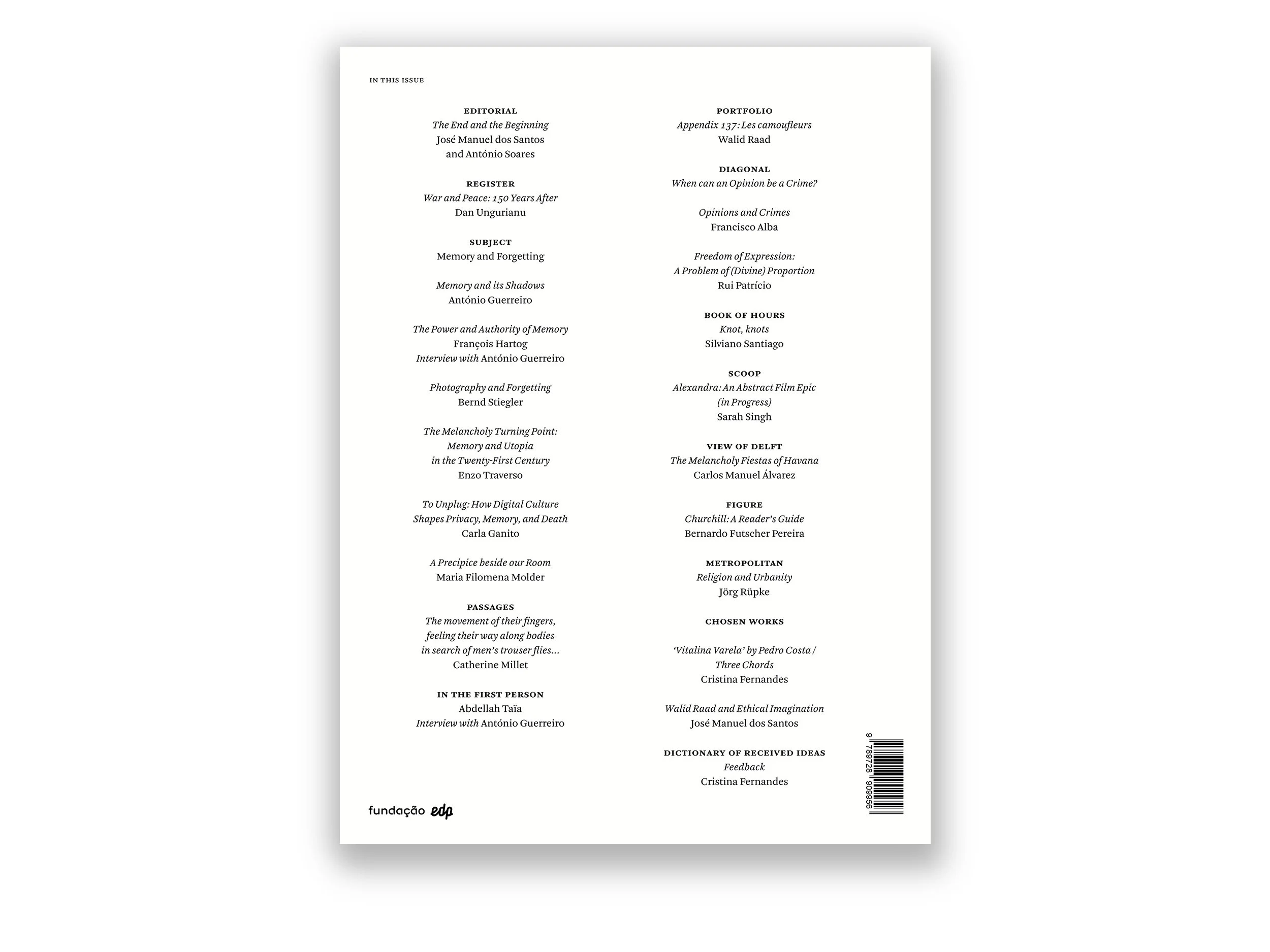
“Today, memory and forgetting have gained the sounds and silences that make up the voice of our time,” one can read in the editorial of Electra’s eighth issue, announcing the theme of this edition’s dossier: Memory and Forgetting.
In this section, there is an interview with historian François Hartog, who undertakes an important reflection on key aspects of historiography and about the different ways to experience time which define each era; Bernd Stiegler, a media theorist and historian, approaches photography as a cultural asset and emphasizes the importance of preserving our photography legacy; historian Enzo Traverso describes a transition that defined the end of the 20th century: the replacement of utopias with the cult of memory; Maria Filomena Molder reflects on the question of the power of memory and mnemotechnic tools. These written pieces are illustrated with images by Gerhard Richter, a reference name in contemporary art, and the cover image is also his work.
This edition presents a portfolio by Lebanese-American artist Walid Raad, whose work is charged with anthropological, philosophical, social, aesthetic and psychological meanings, and in which war is very much present, both in cause and effect; this issue also publishes a diary by the reputed Brazilian writer, essayist and professor, Silviano Santiago, in which moments from his everyday life are interspersed with the tense political and cultural life in Brazil; and Moroccan writer Abdellah Taïa is interviewed by António Guerreiro.
“Scoop” is a new section in Electra whose purpose is to reveal authors’ unpublished, original work. In this edition, Indian photographer, painter and director Sarah Singh presents, in both words and images, her next film.
Also, the founder and editor of Art Press magazine Catherine Millet provocatively comments on a quote by Louis Aragon; the city of Havana is revisited by Cuban writer and journalist Carlos Manuel Álvarez and by the frames of Agnès Varda; and Cristina Fernandes presents her take on Pedro Costa’s latest film, Vitalina Varela.
.
Softcover, 27 x 20 cm, 228 pages
—
..
“Hoje, a memória e o esquecimento ganharam os sons e os silêncios que fazem a voz do nosso tempo.” diz o editorial do número oito da Electra anunciando o tema do dossier desta edição: Memória e Esquecimento.
Nesta secção, é entrevistado o historiador François Hartog, que desenvolve uma importante reflexão sobre questões fundamentais da historiografia e sobre as modalidades da experiência do tempo que definem cada época; Bernd Stiegler, teórico e historiador dos media, aborda a fotografia como um bem cultural e sublinha a importância da preservação do património fotográfico; o historiador Enzo Traverso descreve uma transição que marca o final do século XX: a substituição das utopias pelo culto da memória; Maria Filomena Molder pensa a questão da força da memória e dos instrumentos mnemotécnicos. Estes textos são ilustrados por imagens de Gerhard Richter, uma referência da arte contemporânea, sendo também sua a imagem da capa.
Nesta edição é apresentado um portfolio do artista libanês-americano Walid Raad, autor de uma obra densa de significados antropológicos, filosóficos, sociais, estéticos e psicológicos, na qual a guerra está muito presente, com as suas causas e consequências; é publicado um diário do prestigiado escritor, ensaísta e professor brasileiro Silviano Santiago, onde são registados momentos do seu quotidiano cruzados com a tensa vida política e cultural do Brasil; e o escritor marroquino Abdellah Taïa é entrevistado por António Guerreiro.
“Furo” é uma nova secção da Electra destinada a revelar criações originais inéditas de autores. Nesta edição, a fotógrafa, pintora e realizadora indiana Sarah Singh apresenta, com palavra e imagens, o seu próximo filme.
E ainda, a fundadora e editora da revista Art Press, Catherine Millet comenta provocatoriamente uma citação de Louis Aragon; a cidade de Havana é revisitada pelo escritor e jornalista cubano Carlos Manuel Álvarez e pelos fotogramas de Agnès Varda; e Cristina Fernandes faz uma leitura do último filme de Pedro Costa, Vitalina Varela.
.
Capa mole, 27 x 20 cm, 228 páginas
—
....
“....From the moment when the future is illuminated, we also know that we should hold on to the past, what is important and what is not. History as a discipline in this new regime in the 19th century knew very well what it was necessary to learn from the past, because history is teleological […]..A partir do momento em que é o futuro que ilumina, sabe-se também o que convém reter do passado, o que é e não é importante. A História, a disciplina histórica que se inscreve neste novo regime, no século XXI, sabe muito bem o que é necessário apreender do passado porque a História é teleológica […]....”
“....I don’t believe in the randomness of fate. A tied know is meant to have a purpose. A generally ambiguous one. A purpose kept under lock and key. And in thus being, one must rush backwards. The machinations of fate aren’t last minute. Written down in life’s diary, they await H-Hour. ..Não acredito na espontaneidade do acaso. Nó dado visa a um fim. Em geral, ambíguo. Guarda-o a sete chaves. Se o guarda, há que se correr para trás. As maquinações do acaso não são de última hora. Anotadas na agenda da vida, ficam à espera da hora H. ....”
“....[…] all my life I have had the fantasy of a fluid, fragile desire pervading the urban atmosphere, with a softening effect on the behaviour of people who are usually hurried, harried and repressed. Caressing a hand that holds open a door for you, feeling another hand sliding up your legs as you expose them to the person behind you on the escalator. A pressure or a knowing smile that holds you to nothing when you have to slip out of the metro’s mass of humanity in the rush hour. All this, just in passing, without any fuss. ..Toda a minha vida […] tive a fantasia de que um desejo flutuante, lábil, preenchesse a atmosfera urbana e suavizasse os hábitos dos citadinos apressados, agredidos e prisioneiros. Uma mão que nos segura a porta e que acariciamos, uma outra que sobe ao longo das nossas pernas quando as expomos à pessoa atrás de nós na escada rolante, um descomprometido roçar ou sorriso cúmplice quando se tem de deslizar para fora da massa humana de uma carruagem de metropolitano em hora de ponta. Tudo desta forma, apenas de passagem, sem outras consequências. ....”
-
....
Director / José Manuel dos Santos
Editor / António Guerreiro
Portfolio / Walid Raad
Published by Fundação EDP
Winter 2020Softcover, 27 x 20 cm, 228 pages
ISBN 978 972 8909 956.. Director / José Manuel dos Santos
Editor / António Guerreiro
Portfólio / Walid Raad
Publicado por Fundação EDP
Inverno 2020Capa mole, 27 x 20 cm, 228 páginas
ISBN 978 972 8909 956....
Explore

One of the most consistent and yet fully surprising architects working today, Álvaro Siza, Pritzker Prize shares his List spanning from fundamental editions on Alvar Aalto or Walther Gropius, to lesser-known Italian modernism, Brazil, critical history and philosophy, a striking novel, and poetry, from Portuguese to Greek and Persian masters.
.... You might also like .. Sugestões ....

....
3 Issues + 1 Free (1 Year)
Subscription is valid from the next or current issue only.
Choose your option below.
Electra is an international periodical dedicated to all areas of culture, promoting dialogue between different artistic disciplines, humanistic knowledge and science, cultural theories and practices.
Have Electra at your address!
..
3 Títulos + 1 Grátis (1 Ano)
Envios Gratuitos para Portugal
Assinaturas começam no título seguinte ou corrente.
Escolha a opção que pretende abaixo.
Electra é uma revista internacional de crítica e reflexão cultural, social e política, dedicada às diversas áreas da cultura, promovendo diálogos e oscilações de fronteiras entre disciplinas artísticas, saberes humanísticos e ciência, entre teorias e práticas culturais.
Receba a Electra em sua casa!
....
....
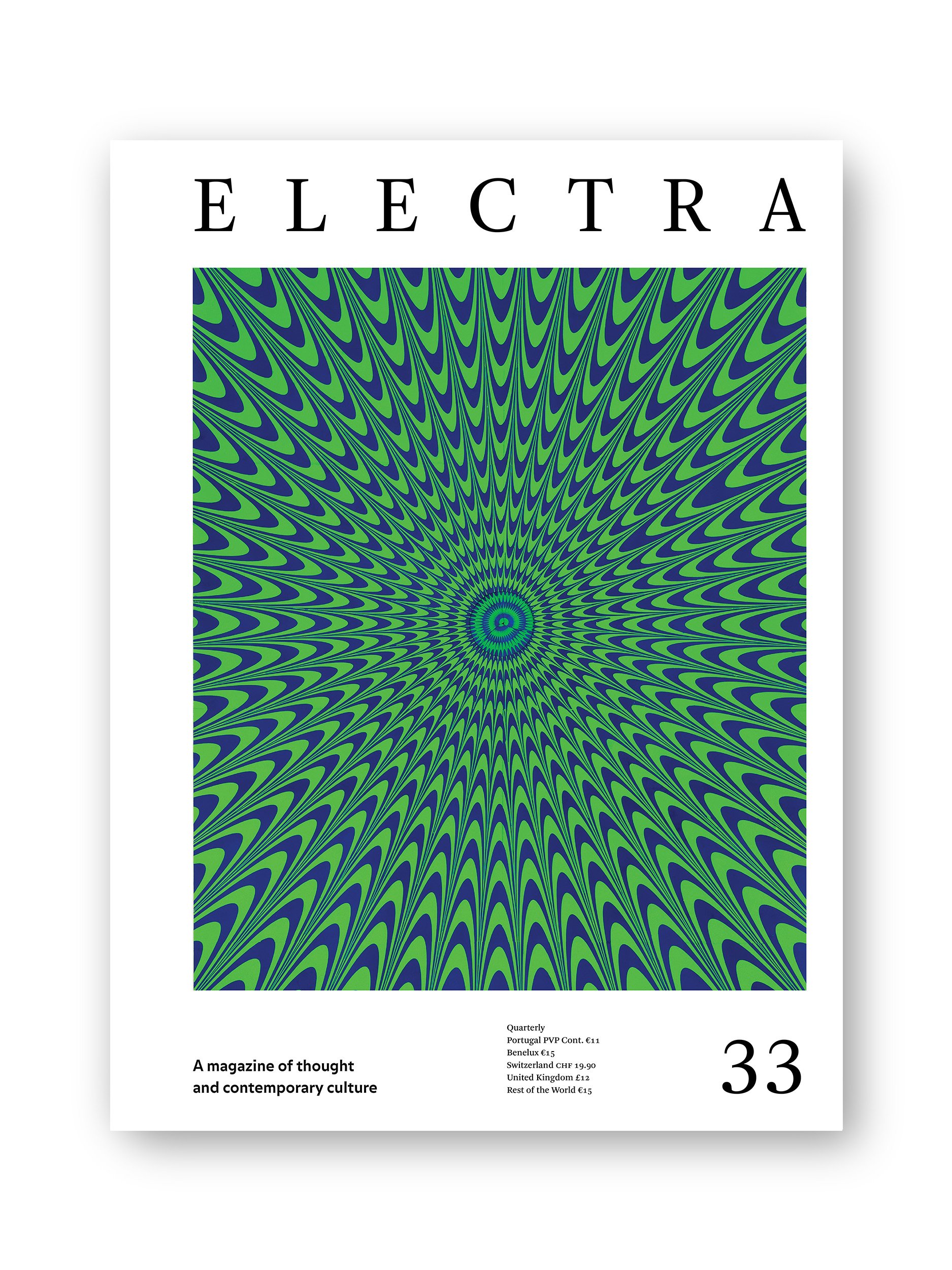
Electra devotes the special feature of issue 33 to the theme of ‘Psyche’, examining the psychologisation of the world and contemporary life. At a time when the language of psychology has permeated politics, society and everyday life, we all seem to be becoming both subjects and objects of analysis. From the sociology of emotions and therapeutic culture to the diagnosis of new authoritarian figures and the digital construction of the subject, the dossier section reveals how this psychologisation is inseparable from global commodification, with profound effects on society, politics, the economy and culture. Drawing on different perspectives and contributions from various authors, including Avital Ronell, Ole Jacob Madsen, Sinziana Ravini, Fabrice Bourlez, Jan de Vos and Pedro Varandas, this dossier analyses and interprets this fundamental symptom of the era in which we live.
Benjamin H. D. Buchloh, one of the most respected art critics of the last half-century and a leading authority on the work of artists such as Gerhard Richter, Marcel Broodthaers and Nancy Spero, speaks to Afonso Dias Ramos about the growing problems arising from a divide between critical practice and artistic production.
This issue’s portfolio section is by Anne-Mie Van Kerckhoven. It presents a representative series of her work, which explores the fundamental and thought-provoking relationship between eroticism and technology from a female perspective. This relationship is inseparable from the broader critical and innovative reflection that this Belgian artist has developed on art, science, politics, society, image and communication.
In the ‘Noah’s Ark’ section, an essay by journalist Andrea Prada Bianchi sheds light on the friendship between fascist dictator Benito Mussolini and anti-fascist resistance fighter Pietro Nenni, leader of the Italian Socialist Party. A narrative of a turbulent and dangerous time, in which life and death were at stake every day, it portrays people and events that shaped the tragic history of the 20th century.
Also in this issue, writer Marie Darrieussecq, a leading figure in the current French fiction scene, publishes a diary interwoven with journeys and places, political unease and family memories, reflecting on the condition of being a writer and a woman; Italian critic Andrea Cortellessa revisits the singular figure of writer, painter, essayist, musician and composer Alberto Savinio, who is often presented as merely Giorgio de Chirico’s brother; writer and essayist Christian Salmon comments on an aphorism by Friedrich Nietzsche; geographer Michel Lussault examines planetary urbanisation and the environmental vulnerability of our habitats; and astrophysicist and journalist Sergio C. Fanjul writes about the word ‘dystopia’.
.
Softcover, 27 x 20 cm, 224 pages
—
..
A Electra dedica o dossier da edição 33 ao tema da “Psique”, interrogando a psicologização do mundo e da vida contemporânea. Num tempo em que a linguagem da psicologia se disseminou pela política, pela sociedade e pelo quotidiano, todos parecemos tornar-nos simultaneamente sujeitos e objectos de análise. Da sociologia das emoções e da cultura terapêutica ao diagnóstico das novas figuras autoritárias e à construção digital do sujeito, revela-se como esta psicologização é inseparável de uma mercantilização global e como produz efeitos profundos na sociedade, na política, na economia e na cultura. A partir de diferentes ângulos e da colaboração de vários autores como Avital Ronell, Ole Jacob Madsen, Sinziana Ravini, Fabrice Bourlez, Jan de Vos e Pedro Varandas, o dossier analisa e interpreta este sintoma fundamental da época em que vivemos.
Benjamin H. D. Buchloh, um dos críticos de arte mais respeitados do último meio século e uma das maiores referências sobre o trabalho de artistas como Gerhard Richter, Marcel Broodthaers ou Nancy Spero, conversa com Afonso Dias Ramos sobre os crescentes problemas que nascem de uma separação entre a prática crítica e a produção artística.
O portfólio deste número é da autoria de Anne-Mie Van Kerckhoven. Nele, apresenta-se uma série representativa da sua obra, na qual está presente a relação fundamental e interpeladora entre erotismo e tecnologia, olhada de um ponto de vista feminino. Tal relação é inseparável da reflexão crítica e inovadora que a artista belga tem desenvolvido sobre arte, ciência, política, sociedade, imagem e comunicação.
Na secção “Arca de Noé”, um ensaio escrito pelo jornalista Andrea Prada Bianchi dá-nos a conhecer a amizade entre o ditador fascista Benito Mussolini e o resistente antifascista Pietro Nenni, líder do Partido Socialista Italiano. Narrativa de um tempo convulsivo e perigoso, em que a vida e a morte se jogavam todos os dias, nela são retratados pessoas e acontecimentos que marcaram a história trágica do século XX.
Ainda nesta edição, a escritora Marie Darrieussecq, nome cimeiro no actual panorama francês da ficção narrativa, publica um diário atravessado por viagens e lugares, pela inquietação política e pela memória familiar, pela condição de escritora e pela condição de mulher; o crítico italiano Andrea Cortellessa revisita a figura do singular escritor, pintor, ensaísta, músico e compositor Alberto Savinio, com frequência apresentado apenas como o irmão de Giorgio de Chirico; o escritor e ensaísta Christian Salmon comenta um aforismo de Friedrich Nietzsche; o geógrafo Michel Lussault trata da urbanização do planeta e da vulnerabilidade e insustentabilidade dos nossos habitats; e o astrofísico e jornalista Sergio C. Fanjul escreve sobre a palavra “Distopia”.
Capa mole, 27 x 20 cm, 224 páginas
—
....
....
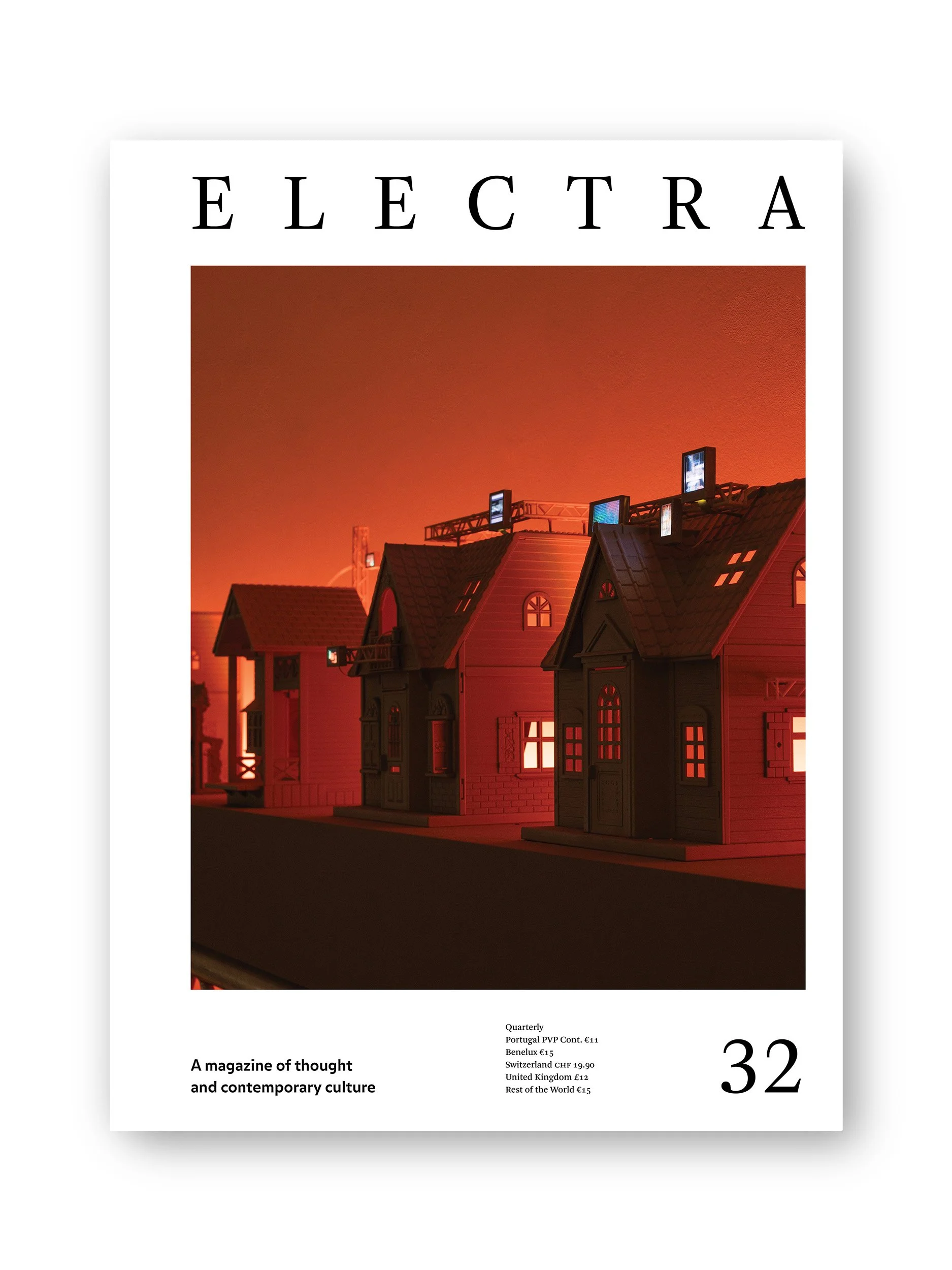
The special feature of Electra issue 32 is ‘Infrastructures’. In a globalised world, this subject has become fundamental for understanding the dynamics that support contemporary societies: from technical progress to the circulation of information and goods, from the logistics that sustain life in major cities to the geopolitical strategies and new technologies that underpin digital platforms. Yet we must not think about infrastructures from a merely technical perspective: we need to examine their increasingly decisive role in systems of political power and economic domination, in regimes of freedom and dependence, in mechanisms of surveillance and control, in apparatuses of administration and oversight. Contributing to this discussion are texts by Yves Citton, Giorgiomaria Cornelio, Anselm Jappe, Brett Neilson, Matteo Pasquinelli and Boris Vormann.
‘In the First Person’ features an interview between Afonso Dias Ramos and renowned German filmmaker, artist and author Hito Steyerl, where she reflects on the complexities of the constant metamorphosis of art, images and technology in the age of Artificial Intelligence.
Anna Maria Maiolino, an acclaimed artist of Italian origin based in Brazil, who received the Golden Lion at the Venice Art Biennale in 2024, is the author of this issue’s Portfolio, where she brings together a selection of her works accompanied by an interview with American curator Helen Molesworth as part of the project The Forgotten Her Story.
With an internationally acclaimed career and a body of work characterised by his striking artistic imagination and technical creativity, Alexandre Estrela was the artist chosen to represent Portugal at the 2026 Venice Art Biennale. For this issue’s ‘Scoop’ section, he and his team have prepared an extension of the RedSkyFalls project to be shown in the Portuguese Pavilion, conceived and graphically structured specifically for the pages of the magazine.
Elizabeth II, Queen of the United Kingdom and Head of the Commonwealth, was born a hundred years ago. Her reign, the longest in British history, lasted more than seventy years, during which the world changed radically; yet she always remained true to herself. Journalist Marc Roche, who met her, has written an article for Electra focusing on the Queen’s careful attention to her public image.
Also in this issue, art director Serge Ricco profiles Bea Feitler, a key figure in the global history of graphic design who left her creative mark on the most important American magazines of her time: Harper’s Bazaar, Ms., Rolling Stone and Vanity Fair; Turkish writer and journalist Kaya Genç takes a stroll through his city, Istanbul, revealing a rich cultural metropolis; Brazilian philosopher Eduardo Wolf offers a critical reflection on the relevance (and irrelevance) of the concept of the ‘Western tradition’ following the publication in the US of The Golden Thread: A History of the Western Tradition, by James Hankins and Allen C. Guelzo; sociologist Vania Baldi examines a quote by Martin Heidegger regarding technology; António Guerreiro writes about the contemporary city as an urban space without limits; and filmmaker and columnist Graça Castanheira reflects on the word ‘immigrant’.
.
Softcover, 27 x 20 cm, 240 pages
—
..
“As infra-estruturas” são o tema do dossier central do número 32 da Electra. Num mundo globalizado, o assunto tornou-se fundamental para compreender as dinâmicas que sustentam o funcionamento das sociedades contemporâneas: do progresso técnico à circulação de informação e mercadorias, da logística que permite a vida nas grandes metrópoles às estratégias geopolíticas e às novas tecnologias que deram origem às plataformas digitais. Mas pensar as infra-estruturas não é apenas uma reflexão técnica: é também procurar entender o seu lugar cada vez mais determinante nos sistemas de poder político e de domínio económico, nos regimes de liberdade e de dependência, nos dispositivos de vigilância e controlo, nos aparelhos de administração e nos mecanismos de fiscalização. Para esta reflexão contribuem os textos de Yves Citton, Giorgiomaria Cornelio, Anselm Jappe, Brett Neilson, Matteo Pasquinelli e Boris Vormann.
Na secção "Primeira Pessoa", é entrevistada a reconhecida cineasta, artista e autora alemã Hito Steyerl que, numa conversa conduzida por Afonso Dias Ramos, nos fala sobre as complexidades da metamorfose constante da arte, das imagens e da tecnologia na era da Inteligência Artificial.
Anna Maria Maiolino, consagrada artista de origem italiana radicada no Brasil, que recebeu, em 2024, o Leão de Ouro da Bienal de Arte de Veneza, é a autora do Portfolio desta edição. Para as páginas da Electra reuniu um conjunto de trabalhos seus, acompanhado de uma entrevista realizada pela curadora norte-americana Helen Molesworth no âmbito do projeto The Forgotten Her Story.
Com uma carreira de notável projecção internacional e uma obra de forte imaginação artística e reconhecida criatividade técnica, Alexandre Estrela representa Portugal na Bienal de Arte de Veneza de 2026. Para a secção Furo desta edição, o artista e a sua equipa prepararam uma extensão-revelação do projeto RedSkyFalls, apresentado no Pavilhão de Portugal, concebida e estruturada graficamente para as páginas da revista.
Isabel II, Rainha do Reino Unido e chefe da Commonwealth, nasceu há cem anos. O seu reinado, o mais longo da história britânica, durou mais de setenta anos, ao longo dos quais o mundo mudou radicalmente; mas ela manteve-se sempre fiel a si mesma. O jornalista Marc Roche, que a conheceu, escreve para a Electra um artigo centrado no cuidado da rainha com a sua imagem.
Ainda nesta edição o director de arte Serge Ricco retrata Bea Feitler, figura fundamental da história mundial do design gráfico e que deixou marca do seu talento criador nas mais importantes revistas americanas do seu tempo, Harper’s Bazaar, Ms., Rolling Stone e Vanity Fair; o escritor e jornalista turco Kaya Genç passeia pela sua cidade, Istambul, e revela uma riquíssima metrópole cultural; o filósofo brasileiro Eduardo Wolf pensa criticamente a pertinência e a impertinência do conceito de «tradição ocidental», a propósito da publicação, nos EUA, da obra The Golden Thread: A History of the Western Tradition, de James Hankins e Allen C. Guelzo; o sociólogo Vania Baldi comenta uma citação de Martin Heidegger sobre a questão da técnica; António Guerreiro escreve sobre a cidade contemporânea como um espaço urbano sem limites; e a realizadora e cronista Graça Castanheira reflecte sobre a palavra “Imigrante”.
Capa mole, 27 x 20 cm, 240 páginas
—
....
....
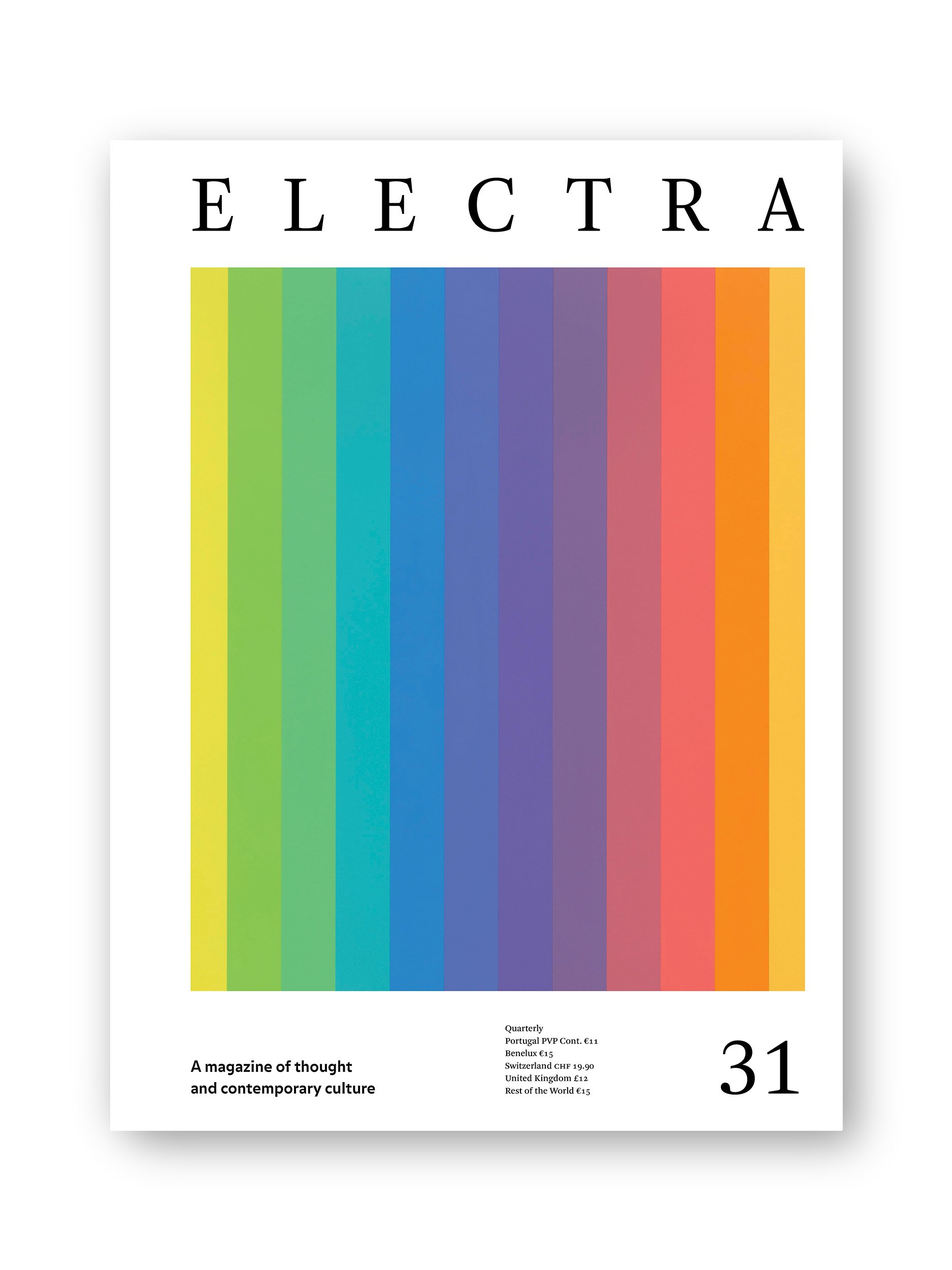
What is colour? What are colours like? How do we see colours? What is the colour of our time? Colour is the central theme of Electra's 31st issue. It imposes itself on our vision with almost irrefutable evidence, yet remains shrouded in mystery. Far from being a property of objects, it is rather a question of perception resulting from light, present in all dimensions of human experience. From art to architecture, from design to politics, colour permeates practices, discourses, and cultures, conveying symbolism and codes that vary across time and space, geography and chronology. Neither science nor empirical knowledge can fully explain it, marked as it is by tensions between chromophilia and chromophobia, exuberance and sobriety. This ‘Subject’, enriched by perspectives from different disciplinary fields, brings together contributions from Michel Pastoureau, Elena Manferdini, Andrea Cavalletti, Anne Lafont, Ricardo Vieira Lisboa, David Scott Kastan, and António Guerreiro.
The renowned curator, art historian, and feminist Tamar Garb is interviewed by Afonso Dias Ramos for the ‘In the First Person’ section. In this conversation, held in Lisbon, she reflects on the multiple geographies that have shaped her life and work, from Cape Town to Paris and London, and on the challenge of different ways of looking at culture across Africa and Europe in times of great tension and political instability.
This issue of Electra also features as yet unpublished works by the great writer, poet, and visual artist Henri Michaux. A leading figure in 20th-century European intellectual scene, he was the author of works of inexhaustible originality, combining surprisingly different types of knowledge and wisdom, genres and disciplines. The important drawings featured in this edition, which are part of his Archive, are presented in a text by curator Tim Geissler.
In the ‘Portfolio’ section, we leaf through the pages of Electra and, at the same time, through the pages of a book intervened and recreated by the imagination and wisdom of Sonia Gomes, one of Brazil's most internationally renowned artists. This work is presented by curators João Mourão and Luís Silva.
On the hundredth anniversary of the birth of Marilyn Monroe, a universal and enduring icon, the renowned Italian philosopher Mario Pezzella, a specialist in film aesthetics, writes an essay of great interpretative depth on what Marilyn was, with her innocent and guilty beauty, and what the world made her. He recounts how Monroe lived her tormented life as a woman, between fame and emptiness, and her dazzling career as an actress.
This issue also features an interview with architect Neil Leach, conducted by Lucinda Correia, in which they discuss architecture in the age of artificial intelligence and reflect on the future of cities; Turkish novelist and journalist Kaya Genç writes about the fascinating figure of German philologist Erich Auerbach and his masterpiece, Mimesis: The Representation of Reality in Western Literature, written in Istanbul; renowned Portuguese artist Jorge Martins comments on a famous quote by Pablo Picasso; writer, multimedia artist, and curator Jeremy Fernando writes, in a very personal tone, about his hometown, Singapore; and professor Damiano Palano offers a reflection on the word ‘Polarisation’.
.
Softcover, 27 x 20 cm, 241 pages
—
..
O que é a cor? Como são as cores? Como vemos as cores? Qual é a cor do nosso tempo? A cor é o tema do dossier do número 31 da Electra. Ela impõe-se à nossa visão com uma evidência quase irrefutável e, ainda assim, permanece envolta em enigmas. Longe de ser uma propriedade dos objectos, é antes uma perceção resultante da luz, presente em todas as dimensões da experiência humana. Da arte à arquitectura, do design à política, a cor atravessa práticas, discursos e culturas, transportando simbolismos e códigos que variam no tempo e no espaço, na geografia e na cronologia. Nem a ciência nem o saber empírico esgotam a sua compreensão, marcada por tensões entre cromofilia e cromofobia, exuberância e sobriedade. Este “Assunto”, enriquecido por perspectivas de diferentes campos disciplinares, reúne os contributos de Michel Pastoureau, Elena Manferdini, Andrea Cavalletti, Anne Lafont, Ricardo Vieira Lisboa, David Scott Kastan e António Guerreiro.
Tamar Garb, a reconhecida curadora e historiadora de arte, e feminista, é entrevistada por Afonso Dias Ramos para a secção “Primeira Pessoa”. Nesta conversa, realizada em Lisboa, ela reflecte sobre as múltiplas geografias que traçaram a sua vida e trabalho, da Cidade do Cabo até Paris e Londres, e o desafio de encarar a cultura em África e na Europa de outras formas, em tempos de grande tensão e instabilidade política.
Este número da Electra revela também obras inéditas do grande escritor, poeta e artista visual Henri Michaux. Figura capital da vida intelectual europeia do século XX, autor de uma obra de inesgotável originalidade, que liga, surpreendentemente, saberes e sabedorias, géneros e disciplinas diferentes. Os importantes desenhos dados a conhecer nesta edição, e que integram o seu Arquivo, são apresentados por um texto do curador Tim Geissler.
Na secção “Portfolio”, folheamos as páginas da Electra e folheamos, ao mesmo tempo, as páginas de um livro intervencionado e recriado pela imaginação e a sabedoria de Sonia Gomes, uma das artistas brasileiras com maior projecção internacional. Este trabalho é apresentado pelos curadores João Mourão e Luís Silva.
Nos cem anos do nascimento de Marilyn Monroe, ícone universal perpétuo, o conceituado filósofo italiano Mario Pezzella, especialista de estética do cinema, escreve um ensaio de grande profundidade interpretativa sobre o que Marilyn, com a sua inocente beleza culpada, era e no que o mundo a tornou. E diz-nos como ela, entre a fama e o vazio, viveu a sua atormentada vida de mulher e a sua fulgurante carreira de actriz.
Ainda nesta edição é publicada uma entrevista ao arquitecto Neil Leach, conduzida por Lucinda Correia, onde se fala de arquitectura na era da inteligência artificial e se reflecte sobre o futuro das cidades; o romancista e jornalista turco Kaya Genç assina um texto sobre a fascinante figura do filólogo alemão Erich Auerbach e a sua obra-prima, Mimesis: A Representação da Realidade na Literatura Ocidental, escrita em Istanbul; o consagrado artista português Jorge Martins comenta uma famosa frase de Pablo Picasso; o escritor, artista multimédia e curador Jeremy Fernando escreve, num registo muito pessoal, sobre a sua cidade natal, Singapura; e o professor catedrático Damiano Palano propõe uma reflexão sobre a palavra “Polarização”.
Capa mole, 27 x 20 cm, 241 páginas
—
....

....
Who among us doesn't feel afraid today? And where do these fears lie? ‘Fear’ is the theme of the central dossier of Electra 30. An omnipresent subject in today's political and cultural discourse, it is analysed here in terms of the intentions behind it, its functions, and its effects. Renowned authors have studied the multiple dimensions of this topic, which today occupies a fundamental place in everyday life. Its power stems not only from objective and uncontrollable causes — be they war, environmental crisis, or economic instability — but also from its deliberate use as an instrument in government practices. Over the history of Western thought, fear has been a structuring element of various philosophical anthropologies. It is also one of the raw materials of history, characterising eras, shaping regimes, and fuelling collective dynamics over the centuries. This dossier brings together texts and interviews that seek to reflect on the specific fears of our time, born of current historical, social, political, and cultural conditions, with contributions from authors such as Frank Furedi, Miguel Benasayag, Frédéric Neyrat, Pedro Levi Bismarck, Jonathan Rosenbaum, and António Guerreiro.
Two interviews feature in the ‘In the First Person’ section: one with French writer Pascal Quignard, author of an immense literary work that spans several genres, dialogues with other arts, and is marked by his cultural and historical incursions, with an emphasis on Roman Antiquity; another with American academic W. J. T. Mitchell, one of the leading figures in the field of visual studies, who talks to us about the new challenges posed by digital machines and artificial intelligence, and about the difficulties of envisaging the very survival of the human species in the current political climate.
Acclaimed American artist Julia Wachtel is the author of this edition's portfolio, representative of a work of great visual seduction underpinned by a critical thinking that questions images and their incessant proliferation. This work is accompanied by a text by poet and essayist Arthur Solway.
Tilmann Lahme, a renowned expert on the Mann family and its notable members, writes an interpretative essay for Electra that reveals the figure of the great writer Thomas Mann, who became a symbol of a time and a world, of its conflicts and tragedies.
In the section ‘Noah's Ark,’ writer and curator Thomas Dylan Eaton tells us about filmmaker Kenneth Anger's relationship with biologist Alfred C. Kinsey and the research institute he founded, which revolutionised our understanding of human sexuality.
Also in this edition, researcher Anne Clerval reflects on the gentrification of cities, examining the case of Paris; historian Yannick Ripa recalls the 50th anniversary of the UN's creation of International Women's Day and the passing of the Veil Law in France, which decriminalised voluntary termination of pregnancy; curator Frederico Duarte visits Chemnitz, named European Capital of Culture 2025, also travelling through the cities that over the years have been successively chosen to embody this ambitious initiative; and journalist José Vítor Malheiros writes about the word ‘Stability.’
.
Softcover, 27 x 20 cm, 216 pages
—
..
Hoje, quem não tem medo? E quais são os nossos medos? “O medo” é o tema do dossier central da Electra 30. Assunto omnipresente no discurso político e cultural da actualidade, é aqui analisado nas suas intenções, funções e efeitos. Conceituados autores têm estudado as múltiplas dimensões deste tópico, que ocupa hoje um lugar fundamental na vida quotidiana. O seu poder não decorre apenas de causas objectivas e incontroláveis — como a guerra, a crise ecológica ou a instabilidade económica —, mas também do seu uso deliberado como instrumento nas práticas de governo. Na história do pensamento ocidental, o medo tem sido um elemento estruturante de várias antropologias filosóficas. É, também, uma das matérias-primas da História: ao longo dos séculos, caracterizou épocas, deu forma a regimes e alimentou dinâmicas colectivas. Neste dossier, reúnem-se textos e entrevistas que procuram pensar os medos específicos do nosso tempo, nascidos das actuais condições históricas, sociais, políticas e culturais, com contributos de autores como Frank Furedi, Miguel Benasayag, Frédéric Neyrat, Pedro Levi Bismarck, Jonathan Rosenbaum e António Guerreiro.
Na secção “Primeira Pessoa”, são publicadas duas entrevistas: uma com o escritor francês Pascal Quignard, autor de uma imensa obra literária que atravessa vários géneros, que dialoga com outras artes e é marcada pelas suas incursões culturais e históricas, com destaque para a Antiguidade Romana; outra com o académico norte-americano W. J. T. Mitchell, uma das referências maiores no campo dos estudos visuais, que nos fala dos novos desafios colocados pelas máquinas digitais e a inteligência artificial, e sobre as dificuldades de entrever a própria sobrevivência da espécie humana no actual clima político.
Julia Wachtel, consagrada artista norte-americana, é autora do portfolio desta edição, representativo de uma obra de grande sedução visual em que está presente um pensamento crítico que interroga as imagens e a sua incessante proliferação. Este trabalho é acompanhado por um texto do poeta e ensaísta Arthur Solway.
Tilmann Lahme, reconhecido especialista da família Mann e dos seus notáveis membros, escreve para a Electra um ensaio interpretativo que nos revela a figura do grande escritor Thomas Mann, que se tornou símbolo de um tempo e de um mundo, dos seus conflitos e tragédias.
Na secção “Arca de Noé”, o escritor e curador Thomas Dylan Eaton conta-nos a relação do cineasta Kenneth Anger com o biólogo Alfred C. Kinsey e com o instituto de investigação por ele fundado, que revolucionou o entendimento sobre a sexualidade humana.
Ainda nesta edição a investigadora Anne Clerval reflecte sobre a gentrificação das cidades, partindo do caso de Paris; a historiadora Yannick Ripa evoca o cinquentenário da criação pela ONU do Dia Internacional da Mulher e da aprovação, em França, da Lei Veil, que despenalizou a interrupção voluntária da gravidez; o curador Frederico Duarte visita Chemnitz, nomeada Capital Europeia da Cultura 2025, viajando também pelas cidades que ao longo dos anos foram sucessivamente escolhidas para darem corpo a esta ambiciosa iniciativa; e o jornalista José Vítor Malheiros escreve sobre a palavra “Estabilidade”.
Capa mole, 27 x 20 cm, 216 páginas
—
....
....
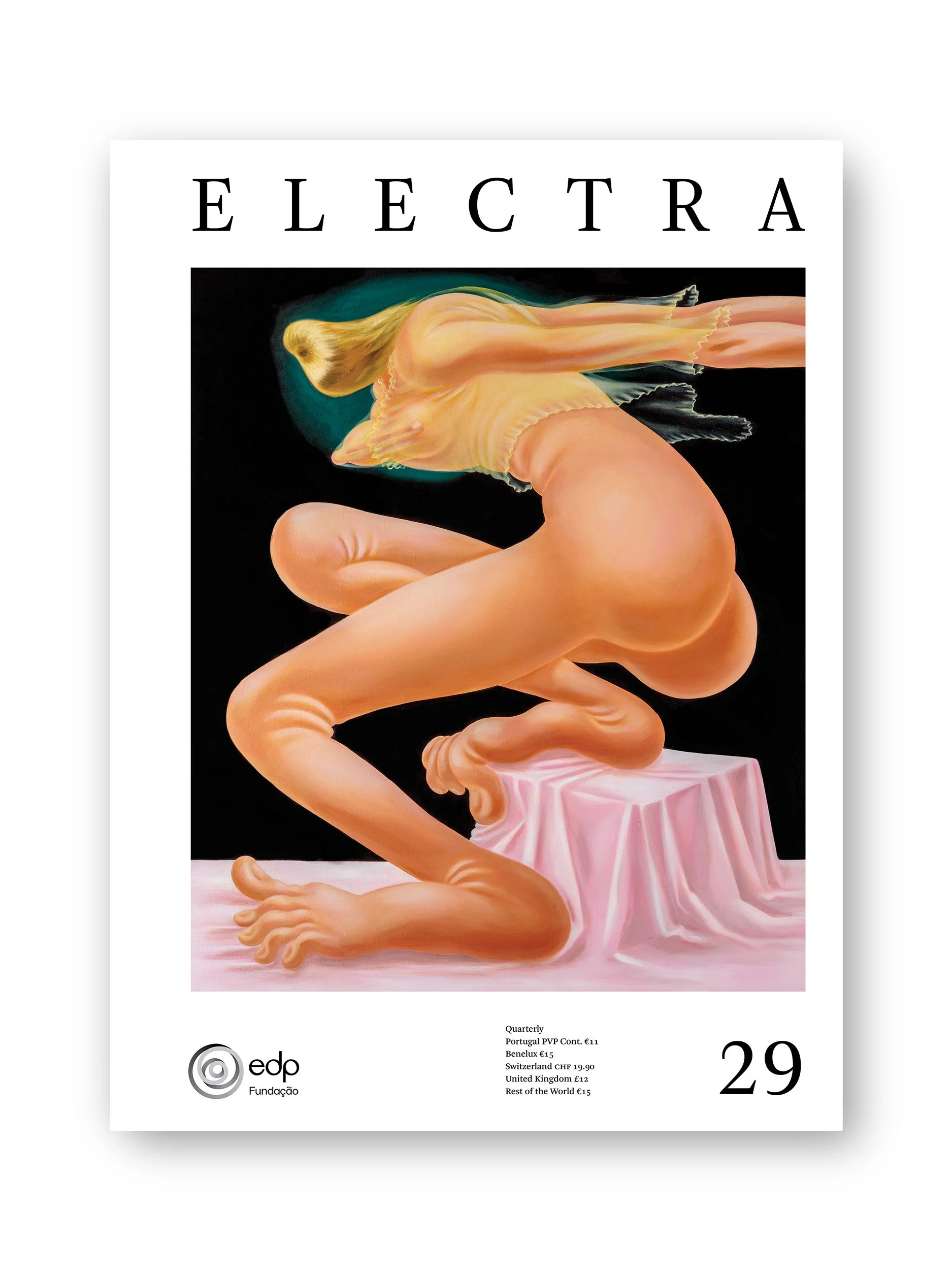
‘The Body’ — in the past, present and future — is the main theme of Electra 29. This issue looks at the body and the place it occupies in time and in a changing world: changes in our relationship with our own bodies and with the bodies of others, in the relationship between body and gender or sex, between the individual and the social body, and also between biological body and cultural body, or between physical body and ageing body. We live in a time when the cultural, social and aesthetic codes that underpin discourses on the body are closely related to the technologies that produce it as a marker of identities and subjectivities. From scientific breakthroughs to technotopias, from cyborgs to queer bodies, mutants and monsters, the condition of transhumanism is a characteristic of our time. These topics are tackled by prestigious authors such as Pascal Quignard, Paul B. Preciado, Camille Froidevaux-Metterie, Arianna Sforzini, Isabelle Queval, José Maria Vieira Mendes, and António Guerreiro, in texts accompanied by pictures by Louise Bonnet and Willem de Kooning.
This issue’s Portfolio is by German artist Imi Knoebel, one of the most important names of post-war art, whose works are represented in the world's most prestigious art collections. The works included here are being shown for the first time, as an exclusive for Electra, and introduced in an essay by Gabriel Barbi.
Also featured exclusively in this issue is the conversation between photographer Jeff Wall and film-maker Pedro Costa, which took place in Lisbon at the opening of MAAT's exhibition Jeff Wall – Time Stands Still. Brought together by mutual admiration and profound reflection on their artistic practices, in this exceptional encounter Wall and Costa explore the affinities and tensions between cinema, photography and painting, bringing to this discussion a unique combination of intellectual rigour and artistic sensitivity.
This summer issue of Electra magazine also features a collection of articles marking the World Expo 2025 in Osaka, and Portugal's participation in it. Photographer Daniel Blaufuks presents a recent campaign in Japan, with images captured in Osaka, Kyoto, Kobe Koyasan, Hiroshima and Himeji. The Portuguese photographer matches the images with haikus by the great Japanese poet Matsuo Bashō. On the centenary of the birth of Yukio Mishima, Thomas Garcin, professor of Japanese Studies at the University of Paris, brings us a portrait that contradicts the clichés surrounding this author. Finally, a set of previously unpublished pictures by female photographer Sakiko Nomura, one of the most prestigious names in Japanese contemporary photography, accompanied by an essay by professor and essayist José Bértolo.
Also in this issue, Afonso Dias Ramos interviews T. J. Clark, one of the most renowned art historians of the last fifty years; researcher and curator Anabela Becho draws a portrait of Mariano Fortuny – painter, sculptor, set and costume designer, theatre director, collector and inventor – in a text that traces his life and work, against a backdrop of images of his palace in Venice; psychoanalyst, novelist and curator Sinziana Ravini deciphers an obscure quote by Jacques Lacan; and Bobby Duffy, Professor of Public Policy at King´s College London, comments on the word ‘Perception,’ examining our common misperceptions of fundamental social and political realities.
.
Softcover, 27 x 20 cm, 227 pages
—
..
“O corpo” — no passado, no presente e no futuro — é o assunto central da Electra 29. Trata-se neste dossier do corpo e da sua inscrição no tempo e num mundo em mudança. Mudanças na relação de cada um de nós com o próprio corpo, na relação do nosso corpo com o corpo dos outros, na relação do corpo com o género e com o sexo, na relação do corpo individual com o corpo social, na relação do corpo biológico com o corpo cultural, na relação do corpo físico com o corpo etário. Vivemos num tempo em que os códigos culturais, sociais e estéticos que estão na base dos discursos sobre o corpo têm uma ligação estreita com as tecnologias que o produzem como marcador de identidades e subjectividades. Dos avanços científicos às tecnotopias, dos cyborgs aos corpos queer, passando pelos mutantes e os monstros, a condição do transumanismo configura-se como uma das características distintivas da nossa época. Sobre estes temas são publicados textos de nomes tão prestigiados como Pascal Quignard, Paul B. Preciado, Camille Froidevaux-Metterie, Arianna Sforzini, Isabelle Queval, José Maria Vieira Mendes e António Guerreiro, acompanhados de imagens de Louise Bonnet e Willem de Kooning.
O “Portfolio” desta edição é da autoria do artista alemão Imi Knoebel, um dos mais importantes do período do pós-guerra e representado nas mais prestigiadas colecções de arte do mundo. O trabalho aqui publicado é inédito, preparado em exclusivo para a Electra, e é apresentado num ensaio de Gabriel Barbi.
Com destaque e também em exclusivo, é publicada uma conversa entre o fotógrafo Jeff Wall e o cineasta Pedro Costa, que teve lugar em Lisboa, por ocasião da inauguração da exposição Jeff Wall – Time Stands Still, no MAAT. Unidos por uma admiração mútua e por um pensamento profundo sobre as suas práticas artísticas, Wall e Costa exploram, neste raro encontro, as afinidades e tensões entre cinema, fotografia e pintura, trazendo para esta discussão uma singular combinação de rigor intelectual e sensibilidade artística.
Neste número de Verão da Electra é reunido um conjunto de artigos que assinalam a Exposição Universal de Osaka e a presença portuguesa nela. Do fotógrafo Daniel Blaufuks é publicada uma campanha realizada recentemente no Japão, com imagens captadas em Osaka, Kyoto, Kobe Koyasan, Hiroshima e Himeji. Às imagens, o fotógrafo juntou as palavras dos haikus do grande poeta Matsuo Bashō. No centenário do nascimento do escritor Yukio Mishima, Thomas Garcin, professor de Estudos Japoneses na Universidade de Paris, desenha-nos um retrato que contraria os lugares-comuns que se acumularam sobre este autor. Por último, é apresentado um conjunto de imagens inéditas da fotógrafa Sakiko Nomura, um dos nomes mais prestigiados da fotografia japonesa contemporânea, acompanhado por um ensaio do professor e ensaísta José Bértolo.
Ainda nesta edição, é entrevistado, por Afonso Dias Ramos, T. J. Clark, um dos historiadores da arte mais importantes dos últimos cinquenta anos; a investigadora e curadora Anabela Becho traça um retrato de Mariano Fortuny - pintor, escultor, cenógrafo, figurinista, encenador, coleccionador, e inventor - num texto que percorre a vida e obra, tendo como cenário as imagens do seu palácio em Veneza; a psicanalista, romancista e curadora Sinziana Ravini decifra uma obscura citação de Jacques Lacan; e Bobby Duffy, Professor de Políticas Públicas no King´s College de Londres comenta a palavra “Percepção”, examinando as percepções erradas que fazemos de realidades sociais e políticas fundamentais.
Capa mole, 27 x 20 cm, 227 páginas
—
....
....
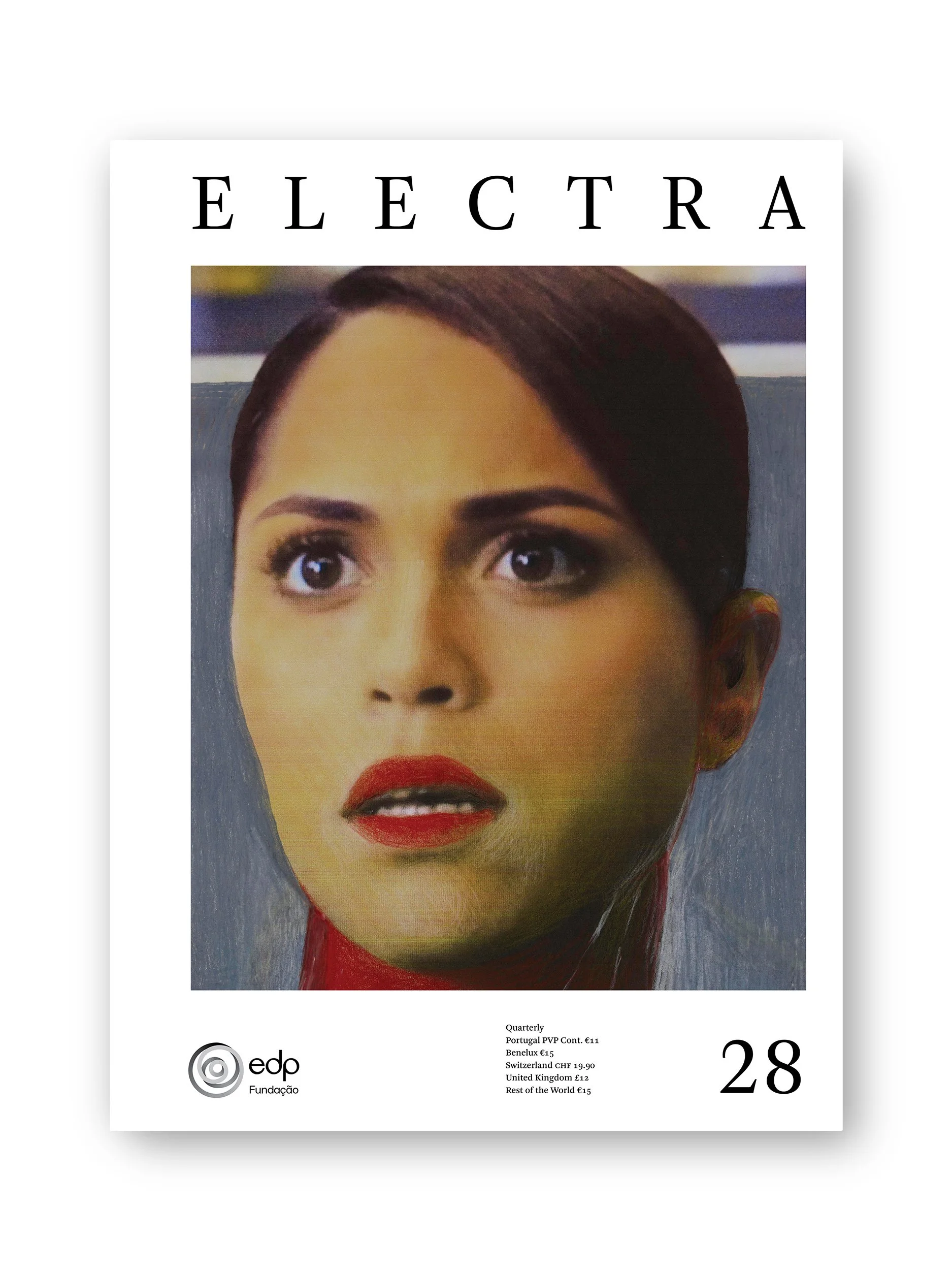
‘The Book,’ ground for culture and civilisation, is the central theme of Electra 28. An extension of memory and imagination, child of obscurity and silence, product of labour and fun, a place of continuity and rupture, motive for bonfires and reason for censure and persecution, an object that spans centuries of history, shaping societies and ways of thinking, but also an entity that goes beyond physical supports and embodies memory, knowledge and the individual and collective imagination, the book has carried the substance of time and the vertigo of life with it over the centuries. This is a subject that, more than ever, requires a deep understanding of its many dimensions: material, cultural, historical, political and symbolic. This dossier brings together texts and interviews from various experts, such as Roger Chartier, Robert Darnton, Rita Luís, John B. Thompson, Adam Garfinkle and Diogo Ramada Curto, who analyse the history of the book and its dissemination, from the invention of the printing press to the digital book, including the transformations in the world of publishing, the impacts of censorship, literacy and ways of reading.
Miriam Cahn, regarded as one of today’s most active and influential artists, is the author of this edition's portfolio. With exhibitions in the most prestigious contemporary art venues, Cahn has created a vast body of work (painting, drawing, photography, sculpture, installation) giving form to the great issues and causes of our time (feminism, ecology, pacifism, war, vulnerable populations) with an intensity and force that often takes on a stance of combat and protest. This portfolio, prepared by the Swiss artist for Electra, is as overview of her works on paper over the last thirty years.
The name Emir Kusturica arouses both admiration and controversy, as one of the most awarded and controversial film directors of the 1990s. True to himself, Kusturica spoke to Electra in a rare interview, conducted by Italian journalist Andrea Prada Bianchi, in which he comments on his work and his vision of the world today, in a provocative and challenging tone that many find difficult to accept. The conversation was held in Serbia during the Küstendorf Film Festival, taking place during a car journey, narrated as a chapter in a novel.
Also in this issue, renowned writer Brenda Lozano evokes the place where she was born, Mexico City; essayist and novelist Christian Salmon reflects on the political matrix of an emerging neofascism; filmmaker Francisco Noronha revisits Jean-Luc Godard’s biographical and artistic career; professor and poet Giancarlo Consonni addresses the disappearance of the historic city, the regression of urbanity and the degradation of urban beauty; António Guerreiro interprets a quote by the writer Stéphane Mallarmé; the poet José António Almeida comments on the ‘Declaration Fiducia supplicans: On the Pastoral Meaning of Blessings’ approved by Pope Francis; and Diogo Vaz Pinto writes about podcasts.
.
Softcover, 27 x 20 cm, 210 pages
—
..
Fundamento de cultura e de civilização, “O livro” é o tema central da Electra 28. Extensão da memória e da imaginação, filho da obscuridade e do silêncio, produto do trabalho e do divertimento, lugar de continuidade e de ruptura, móbil de fogueiras acesas e motivo de censuras e perseguições, objecto que atravessa séculos de história, moldando sociedades e modos de pensar, mas também uma entidade que ultrapassa suportes físicos e encarna a memória, o saber e o imaginário individual e colectivo, o livro tem transportado consigo, ao longo dos séculos, a substância do tempo e a vertigem da vida. Este é um tema que, mais do que nunca, exige uma compreensão profunda das suas múltiplas dimensões: materiais, culturais, históricas, políticas e simbólicas. Neste dossier são reunidos textos e entrevistas de diversos especialistas, como Roger Chartier, Robert Darnton, Rita Luís, John B. Thompson, Adam Garfinkle e Diogo Ramada Curto, que analisam a história do livro e da sua difusão, desde a invenção da imprensa até ao livro digital, incluindo as transformações do mundo da edição, os impactos da censura, a literacia e os modos de ler.
Miriam Cahn, considerada uma das artistas mais activas e influentes da actualidade, é a autora do portfólio desta edição. Com exposições nos mais prestigiados lugares da arte contemporânea, Cahn é a criadora de uma vasta obra (pintura, desenho, fotografia, escultura, instalação), na qual as grandes questões e causas do nosso tempo (feminismo, ecologia, pacifismo, guerra, populações vulneráveis) ganham forma e figura com uma intensidade e força que, não raro, assumem a postura do combate e do protesto. Este portfólio, preparado pela artista suíça para a Electra, é representativo dos seus trabalhos sobre papel dos últimos trinta anos.
O nome de Emir Kusturica desperta tanto admiração como polémica. Foi um dos realizadores de cinema mais premiados e controversos dos anos 90. Fiel a si mesmo, Kusturica falou para a Electra numa entrevista rara, conduzida pelo jornalista italiano Andrea Prada Bianchi, em que comenta a sua obra e a sua visão do mundo actual, num tom provocador e desafiante que muitos consideram difícil de aceitar. A conversa aconteceu na Sérvia, durante o festival de cinema de Küstendorf, e decorreu numa viagem de carro, contada como se fosse um capítulo de um romance.
Ainda nesta edição, a reconhecida escritora Brenda Lozano faz uma evocação do lugar onde nasceu, a Cidade do México; o ensaísta e romancista Christian Salmon reflecte sobre a matriz política de um neofascismo emergente; o realizador Francisco Noronha revisita o percurso biográfico e artístico de Jean-Luc Godard; o professor e poeta Giancarlo Consonni aborda o tema do desaparecimento da cidade histórica, da regressão da urbanidade e da degradação da beleza urbana; António Guerreiro interpreta uma citação do escritor Stéphane Mallarmé; o poeta José António Almeida comenta a «Declaração Fiducia supplicans sobre o sentido pastoral das bênçãos», aprovada pelo Papa Francisco; e Diogo Vaz Pinto escreve sobre podcasts.
Capa mole, 27 x 20 cm, 210 páginas
—
....

....
Of narcissism, as Flaubert said of stupidity, it can aso be said that it is found in all ages, but each age has its own narcissism. That of our time appears to be an omnipresent germ in all aspects of individual and collective life, active in the multiple political, cultural, economic, social, technological and communication systems, giving rise, directly or indirectly, closely or remotely, to the greatest perversions, excesses and arbitrariness, and jeopardising primordial ethical codes and the founding rules of coexistence. The subject of the Electra27 central dossier is exactly ‘Narcissism,’ one of the traits that shape our time, presenting essays and interviews by prominent authors such as Élisabeth Roudinesco, Sinziana Ravini, Miguel Benasayag, Dominique Rabaté, António Bracinha Vieira and Vincent Cocquebert.
In this issue, anthropologist Giulia Bogliolo Bruna writes about Jean Malaurie, a sage whose life was like a novel: scientific explorer of the polar regions and defender of the rights of Arctic minorities, particularly of the indigenous peoples in Greenland, ethnohistorian, geographer and writer, Malaurie was also director of the École des Hautes Études en Sciences Sociales and founder of the prestigious ‘Terre Humaine’ collection.
Yuri Slezkine, professor at the Universities of Berkeley and Oxford and considered one of the world's leading experts on Russian history, summons a beautiful and original memory of Moscow, combining his personal story with the history of the city, visiting different periods, political and cultural figures, memorable events and places of worship.
This issue’s ‘In the First Person’ section features acclaimed British author and essayist Geoff Dyer, who speaks to Electra about books, photographs and the idea of the end, exploring a variety of themes in contemporary culture, ranging from the creative process of writing to the attention to the world that images evoke.
Also in this issue we find recent works by artist Francisca Carvalho; poet, playwright and filmmaker Regina Guimarães comments on a statement by Jean Genet about art and politics; architect Gilles Delalex, founder of Studio Muoto, questions whether anarchist reasoning can generate an architecture; writer and curator Thomas Dylan Eaton tells the story of the famous Hanuman book collection, from India to New York and San Francisco in the late 20th century; Afonso Dias Ramos comments on and connects two of the most eagerly awaited publications of recent years, the catalogue of photographic materials that belonged to W.G. Sebald, and the letters that John Berger exchanged with his son at the end of his life; and journalist Bárbara Reis writes about the word ‘Bubble.’
.
Softcover, 27 x 20 cm, 194 pages
—
..
Do narcisismo, como Flaubert disse da estupidez, pode também afirmar-se que é de todos os tempos, mas que cada tempo tem o seu narcisismo. O do nosso tem mostrado ser um germe omnipresente em todos os aspectos da vida individual e colectiva, activo nos vários sistemas políticos, culturais, económicos, sociais, tecnológicos e comunicacionais, originando, de modo directo ou indirecto, próximo ou remoto, as maiores perversões, excessos e arbitrariedades, que põem em causa os códigos éticos primordiais e as regras fundadoras da convivência. É sobre “O narcisismo”, um dos traços que desenham o perfil do nosso tempo, que trata o dossier central da Electra 27, com ensaios e entrevistas de figuras tão relevantes como Élisabeth Roudinesco, Sinziana Ravini, Miguel Benasayag, Dominique Rabaté, António Bracinha Vieira e Vincent Cocquebert.
Neste número, a antropóloga Giulia Bogliolo Bruna, escreve sobre Jean Malaurie, um sábio cuja vida foi um romance: explorador científico das regiões polares e defensor dos direitos das minorias árticas, nomeadamente da Gronelândia, etno-historiador, geógrafo e escritor, Malaurie foi também director na École des Hautes Études en Sciences Sociales e fundador da prestigiada colecção “Terre Humaine”.
Yuri Slezkine, professor na Universidade de Berkeley e de Oxford, considerado um dos grandes especialistas mundiais de História da Rússia, faz nesta edição uma bela e original evocação de Moscovo, cruzando a história pessoal com a história da cidade, e onde passam épocas distintas, figuras da política, vultos da cultura, acontecimentos memoráveis, lugares de culto.
Na secção “Primeira Pessoa”, o aclamado escritor e ensaísta britânico Geoff Dyer fala com a Electra sobre livros, fotografias e a ideia de fim, explorando uma diversidade de temas da cultura contemporânea que vão desde o processo criativo de escrever um texto à atenção ao mundo que as imagens despertam.
Ainda nesta edição, são reveladas obras muito recentes da artista Francisca Carvalho; a poeta, dramaturga e cineasta Regina Guimarães comenta uma afirmação de Jean Genet sobre arte e política; o arquitecto Gilles Delalex, fundador do Studio Muoto, questiona se o pensamento anarquista pode gerar uma arquitectura; o escritor e curador Thomas Dylan Eaton faz a história da famosa colecção de livros Hanuman, desde a Índia até à Nova Iorque e São Francisco do final do século XX; Afonso Dias Ramos comenta e relaciona duas das mais aguardadas publicações dos últimos anos, o catálogo dos materiais fotográficos que pertenciam a W. G. Sebald, e as cartas originais que John Berger trocou com o filho na fase final da sua vida; e a jornalista Bárbara Reis escreve sobre a palavra “Bolha”.
Capa mole, 27 x 20 cm, 194 páginas
—
....
....
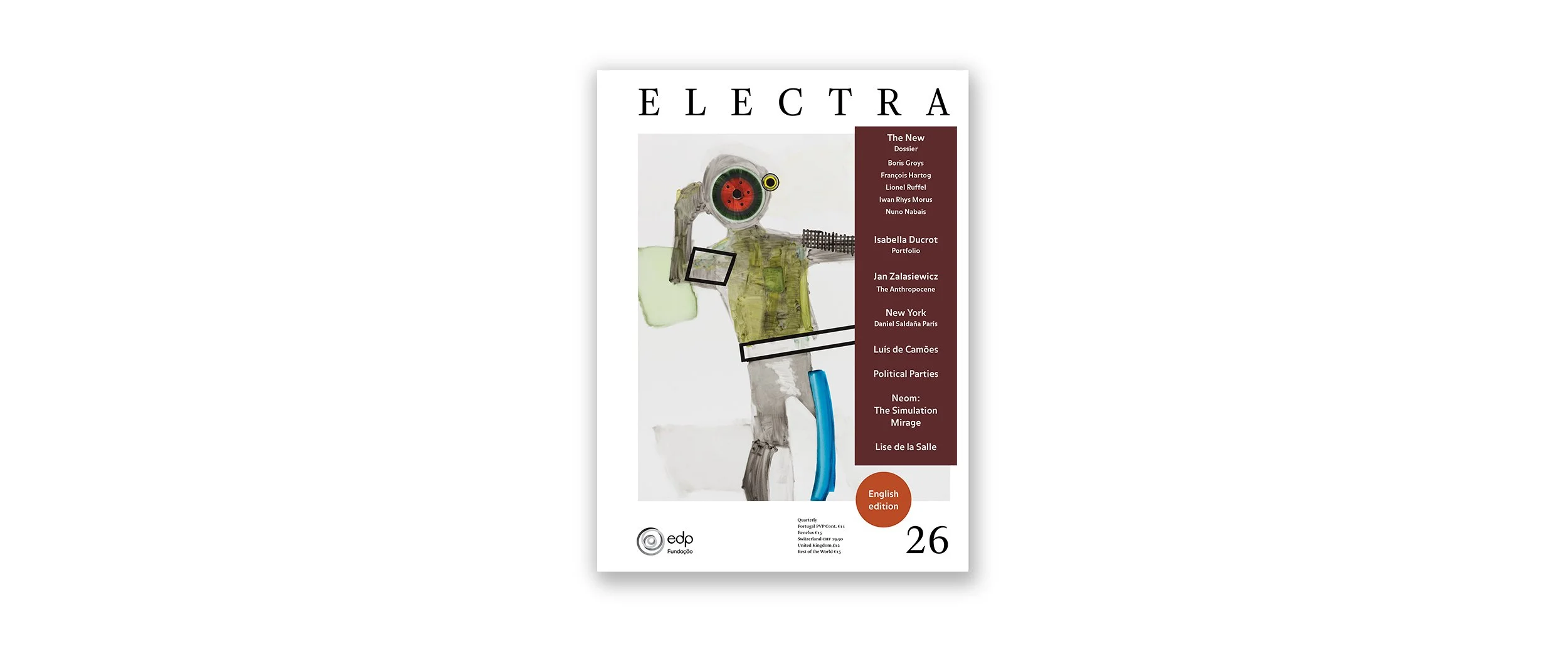
It is a hallmark of our time, an imperative that has spread to all the expressions of our common experience, a theme that, by definition, is always topical. We're talking about ‘The New,’ and the central dossier of Electra 26 is dedicated to it. But what is new today is not that which interrupts the course of the world and of time, such as revolutions in the world of politics or artistic avant-gardes in the cultural field. There is another sense of the new, one which is suited to the spirit of the age and the social and cultural logics that define it: the new in the sense of novelty, amplified by consumer society, as an eloquent manifestation of the futility of time. To develop this theme, Electra brings together contributions from Boris Groys, interviewed by Catarina Pombo Nabais, François Hartog, Iwan Rhys Morus, Lionel Ruffel, and Nuno Nabais.
Highlights of this issue include the interview and portfolio by Italian artist, writer and collector Isabella Ducrot, in whose work textiles are of fundamental importance. At the age of 94, Ducrot's artistic recognition and international media acclaim continue to grow. In her studio, located in the magnificent Palazzo Doria Pamphilj in Rome, where she continues to work, Ducrot received and spoke with Electra, and showed her works and her collections of art and textiles.
The ‘First Person’ section features an interview with geologist and palaeontologist Jan Zalasiewicz, a remarkable scientist who, against the decision taken by a subcommittee of the International Union of Geological Sciences, argued that there is clear scientific evidence that the Earth has entered the beginning of a new geological epoch which meteorologist and atmospheric chemist, Paul Crutzen, dubbed the ‘Anthropocene.’
In the area of political theory, the fate and formal metamorphosis of the ‘political party’ is discussed, an institution that has played a fundamental role in the construction of the modern political body. This topic is discussed in two articles by sociologist Pedro Magalhães and political philosophy professor Damiano Palano.
Also in this issue of Electra, writer Christian Salmon, using a classic phrase by Charles Péguy, analyses the relationship between the present day and Greek antiquity; on the 500th anniversary of the uncertain birth date of Luís de Camões, José Augusto Bernardes writes about the life and work of the great Portuguese poet; Lise de la Salle talks about her work as a pianist, testifying to her daily intimacy with music and meditating on what it means to her; mathematician Umberto Bartocci revisits the mystery of the disappearance in 1938 of Italian physicist Ettore Majorana, a scientist with a remarkably promising career and a disciple of the Nobel Prize for Physics Enrico Fermi, who considered him a genius; architect João Bravo da Costa reflects on Neom, a colossal urban and architectural project being built in the remote deserts of Saudi Arabia; novelist and essayist Daniel Saldaña París tells us about New York, the city where he lives, and about his discovery of this fascinating American city, recalling everything he has read, seen and experienced about it; and Rui Manuel Amaral writes about the word ‘Innovation’.
.
Softcover, 27 x 20 cm, 220 pages
—
..
É uma marca distintiva do nosso tempo, um imperativo que se estendeu a todos os fenómenos da nossa experiência comum, um tema que por definição, é sempre actual. Falamos de “O novo”. A este assunto é dedicado o dossier da Electra 26. Mas o novo, nos nossos dias, não é o que interrompe o curso do mundo e do tempo, como foram os fenómenos das revoluções, no domínio político, ou das vanguardas artísticas, no campo cultural. Há um outro sentido do novo, que se adequa ao espírito da época e às lógicas sociais e culturais que o definem: é o novo no sentido da novidade, amplificado pela sociedade de consumo, enquanto manifestação eloquente da futilidade do tempo. Para desenvolver este tema, a Electra reúne contributos de Boris Groys, entrevistado por Catarina Pombo Nabais, François Hartog, Iwan Rhys Morus, Lionel Ruffel e Nuno Nabais.
Em destaque, neste número, estão a entrevista e o portfólio da artista, escritora e coleccionadora italiana Isabella Ducrot, em cuja obra os tecidos assumem uma importância fundamental. Aos 94 anos, o reconhecimento artístico e a consagração mediática internacionais não param de aumentar. No atelier, situado no magnífico Palazzo Doria Pamphilj, em Roma, onde continua a trabalhar, Ducrot recebeu e conversou com a Electra, e mostrou as suas obras e as suas colecções de arte e de têxteis.
Na secção "Primeira Pessoa”, é entrevistado o geólogo e paleontólogo Jan Zalasiewicz, um notável cientista que, contra a decisão tomada por uma subcomissão da União Internacional das Ciências Geológicas, defendeu que há evidentes provas científicas que atestam a entrada da Terra no início de uma nova época geológica, a que um meteorologista e químico da atmosfera, Paul Crutzen, chamou «Antropoceno».
Na área da teoria política, são abordados o destino e as metamorfoses da forma “partido”, essa instituição que teve um papel fundamental na construção do corpo político moderno. Um tema discutido em dois artigos pelo sociólogo Pedro Magalhães e pelo professor de Filosofia Política Damiano Palano.
Ainda nesta edição da Electra o escritor Christian Salmon, a partir de uma frase, que se tornou clássica, de Charles Péguy, analisa a relação da nossa actualidade com a Antiguidade grega; nos quinhentos anos da incerta data do nascimento de Luís de Camões, José Augusto Bernardes escreve sobre a vida e a obra do grande poeta português; Lise de la Salle fala do seu ofício de pianista, dando testemunho da intimidade quotidiana que tem com a música, meditando sobre o que isso representa para ela; o matemático Umberto Bartocci revisita o mistério do desaparecimento, em 1938, do físico italiano Ettore Majorana, cientista com uma notável carreira carregada de futuro e discípulo do Prémio Nobel da Física Enrico Fermi, que o considerava um génio; o arquitecto João Bravo da Costa reflecte sobre o Neom, um colossal projecto urbanístico e arquitectónico que está a ser edificado nos desertos remotos da Arábia Saudita; o romancista e ensaísta Daniel Saldaña París dá-nos um testemunho sobre Nova Iorque, cidade onde reside, e da descoberta que fez desta fascinante urbe norte-americana, evocando tudo o que, sobre ela, leu, viu e viveu; e Rui Manuel Amaral escreve sobre a palavra “Inovação”.
Capa mole, 27 x 20 cm, 220 páginas
—
....

....
‘We have never lied as much as today. Nor have we ever done it so blatantly, systematically and constantly.’ These words were written by Russian-born French philosopher Alexandre Koyré during the Second World War, a statement that takes on a new and unexpected relevance in our time. The history of humanity is inseparable from the history of lies, recording its forms and metamorphoses through the centuries and according to the paradigms of each era and its social, economic, cultural and religious practices. ‘‘Lies’ is the subject of the Electra #25 central dossier, a theme that is both universal and contemporary, in an issue that includes contributions on politics, art and images, the post-truth media regime and fake news, the stages of phylogenetic natural history, and the hegemony of technology. On ‘Lies’ we find texts by Martin Jay, Bárbara Reis, Daisy Dixon, Myriam Revault d’Allonnes, Peter Hill, and António Bracinha Vieira.
For the centenary of Franz Kafka's death, this issue features three articles on the Czech writer: one by Gianluca Cuozzo on representations of bureaucracy and the exercise of power; another by António Guerreiro focusing on biographical issues; and finally, an article by Jacques Le Rider on Kafka's bilingual condition, his relationship with the German and Czech languages, and the historical and linguistic context of Prague.
Simon Critchley, one of the most prolific and popular philosophers of recent decades, speaks to Electra about some of the themes that have guided his work, from the place of philosophy in contemporary society to the disillusionment with liberal democracy, from the cultural importance of football to the challenge of autobiographical writing.
This issue's portfolio presents a new series of photographs by João Penalva, an artist widely recognised for his work that crosses video, installation, photography, music, performance, text, and image.
The ‘Figure’ of this issue is Anabela Becho, fashion historian, curator and researcher, who shows us how the great American painter Georgia O'Keeffe turned the way she dressed her body into an affirmation of herself, both as a woman and a modern artist. In a new section of Electra entitled ‘Noah's Ark’, Italian sociologist Vania Baldi questions the limitless belief in AI and the ethical neglect towards new Artificial Intelligence systems.
Also in this issue, journalist Alexandra Prado Coelho and semiotics professor Gianfranco Marrone comment on a provocative statement by the famous and feared Spanish gastronomic critic Rafael García Santos; Marta G. Franco tells us about Holy Week in Seville; art critic José Marmeleira writes about a recent book by Hal Foster, one of North America’s best known art critics and historians; and António Guerreiro reflects on the word ‘Commentator’.
.
Softcover, 27 x 20 cm, 223 pages
—
..
«Nunca se mentiu tanto como nos dias de hoje. Nem alguma vez se mentiu de uma maneira tão descarada, sistemática e constante.», escreveu o filósofo francês de origem russa Alexandre Koyré, durante a Segunda Guerra Mundial. Esta afirmação assume no nosso tempo uma nova e inesperada validade. A história da humanidade é inseparável da história da mentira, registando as suas formas e metamorfoses ao longo dos séculos e segundo os paradigmas de cada tempo e as suas práticas sociais, económicas, culturais e religiosas. “A mentira”, um tema ao mesmo tempo muito universal e muito contemporâneo, é o assunto do dossier central da Electra 25, que conta com contribuições que abordam a política, a arte e as imagens, o regime mediático da pós-verdade e as fake news, as etapas da história natural filogenética e a hegemonia da técnica. Sobre “A mentira” escrevem Martin Jay, Bárbara Reis, Daisy Dixon, Myriam Revault d’Allonnes, Peter Hill e António Bracinha Vieira.
Pelo centenário da morte de Franz Kafka, são publicados nesta edição três artigos sobre o escritor checo: um de Gianluca Cuozzo, sobre as representações da burocracia e do exercício do poder; outro de António Guerreiro centrado nas questões biográficas; e, por último, um artigo de Jacques Le Rider, sobre a condição bilingue de Kafka, a sua relação com as línguas alemã e checa, e o contexto histórico e linguístico de Praga.
Simon Critchley, um dos filósofos mais prolíficos e populares das últimas décadas, fala com a Electra sobre alguns dos temas que têm vindo a orientar o seu trabalho, desde o lugar da filosofia na sociedade contemporânea à desilusão com a democracia liberal, da importância cultural do futebol até ao desafio de uma escrita autobiográfica.
O portfólio deste número é da autoria de João Penalva, um artista amplamente reconhecido pelos seus trabalhos de cruzamento do vídeo, da instalação, da fotografia, da música, da performance, do texto e da imagem, e que aqui apresenta uma série inédita de fotografias.
Na secção “Figura”, Anabela Becho, historiadora de moda, curadora e investigadora, mostra-nos como a grande pintora americana Georgia O’Keeffe fez da maneira como vestia o seu corpo uma afirmação como mulher e artista moderna. Numa nova secção da Electra, intitulada “Arca de Noé”, o sociólogo italiano Vania Baldi, elabora uma reflexão que contraria a crença ilimitada e a negligência ética em relação aos novos sistemas da Inteligência Artificial.
Ainda nesta edição, a jornalista Alexandra Prado Coelho e o professor de semiótica Gianfranco Marrone comentam uma afirmação provocadora do famoso e temido crítico gastronómico espanhol Rafael García Santos; Marta G. Franco faz-nos um relato da Semana Santa de Sevilha; o crítico de arte José Marmeleira escreve sobre um livro recente de Hal Foster, um dos mais importantes críticos e historiadores de arte norte-americanos, e António Guerreiro sobre a palavra “Comentador”.
Capa mole, 27 x 20 cm, 223 páginas
—
....
DAM Architectural Book Award 2024!